'K-Voice AI Alliance' launched
Research to cover speech patterns, emotions and conversational context
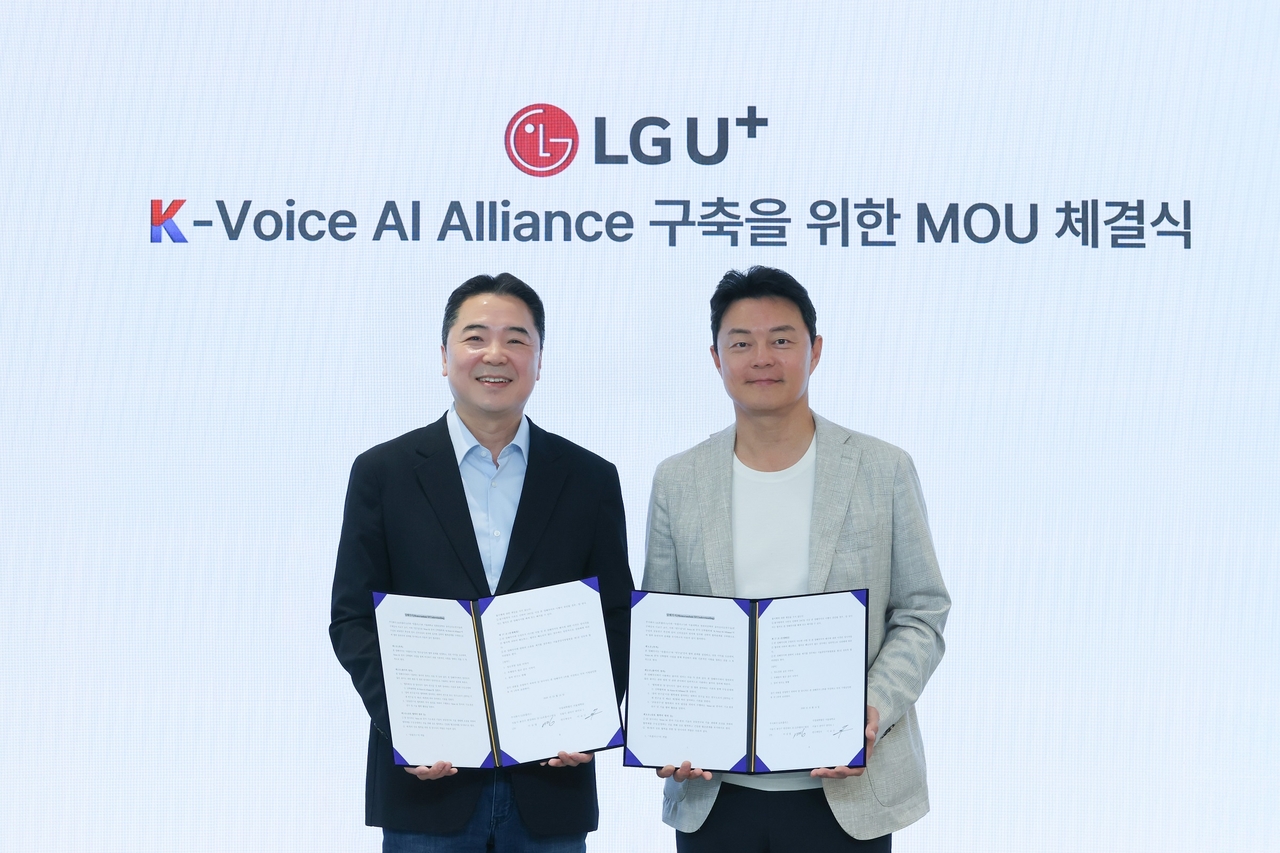
LG Uplus is teaming up with leading South Korean universities to develop next-generation voice AI technology tailored to the Korean language.
The telecom company announced Monday that it has launched the K-Voice AI Alliance with Seoul National University, KAIST and Yonsei University.
The collaboration aims to combine LG Uplus' experience in developing voice AI services with the AI research capabilities of domestic universities to build voice AI technology optimized for Korean.
Conventional voice AI systems work by converting speech to text, generating a response and then converting that response back into speech. The multi-step sequential process has led to response delays and unnatural pronunciation, limiting the fluency of conversations.
A newer approach drawing increasing attention is voice-to-voice (V2V) technology, which cuts out those intermediate steps and allows AI to understand spoken input directly and respond in speech.
V2V technology can capture not only the content of speech but also intonation, emotion and conversational context, enabling more natural communication between humans and AI.
Through the alliance, LG Uplus plans to establish benchmarks for evaluating Korean-language voice AI performance and co-develop a "K-Voice Engine" applicable across a range of services.
Each participating university will conduct foundational voice AI research based on its own areas of expertise.
Seoul National University will focus on enabling AI to converse using contextually appropriate speech styles and tones, and to respond naturally while listening to users.
KAIST will research technology that helps AI determine which speaker to respond to in multi-party conversations. The university will also develop capabilities that allow AI to retain earlier parts of a conversation and maintain context over extended exchanges.
Yonsei University will analyze how well customers understand AI explanations and whether they can complete consultations smoothly when voice AI is applied to actual customer service settings.
LG Uplus plans to apply technologies developed through the joint research to its various voice AI services in stages.
The company views voice AI as a core technology for next-generation AI services and has been expanding its related business. In March, it unveiled its "U+ Voice AI" strategy in a keynote address at MWC 2026, the world's largest mobile communications exhibition, and has been co-developing a network-based voice AI solution with global telecom equipment maker Ericsson since July.
"Through this industry-academia collaboration, we will secure K-Voice AI technology tailored to Korean speakers and the Korean language, and deliver new voice AI experiences to our customers," LG Uplus Chief Technology Officer Lee Sang-yeop said. "We will strengthen our technological competitiveness so that fewer people — including the elderly — are left behind in the AI era."
Meanwhile, LG Uplus is also pursuing AI-driven innovation at its customer service centers. Applying AI technology to its in-house call centers cut the average wait time to reach a customer service agent from 47 seconds in 2024 to 5 seconds this year, according to a September announcement. The company has set a goal of building an "AI-native customer center" with zero wait times by 2030.
woo@heraldcorp.com