
Couple seeks to borrow 2 billion won from seller at 5% annual interest, 3-year maturity
Employment certificates, two years of income records required to verify repayment ability
Jeonse conversion or sale eyed after owner-occupancy period — securing principal at maturity is the key hurdle
This article is part of HeralDeep, a members-only content series by The Herald Business titled "How Manager Kim Bought a Home in Seoul." Subscribe to read the full story of one family's journey to homeownership in Seoul. Names and certain details have been changed to protect the subjects' identities.

"We're going to have to tighten our belts now."
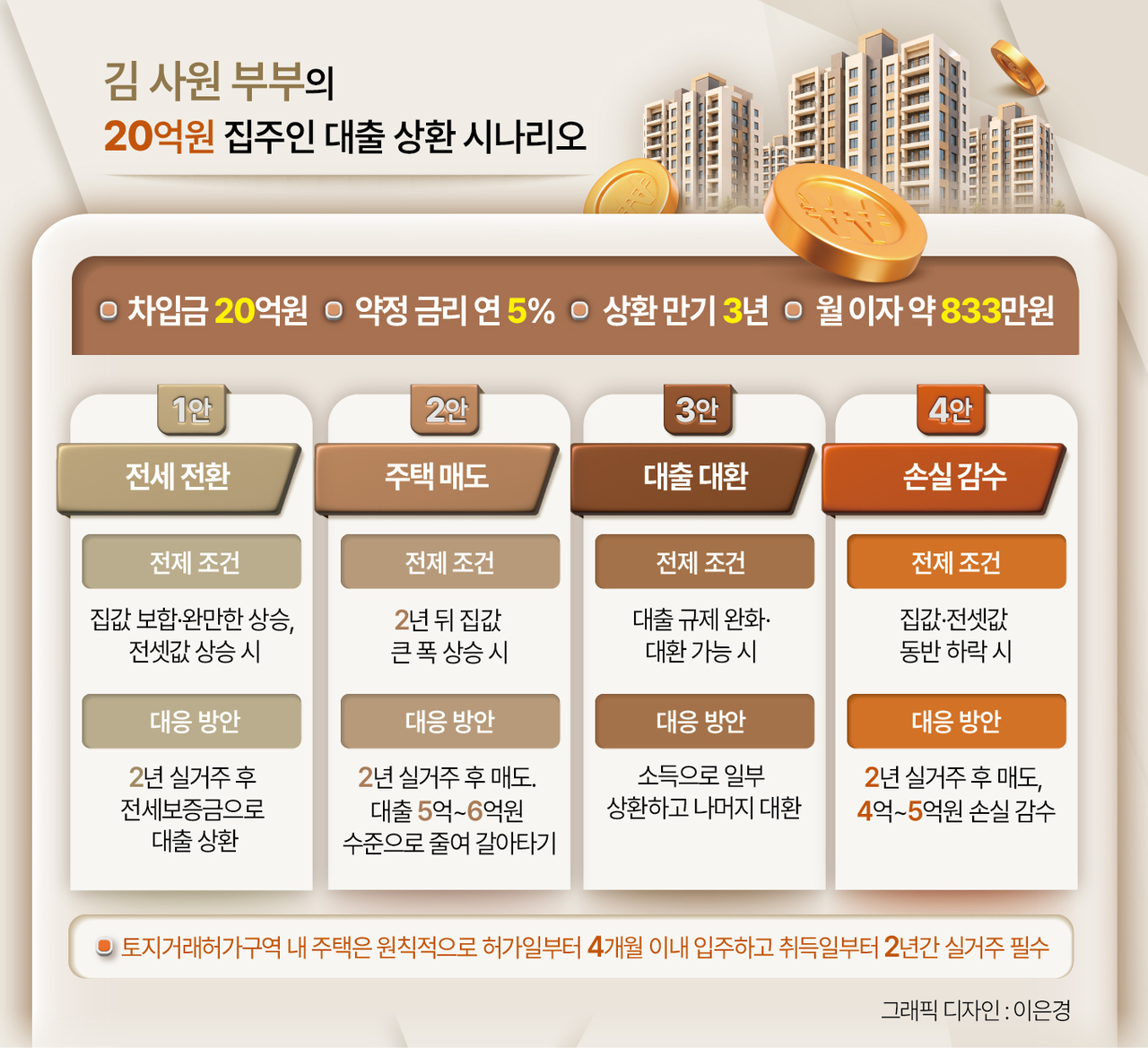
That was the reaction of Siori (@c.ori.money on Instagram), a salaried worker in her 20s, after deciding to buy an apartment in Seoul's Banpo neighborhood priced in the 4 billion won ($2.98 million) range. The couple plans to borrow 2 billion won directly from the seller at an annual interest rate of 5 percent, with a three-year repayment term. Monthly interest payments alone will run about 8.33 million won.
By selling apartments they each own — one in Suji, Yongin, and one in Bundang, Seongnam, both in Gyeonggi Province — the couple expects to raise about 2 billion won in cash. Combined with the 2 billion won loan from the seller, they plan to purchase a near-new apartment of a standard floor plan in Banpo. An additional mortgage of about 200 million won from a bank is also planned, bringing total borrowings to an estimated 2.2 billion won.
This comes after the couple walked away from a purchase agreement for a unit at Trimage in Seongsu-dong, absorbing a loss of 120 million won, only to set their sights on a home priced more than 1 billion won higher.
The two did not start out in agreement, however. The husband, who tends to be cautious about debt, preferred an apartment in the mid-3 billion won range, while Siori believed it was better to borrow up to 2 billion won and move straight into a higher-tier home in one step.
After multiple discussions, the couple decided to go ahead with the Banpo purchase.
Seller offers 2 billion won loan — and demands income proof, just like a bank
The financing method the couple chose is known as seller financing. Under this arrangement, the seller defers receipt of part of the purchase price, lends that amount to the buyer and registers a collateral mortgage on the property. The buyer pays interest over the agreed period and repays the principal at maturity.
Siori first encountered this type of transaction during a property scouting visit to Cheongdam-dong last winter. A real estate agent there explained that a seller could lend funds to a buyer in exchange for registering a collateral mortgage on the property. Earlier this year, Siori said, the couple even explored using seller financing to buy a unit at Cheongdam Xi.
Through that process, Siori came to realize that borrowing money from a seller to buy a home was not as unusual a transaction as it might seem. After later encountering listings in the Banpo area where sellers were offering loans of 2 billion won or more, the couple decided to make seller financing a primary funding tool.
The seller was not willing to lend billions of won to just anyone. According to Siori, the seller asked the couple to provide employment certificates and income verification documents for the most recent two years to confirm their ability to repay.
The couple negotiated the loan terms with the seller based on the assets they had built up and their income records. Siori said the seller had held the property for a long time and was looking to sell partly because of tax considerations tied to long-term ownership.
In the end, the interests of a long-term owner looking to exit and a couple in their 20s hoping to trade up on the strength of their future income aligned.

Notably, even with such a large seller-financing offer on the table, competition among prospective buyers was not fierce.
"Even when a seller offers to lend 2 billion won, it seems not many people are willing to pay that interest every month," Siori said. "No matter how much you earn, it's not common to want to spend close to 10 million won a month just on interest."
Under the terms the couple negotiated with the seller, annual interest comes to 100 million won, or about 8.33 million won per month on average. If the couple pays only interest for the full three years without touching the principal, cumulative interest payments would reach 300 million won.
On top of that, the couple will also need to cover interest on the roughly 200 million won bank mortgage they plan to take out, along with property holding taxes and maintenance fees.
"If things get to a point where the interest becomes too hard to manage, I've even thought about bridging a few months with a personal credit loan," Siori said — a sign of just how little financial cushion the plan leaves.
'Borrow 1 billion for a 3 billion won home vs. borrow 2 billion for a 4 billion won home' — a couple divided
The interest payments and the burden of repaying the principal were precisely what worried the husband most.
The husband had been cautious about debt. When the couple bought an apartment in Bundang in 2024, he preferred to minimize borrowing, and he worried about interest costs when they later took out a mortgage.
"My husband used to say he didn't want to pay more than 1 million won a month in loan interest," Siori said. "I remember persuading him back then, too, that we could afford a slightly better home."
In this latest move, the husband's preferred price range was the mid-3 billion won level. His thinking was to buy a near-new apartment such as Banpo Summit or Banpo Riche and keep the seller loan to around 1 billion won.
Siori, by contrast, believed it was better to borrow up to 2 billion won and enter the 4 billion won tier in a single move.
"My husband said he was fine up to the mid-3 billion won range," Siori said. "Beyond that, the interest burden grows proportionally, so he was more cautious."
Siori's willingness to take on more debt came from a conviction that if they did not act now, getting into Banpo could become much harder later.
Siori reasoned that as lending regulations tighten and property holding taxes rise, future buyers in Banpo would increasingly be wealthy individuals with ample cash or high incomes. Once ownership shifted to that group, she believed, the window to buy would narrow further.
"Once ownership shifts to people like that, I think it will be far harder for me to get in here five or ten years from now than it is today," Siori said.
"Premium assets are finite," she added. "I thought the right move was to secure one when the opportunity was there and then fight to hold on. Of course, holding on requires income to back it up."
The husband ultimately came around to that view.
"My husband basically trusts me a lot," Siori said. "He worries, but he has never stopped me. I feel the weight of that. I can't afford to make the wrong call, so I have to work even harder."
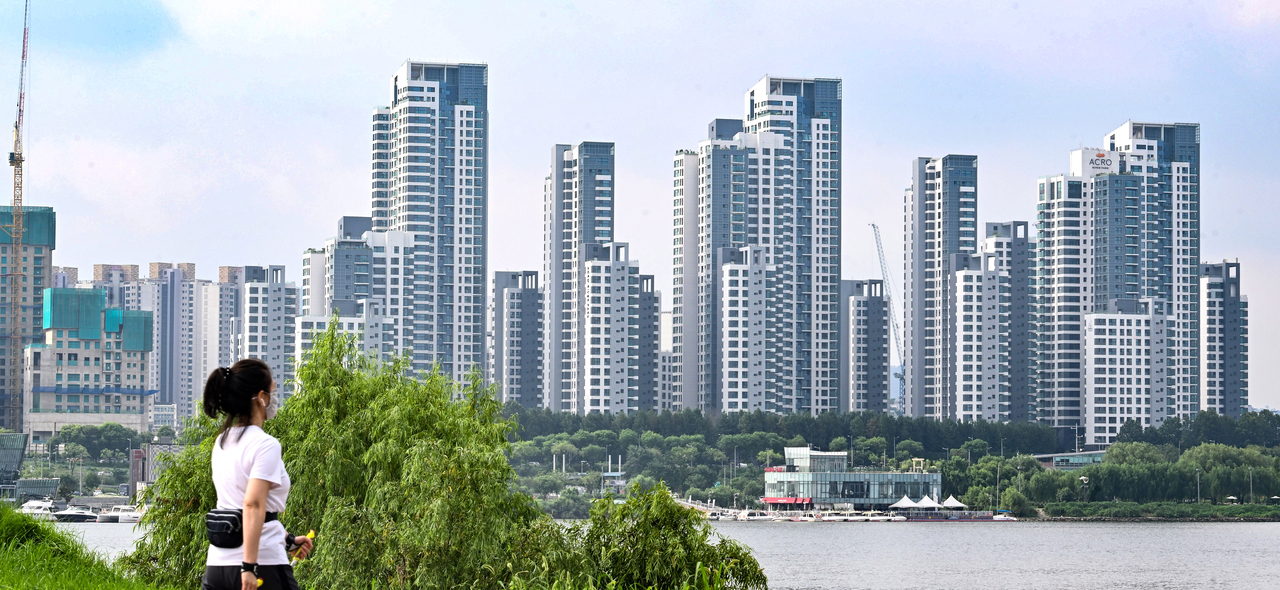
Apgujeong was tempting, but repayment math pointed to Banpo
The couple's choice of Banpo was also shaped by calculations about how they would eventually repay the principal.
Siori said she looked at reconstruction apartments in Apgujeong as well, but finding a seller willing to offer seller-financing terms proved relatively difficult there. The low jeonse prices relative to sale prices were an added concern.
That gap mattered to a couple whose primary repayment plan was to rent out the unit on a jeonse basis and use the deposit to pay back the 2 billion won loan.
"Honestly, Apgujeong was more appealing," Siori said, "but the jeonse prices there were too low relative to the sale price for our financing structure to work."
The prospect of having to live in an aging apartment there for at least two years was another factor. Ultimately, the couple chose Banpo for its near-new living environment, transport access and expected rental demand.
The couple's top repayment priority is converting the unit to a jeonse rental.
Under rules governing properties in land transaction permit zones, buyers are in principle required to live in the unit for two years from the date of acquisition. After fulfilling that owner-occupancy requirement, the couple plans to bring in a jeonse tenant and use the deposit to repay the seller-financing loan.
The three-year repayment term is a critical condition for this plan. It leaves time to pursue a jeonse conversion or a sale even after the two-year owner-occupancy obligation is met.
Underlying this is Siori's own market outlook. She expects home prices to rise gradually rather than sharply over the next few years, while jeonse prices climb at a relatively faster pace. "If we move out and rent the place on jeonse, it would actually be better for us if jeonse prices rise even if home prices fall," she said.
The logic is that even without home price appreciation, using the jeonse deposit to pay down debt would allow the couple to hold the apartment over the long term.
Siori said the couple is also considering a scenario in which, after converting to jeonse, they rent a cheaper monthly-rent unit elsewhere while retaining ownership of the Banpo apartment. If lending regulations ease or their financial position improves, they plan to move back in for the long term.
The second scenario applies if home prices rise more than expected. In that case, the plan is to sell the apartment and clear the 2 billion won collateral mortgage, then trade down to a smaller or lower-tier home.
"If prices have risen a lot more than expected two years from now, I'm thinking about selling once and clearing the mortgage," Siori said. "Even if we end up with a smaller unit or a slightly less desirable location, we could cut the loan down to around 500 million to 600 million won and just live there long-term."
The third option is to use income and savings to pay down part of the principal and refinance the remainder through another loan. The risk, however, is that persistent lending regulations or higher interest rates could make refinancing difficult.
'What if both home prices and jeonse values fall?' — the worst-case scenario
The scenario Siori fears most is a simultaneous drop in both home prices and jeonse values.
Falling home prices would reduce the proceeds available from a sale, and declining jeonse values would undercut the option of using a deposit to repay the loan. If that happens, the couple has decided they would sell at a loss and clear the debt.
"In that case, I figured we would live there for two years, sell the place and pay off the mortgage," Siori said.
Siori acknowledged that the process could result in a loss of several hundred million won, which she is prepared to accept as the cost of a failed investment.
"I run a lot of simulations in my head. I think through both the worst-case and best-case outcomes. If I decide the potential loss is something I can handle, I go ahead."
That has been her guiding principle since buying her first apartment in Suji. Even then, she had a plan: if she could not find a tenant or prices fell, she would move in herself and pay down the mortgage.
There is no guarantee, however, that actual losses would stay within the range Siori anticipates. Prices could fall further than expected, a sale might not happen when needed, and if the couple cannot raise the funds at maturity, the collateral mortgage could be enforced and the property put up for auction.
'You buy a home not with money but with courage' — a couple's investment philosophy
Looking back on her path to building wealth, Siori said the single most important decision was maximizing leverage when she bought her first home.
When the couple purchased an apartment in Suji in 2024 for around 600 million won, their own capital — including acquisition tax and renovation costs — came to about 150 million won. The rest was financed through a mortgage.
"If I had been too scared of debt and borrowed only a little for that first home, the capital gain would have been far smaller," Siori said. "Using maximum leverage at that point was the most decisive choice I made."
What she emphasizes is the importance of calculating the worst-case scenario before investing — and then finding the courage to act if you decide you can absorb it.
"The moment I send the down payment is always the scariest. Did I buy well? What if prices fall? Should I have bought somewhere else? Am I buying at the peak? Those thoughts keep running through my head. I think you need the courage to push past that fear."
"I think people buy homes not because they have money, but because they have courage," she added.
Of course, the couple's approach is not one that anyone can simply replicate. Seller financing of 2 billion won requires a substantial asset base and stable cash flow sufficient to service both interest and principal. High leverage, in particular, amplifies not only gains from rising prices but also losses when prices fall.
"I think real estate is an asset where you can never time the bottom," Siori said. "Unlike stocks, you can't just buy whenever you feel like it. I see it as buying when you can and then fighting to hold on."
About two years ago, Siori put down roughly 150 million won to buy a first home in Suji. Now, borrowing 2 billion won, the couple is heading to Banpo.
Whether the success of that first purchase will repeat itself remains to be seen. The test ahead is whether the couple can sustain monthly interest payments of 8.33 million won and come up with 2 billion won in principal three years from now.
quq@heraldcorp.com





