'We agree the naval academy cannot leave the sea': minister says location still under review
Alumni chief warns those who backed closure will be named in white paper, face disciplinary review
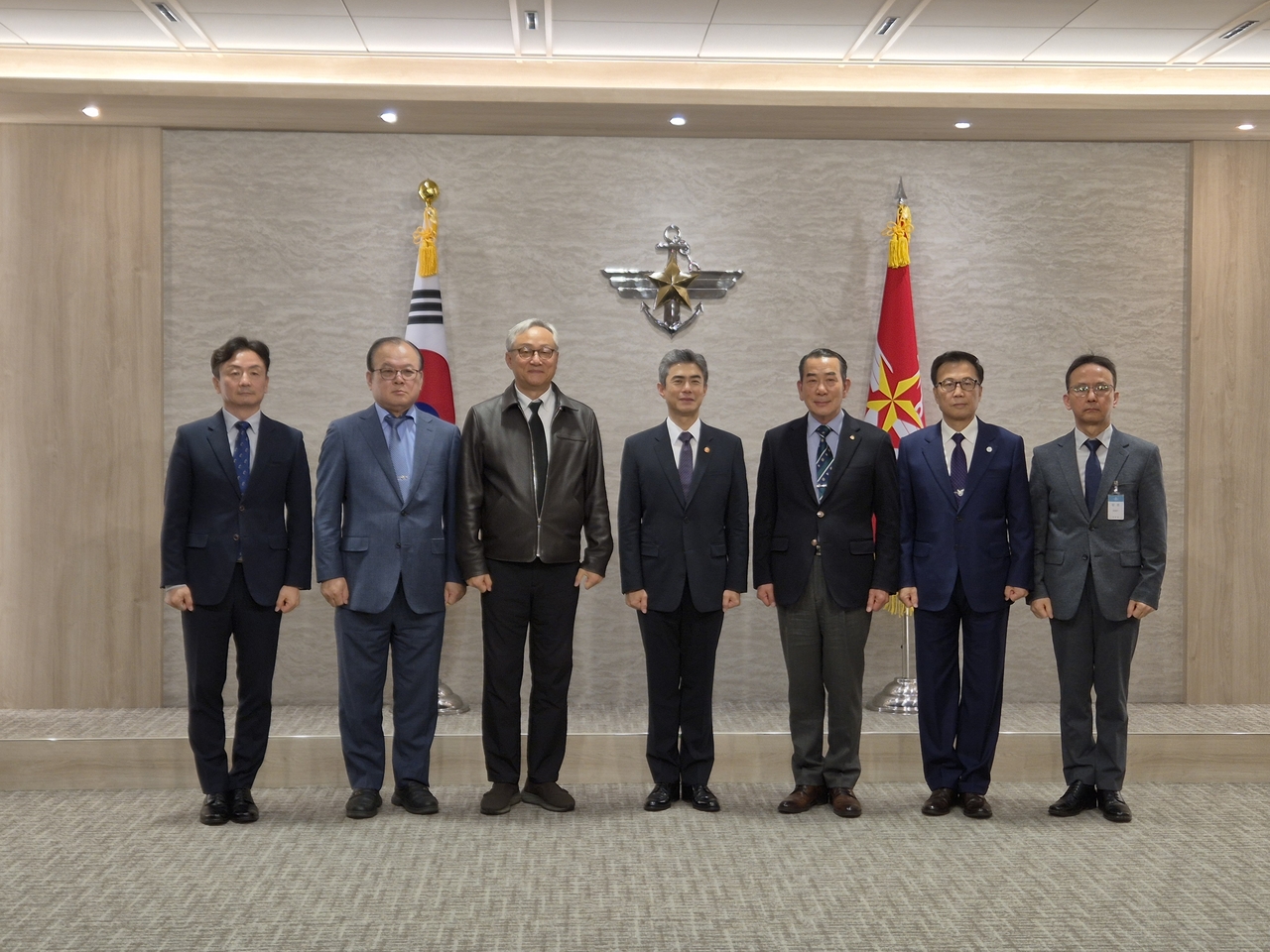
Defense Minister Kang Shin-chul met Monday with the heads of the three military service academy alumni associations, saying he has heard that the proposed Korea Armed Forces Academy plan needs refinement and that he is considering multiple options.
Kang made the remarks at the Defense Ministry building in Yongsan, Seoul, where he sat down with Park Pan-jun, head of the Korea Military Academy alumni association, Hwang Seong-jin, head of the Korea Air Force Academy alumni association, and Lee Beom-rim, head of the Korea Naval Academy alumni association.
"Since taking office, I have been continuously listening to views on military academy education reform — from cadets to active-duty and reserve personnel, and from the public," Kang said. "I felt it was essential to meet with the alumni association heads, who represent the graduates of the Army, Navy and Air Force academies."
Park raised pointed questions at the meeting, asking why there seemed to be such urgency to push the Army academy out of its Taereung campus. "I raise questions about whether this is education reform, defense reform, or whether there is a political or policy agenda behind it," he said.
Park also expressed concern for junior academy graduates who may be working on the unified academy project against their own wishes. "As time passes, they could suffer just as those who carried out the Dec. 3 martial law order have suffered, and that breaks my heart," he said.
Park added that the alumni association is compiling a white paper to put on record the actions and responsibilities of academy graduates who led the push to close their own alma maters. "We are also reviewing, in accordance with our bylaws and due process, whether to pursue disciplinary action," he said.
Kang pushed back on the concerns, saying there had been no plan to close or consolidate the academies before he took office, and that he personally had no intention of shutting them down.
"We clearly have a three-service structure — how could the academies that train officers for each branch simply disappear? They cannot," he said. "You learn joint operations by first mastering each service's expertise. Unless we become a unified military, service-specific education must absolutely remain."
When Lee pointed out that establishing a Korea Armed Forces Academy would legally dissolve the individual academy establishment decrees and produce a first graduating class under the new name, Kang acknowledged the legal reality while insisting the individual schools would remain. "Legally that may be the case, but since each service's school will still exist, the establishment decrees for each will have to be reissued," he said, adding that school names would not disappear and that graduates could still receive certificates or diplomas from their respective academies under various options being considered.
Kang was clear about the need for integrated education. "What matters is not whether cadets eat and sleep together, but how the education is structured," he said. "A network-based model is also possible. I am not completely ruling out integrated education."
He also raised the need for a graduate school program under the Korea Armed Forces Academy. "A good school needs good professors, and without a graduate program it is not easy to attract them," Kang said. "Even trying to hire a single AI professor at the naval academy — they just do not come. That is the reality."
On the question of relocating the naval academy and the project's cost, Kang struck a more cautious tone. "I fully agree that the naval academy needs the sea and cannot leave that environment," he said. "I will continue gathering opinions as I think through the location issue." On the project cost, which has been cited as potentially reaching 3 trillion won ($2.21 billion), Kang said the actual figure would fall short of that but acknowledged the concern was valid.
Near the end of the meeting, the Air Force academy alumni association asked whether the establishment of a Korea Armed Forces Academy was a foregone conclusion or whether maintaining the current structure remained an option. Kang said the name "Korea Armed Forces Academy" had already become widely used and that the project would move forward because it was necessary. "How it will look — what form integrated education will take — is something I will keep working through," he said, adding that he planned to meet with cadets Tuesday to further refine the plan.
The alumni associations presented Kang with handwritten letters from cadets and a letter addressed to the president from the three alumni association heads, asking him to arrange a meeting with the president.
Kang said he believed surveys and public hearings proposed by the cadets were necessary, but urged the associations not to oppose the reform simply for the sake of opposing it.
rimsclub@heraldcorp.com