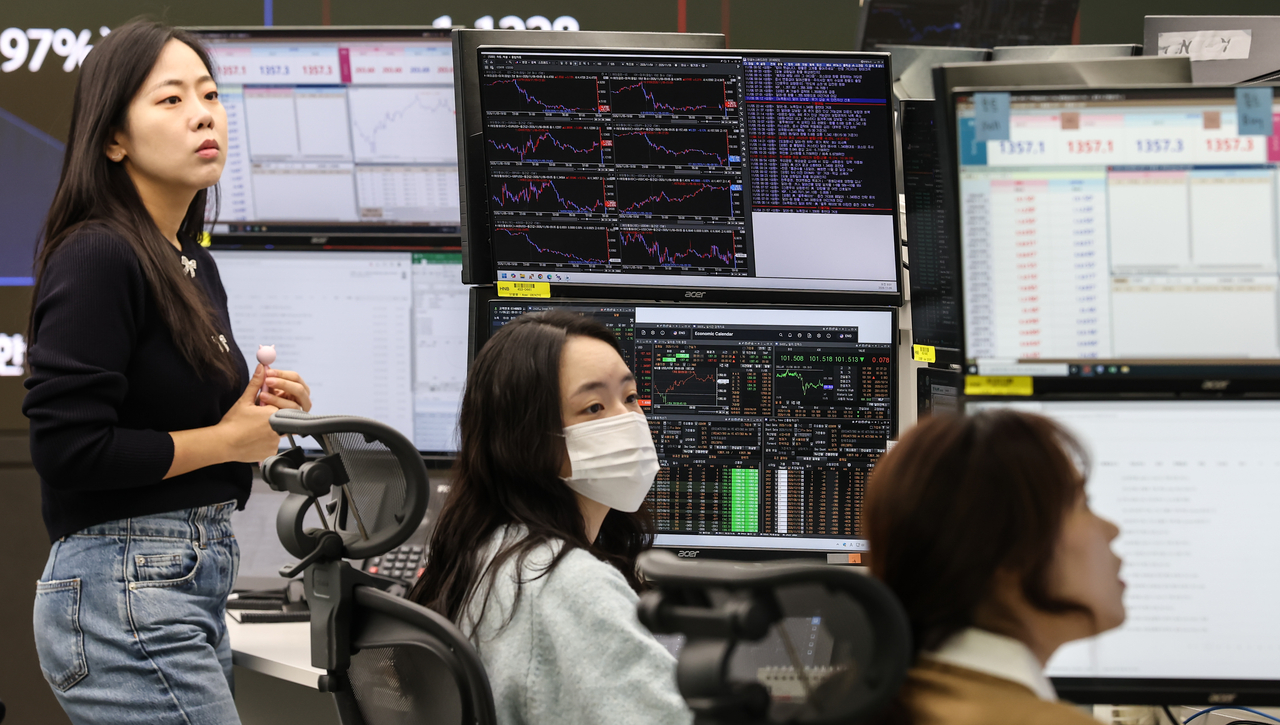
Retail investors have poured massive sums into leveraged exchange-traded funds as market volatility has surged, but losses are mounting rapidly as the downturn deepens.
Experts have repeatedly warned since last month that approaching leveraged products purely in hopes of a rebound risks losses that may be impossible to recover from. By design, leveraged products magnify losses in a falling market — and even a full index recovery may not be enough to restore the original principal.
According to ETF Check, KODEX Leverage was the most net-purchased ETF among retail investors in the month through Friday, with individuals buying approximately 1.23 trillion won ($906 million) net. KODEX Kosdaq150 Leverage followed closely, with net purchases of about 1.2 trillion won over the same period. Combined, retail investors channeled more than 2 trillion won into just these two flagship leveraged ETFs within a single month.
The problem is that a sharp market selloff has left investors who bought these ETFs at what they thought were bargain prices facing severe losses. The market was rattled in particular by what analysts called the "blue wave shock" — concerns that a sweeping Democratic Party victory in the US midterm elections Thursday through Friday would lead to tighter AI regulation — prompting many retail investors to buy into the falling ETFs.
The one-month returns on the two products tell the story: KODEX Leverage fell 51.29 percent and KODEX Kosdaq150 Leverage dropped 57.75 percent. While results vary by product, an investor who put 1 billion won into either fund a month ago would now be sitting on roughly 500 million won.
Retail investors dominated buying in leveraged products by a wide margin. Foreign investors also net-purchased KODEX Leverage during the same period, but their buying totaled only about 180 billion won — far less than the retail figure. Institutional investors, meanwhile, took the opposite side more aggressively, with their top net purchase being KODEX 200 Futures Inverse 2X, at about 320 billion won net.
The risks of leveraged ETFs go beyond simply amplifying losses when an index falls. These products are typically designed to track a fixed multiple of the underlying index's daily return. If the index rises 1 percent in a day, the fund aims to gain around 2 percent — but if the index falls 1 percent, the loss also widens to around 2 percent.
Leveraged products suffer most when declines are sustained, but they are also at a disadvantage in volatile, range-bound markets. When an index swings sharply up and down, or drifts sideways for an extended period without a clear direction, the daily resetting of returns causes a compounding effect that can erode the ETF's value quickly.
Consider a simple example: an investor puts in 1 million won. If the index falls 10 percent on the first day and then fully recovers the next, a standard ETF returns to 1 million won. A 2x leveraged ETF, however, drops 20 percent on the first day to 800,000 won. Even after the index retraces its full loss the following day, the leveraged ETF recovers only to about 978,000 won. Even when the market appears to have returned to its starting point, the leveraged investor is still sitting on a loss.
In short, leveraged ETFs can amplify gains when the market rises steadily in one direction — but in a market without clear direction, time itself works against the investor.
Industry experts advise that leveraged ETFs should be viewed not as long-term holdings or a way to recoup losses, but as high-risk instruments for short-term use by investors who fully understand their structure and the risks of volatility. Practitioners have been sounding the alarm on leveraged investing since last month, saying that with volatility unlikely to ease anytime soon, buying leveraged products amounts to little more than gambling.
Kim Eun-ha, head of Hanwha Investment & Securities' Central WM Center, said in the "Following the Big Money" column in late October that investors should "avoid leverage," adding that "buying more of a fallen stock with borrowed money is no different from betting your investment capacity on the expectation that the share price will rebound quickly."
Kim also warned that "if the rebound comes later than expected, or if prices fall further, you may be forced to sell even the stocks you believed in for their long-term growth potential at a time you never intended."
Kang Gu-hyeon, a senior manager at Mirae Asset Securities, raised a similar concern in the same column on Oct. 19, saying "the problem is when the market fails to rebound quickly." Kang warned that "if investors who bought stocks on margin are forced into liquidation due to insufficient collateral, a flood of sell orders could hit the market, triggering a vicious cycle that drives share prices down further."

th5@heraldcorp.com