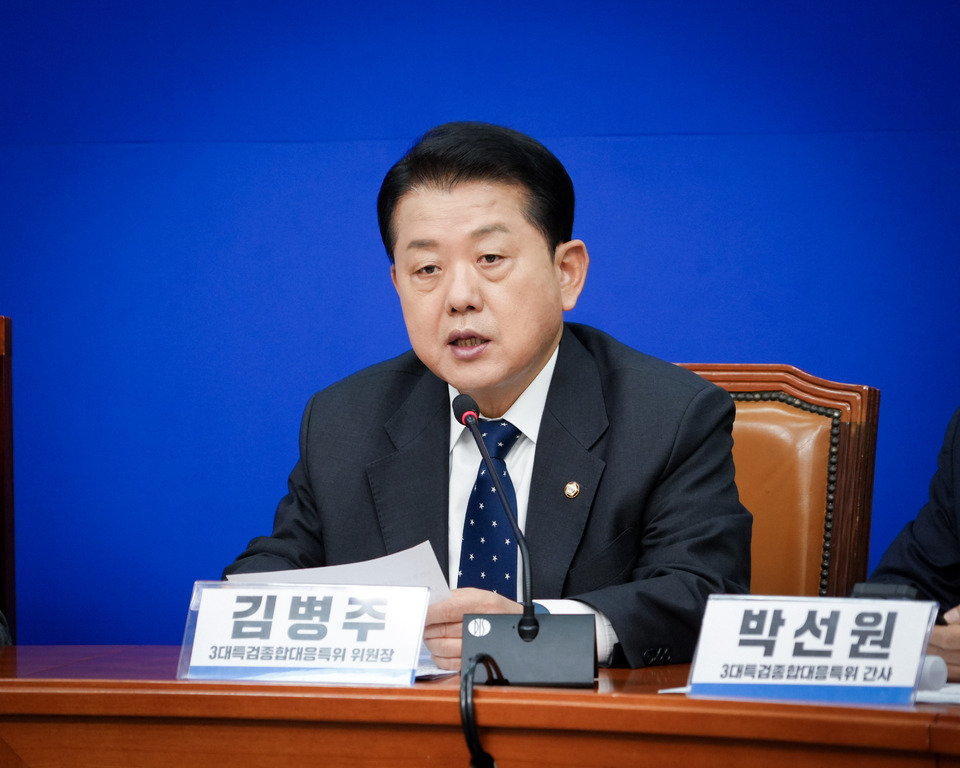
Rep. Kim Byung-joo of the Democratic Party of Korea said the US midterm elections, in which the Democratic Party won a sweeping victory, will have little bearing on the timeline for transferring wartime operational control to South Korea. "The influence of the US Congress does not really extend to OPCON," Kim said. "What matters most is the relationship between the two countries' military authorities, and particularly the views of the two chairmen of the joint chiefs of staff."
Kim, who serves as President Lee Jae-myung's special adviser on defense policy and leads the ruling party's side on the National Assembly's Defense Committee, made the remarks during a recent visit to US Indo-Pacific Command. "The delegation had extensive discussions about the OPCON transfer," he said. "Indo-Pacific Command has a solid understanding of what our government wants."
Kim said the Indo-Pacific Command commander's official position was that the existing conditions-based agreement between the two allies remains fully valid, while leaving open the possibility of policy considerations. "That is different from what USFK Commander Xavier Brunson has said," he added.
On reports that the US Democratic Party may introduce an impeachment motion against Defense Secretary Pete Hegseth this week, Kim said the system would continue to function regardless. "In any country, when a minister is incapacitated, there is someone who acts in that minister's place," he said. "I do not see a major problem with things that run on a system. The Security Consultative Meeting and the Military Committee Meeting are both systemic forums."
Asked whether a shift in the composition of the US Congress after the midterms could make it harder to introduce nuclear-powered submarine fuel or revise the nuclear cooperation agreement, Kim said he largely disagreed with that assessment. "The US Democratic Party has traditionally respected agreements reached between the two countries and particularly values the South Korea-US alliance," he said.
However, Kim acknowledged that additional work would be needed. "There will have to be some further effort to persuade Democratic members of the Senate and House armed services committees," he said. "That is why I think the Lee Jae-myung administration and the National Assembly need to put in that kind of effort."
On the proposed extension of the Cheonghae Unit's overseas deployment, Kim said the naval unit had shown vulnerabilities to new threats such as drones and underwater mines. "When the unit carries out its mission next year, it would be appropriate to extend the deployment after reinforcing its self-defense capabilities," he said.
Responding to criticism from the Rebuilding Korea Party and the Progressive Party, who have called the extension a "roundabout troop dispatch," Kim rejected the characterization outright. "This is absolutely not a roundabout troop dispatch," he said. "Protecting our merchant vessels and oil tankers has long relied on the support of multiple countries alongside a single Cheonghae Unit destroyer. Now there are significant gaps in military presence in that region, piracy has tripled and new threats have emerged — reinforcing our own self-defense capabilities before sending the unit is simply a natural duty of our state."
bigroot@heraldcorp.com