First full budget under Mayor Jeon Jae-soo to be submitted to city council Wednesday
Budget targets relocation support for shipping firms, North Port dome arena
Mayor focuses on maritime infrastructure, tourism, AI and community sports
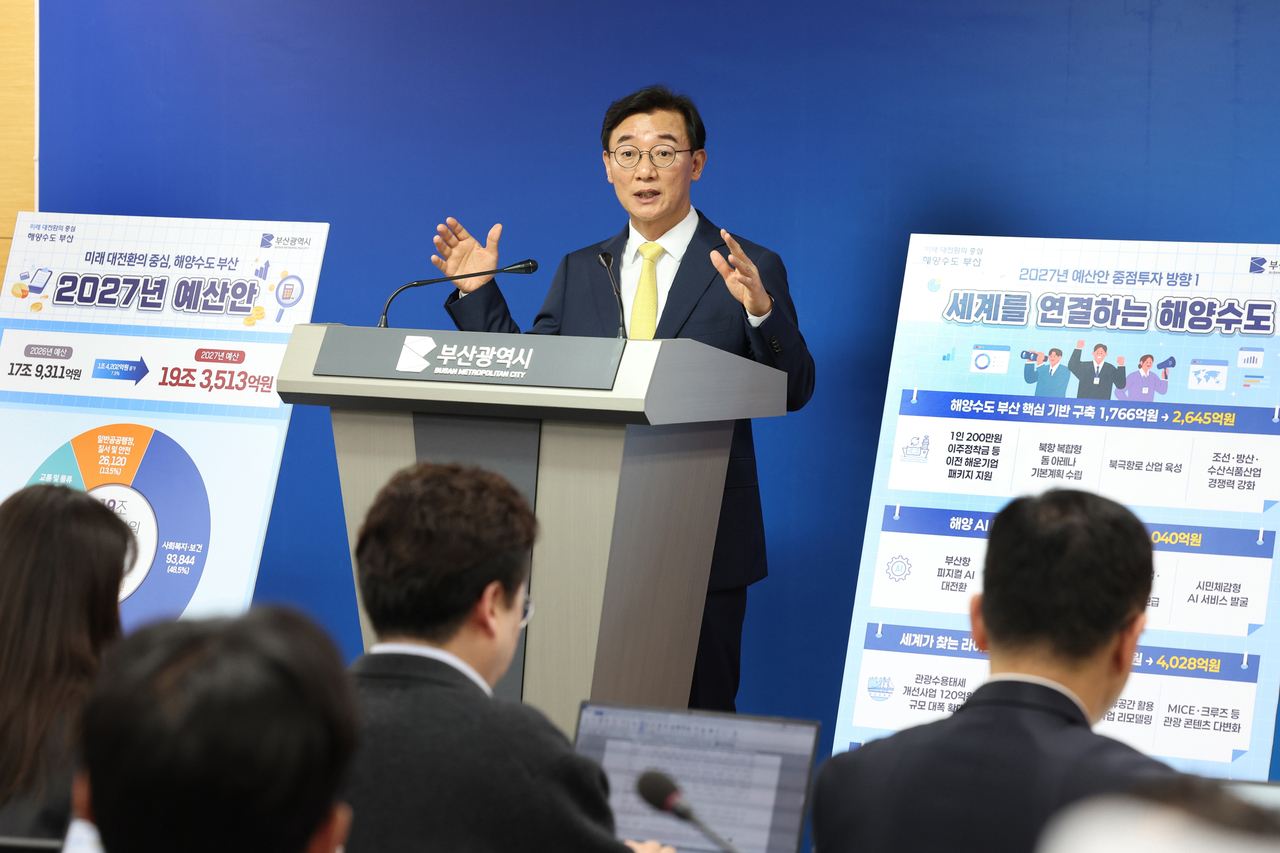
Busan has drawn up a 19.35 trillion won ($14.3 billion) budget for 2027, a 1.42 trillion won increase — or 7.9 percent — over this year's original budget. It is the first full-year budget since Mayor Jeon Jae-soo took office, and the city plans to submit it to the city council Wednesday.
Speaking at a press conference Monday afternoon, Jeon said the 2027 budget proposal marks "the first step toward a full-scale transformation of Busan into a maritime capital," adding that the city had "faithfully included priority projects so that residents can feel the change and results of city governance." He acknowledged that high inflation and a construction slowdown continue to weigh on the local economy, but said trial operations on the Arctic shipping route had opened new possibilities.
Spending is concentrated across four areas: maritime capital infrastructure at 1.01 trillion won, up 30.7 percent; an innovation economy at 1 trillion won, up 24.9 percent; balanced regional growth at 1.75 trillion won, up 12.8 percent; and public welfare at 9.05 trillion won, up 11.9 percent.
Under the maritime capital category, the city will introduce a new program providing 2 million won per person in relocation allowances for employees of shipping companies moving to Busan and their accompanying family members, with a total budget of 2 billion won. The plan also includes fuel subsidies for shipping lines operating Arctic route trial runs, a strategy study for a mixed-use dome arena at North Port, and a development plan for an integrated city around Gadeokdo Airport. The city will invest 104 billion won in maritime AI transformation and 402.8 billion won in tourism, while construction on the third exhibition hall at Bexco is set to begin in April.
On the livelihood front, the city will issue 1.5 trillion won worth of its Dongbaekjeon local currency with a year-round 10 percent cashback rate capped at 500,000 won per month, and will provide 1.32 trillion won in new policy loans for small business owners and small and medium-sized enterprises. A "First Career Guarantee" program will offer one year of work experience to unemployed youth, and young people without homes in the median income bracket of 100 to 120 percent will receive 200,000 won per month in rent support.
Support for marriage and childbirth was also significantly expanded. The city will introduce a 1 million won marriage grant per household, along with a child-welcoming allowance of 10 million won for a first child, 12 million won for a second, and 15 million won for a third or subsequent child. The age eligibility for child allowances will be extended to under 10, and a new basic child allowance of 200,000 won per month — or 300,000 won for home-reared children — will be created.
In transportation, the city's Dongbaek Pass and K-Pass transit discount programs will be merged into a unified Busan public transit pass starting in May next year, and tolls on the Sujeongsan Tunnel will be eliminated in April when its private investment operating contract expires.
On the revenue side, local tax income is projected at 5.38 trillion won, up just 0.6 percent, while local allocation tax receipts of 2.41 trillion won are up 28.2 percent and national subsidies of 7.79 trillion won are up 10.1 percent. Local bond issuance stands at 825 billion won. The city said it has kept its managed debt ratio at an appropriate level.
"In drawing up the budget, we focused on four areas: maritime capital infrastructure, tourism, AI and community sports," Jeon said. "We will reflect the realities of people's livelihoods to support current hardships, while ambitiously incorporating those four areas to move toward a dynamic city with future competitiveness."
kaf2002@heraldcorp.com