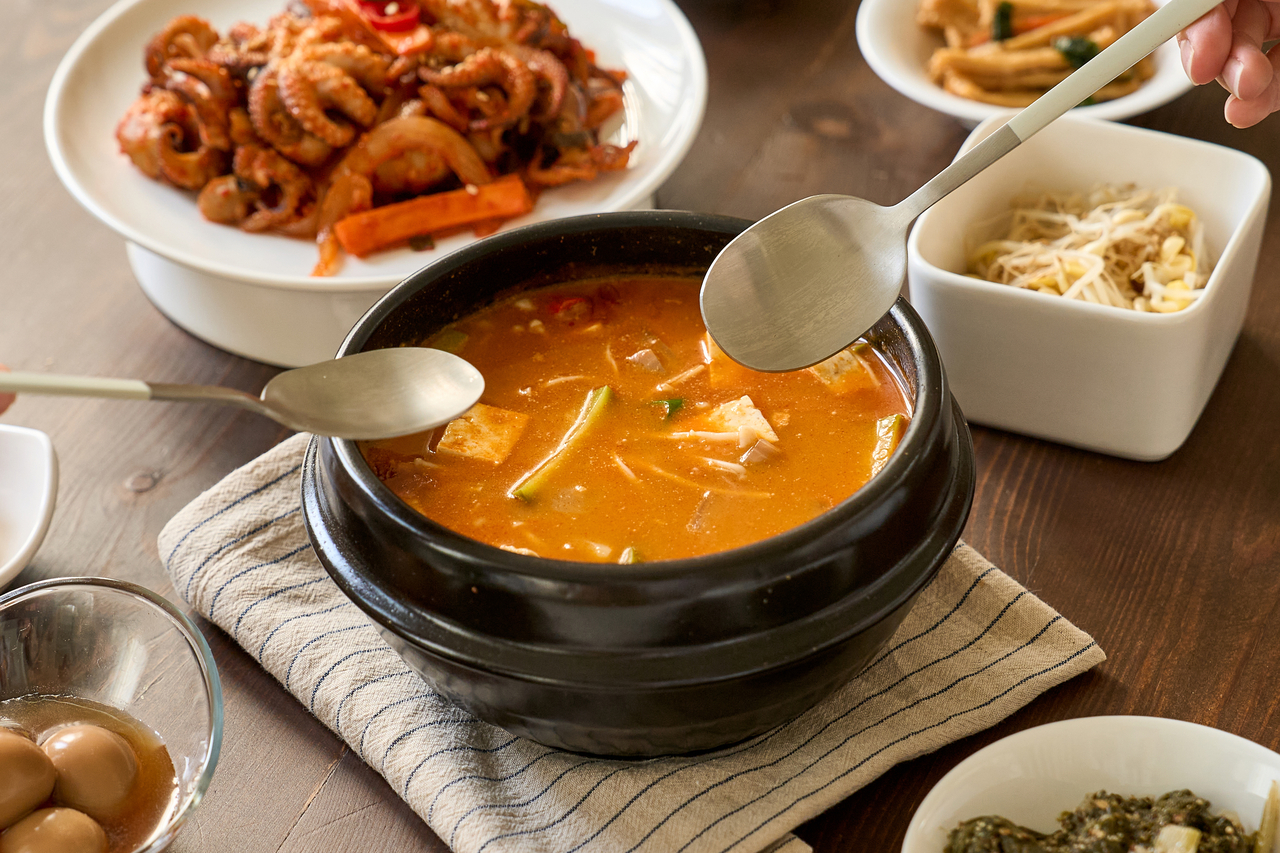
Korea, China and Japan share broad cultural roots yet have developed strikingly different food cultures. Among the three, Korea stands out for one habit in particular: the spoon is an indispensable fixture at every meal.
China has spoons for sipping broth, and Japan has them too, but neither country treats the spoon as an everyday essential the way Korea does — a constant companion at the table from the first bite to the last.
Why did the spoon survive on the Korean table? The answer lies in the structure of hansik itself. A typical Korean meal centers on rice and soup, with a pot of jjigae and an array of banchan arranged alongside. In that setting, the spoon took on the job of scooping rice and lifting broth, while chopsticks became the tool for picking up kimchi, seasoned vegetables, fish and other side dishes. Because the two utensils divided the work between them, a culture of using both throughout a single meal took hold.
In China, by contrast, the role of chopsticks grew as eating habits shifted across regions and dynasties. In northern China especially, wheat-based foods — noodles, mandu and breads — became staples, and chopstick-centered eating developed naturally around them. The spoon never disappeared from Chinese tables, but it settled into a supporting role, used mainly for soup and porridge rather than as a primary utensil for rice.
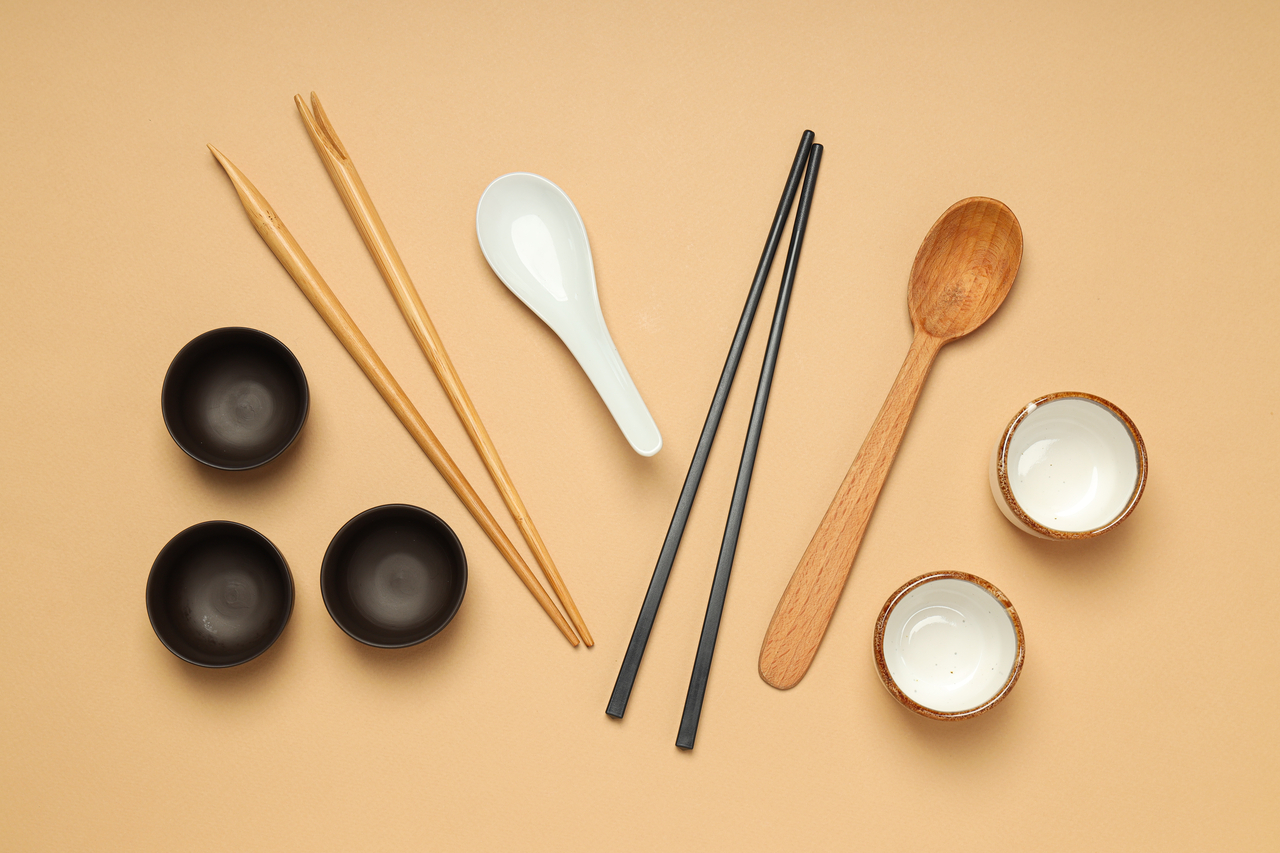
Japan developed yet another approach. Japanese dining custom calls for lifting the rice bowl or soup bowl close to the mouth — rice is eaten with chopsticks, and miso soup and other broths are drunk directly from the bowl. A spoon was simply not needed. Today in Japan, spoons appear mainly with curry, Western-style dishes and children's tableware.
The contrast also shows up in how the rice bowl itself is handled. In Korea, the bowl stays on the table and the diner uses a spoon to eat from it. In Japan, picking up the bowl and holding it while eating is the natural thing to do. Even when both countries are eating the same steamed rice, the tools and the gestures around them diverged.
The spoon's history in Korea runs deeper than most people realize. It is believed to have arrived from ancient China, where spoons were used as ritual implements as far back as the Shang and Zhou dynasties. They are thought to have become personal dining utensils during the Sui and Tang dynasties, passing through the Wei, Jin, and Northern and Southern Dynasties period along the way.
On the Korean Peninsula, a bronze spoon comparable to those of China's Northern Wei period was unearthed from the Tomb of King Muryeong of Baekje, and 26 bronze spoons were found at Wolji Pond — formerly known as Anapji — in Gyeongju, dating to the Unified Silla period. Finds multiplied during eras of active exchange with the Tang dynasty. The spoon's form and use are thought to have spread further during the Goryeo period through contact with northern cultures such as the Khitan and Jurchen.
Jeong Eui-do, director of the Korea Cultural Heritage Research Institute and an archaeologist, has compared the distribution of spoon artifacts on the Korean Peninsula with those from northern China, suggesting that Korea's spoon culture likely developed through sustained exchange with China and the broader northern cultural sphere.
123@heraldcorp.com