A sharp sell-off in domestic equities is rippling through the equity fund market, with the number of funds trading below the 1,000-won benchmark price nearly doubling in a single month. As money flows out of equity funds, rumors of redemptions at a specific asset manager have added to the chill on investor sentiment.
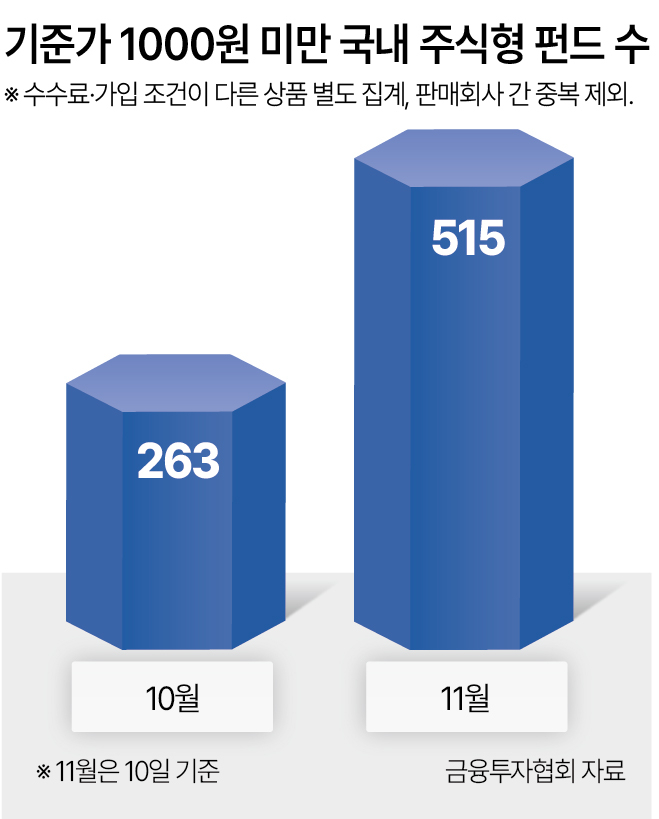
An analysis of October and November data from the Korea Financial Investment Association's Fund Damoa platform shows that the number of domestic equity fund products with a benchmark price below 1,000 won rose from 263 in October to 515 as of Tuesday. Products with benchmark prices that have fallen to the 500-won range jumped from two to 22 over the same period. The share of sub-1,000-won products in the total universe climbed from 7.7 percent to 15.0 percent. The figures count each share class of the same fund separately when fees or subscription terms differ, and exclude duplicates across distributors.
A fund's benchmark price is the net asset value of the fund expressed per 1,000 units — a concept similar to a stock's share price. Funds are generally launched at 1,000 won, so a benchmark price in the 500-won range, absent special factors such as distribution payments, means the fund's asset value has been roughly halved since inception.
The C-W class of Welcome Active IPO Kosdaq Venture Fund No. 2 — a share class restricted to wrap accounts and discretionary trust accounts — was set up on March 24 and now carries a benchmark price of 560.11 won, reflecting a return of minus 43.99 percent since inception. "It appears that quite a few funds launched in the first half of this year have seen their benchmark prices fall to the 500-won range as markets have dropped sharply of late," an industry official said.
Capital flows into equity funds have also deteriorated. According to a report released Monday by Yuanta Securities Korea, global equity funds recorded net inflows of $89.22 billion in the week of Oct. 29 through Nov. 4 — the largest weekly inflow in 20 weeks — while Korean equity funds saw $650 million flow out, swinging to net outflows for the first time in six weeks.
Analysts attributed the divergence to a combination of factors: Samsung Electronics' decision to delay additional shareholder returns, an earnings shock at US tech giant Alphabet, worsening sentiment toward semiconductor investment, and growing concerns over US data center regulations. Kim Yong-gu, a researcher at Yuanta Securities Korea, said the sharp market declines on Thursday and Friday had yet to be reflected in the following week's statistics, making further expansion of net outflows "unavoidable."
Domestic markets have fallen steeply over the past month. According to Korea Exchange, the Kospi dropped 23.00 percent between Oct. 8 and Tuesday. Analysts warn that even if a short-term rebound emerges, sustaining a recovery will be difficult given the decline in trading volume and customer deposits held at brokerages.
Han Ji-young, a researcher at Kiwoom Securities, noted that while foreign investors turned net buyers on Tuesday for the first time in eight trading sessions and the Kospi rebounded more than 4 percent, daily trading value came in at around 15 trillion won ($11.2 billion) — below the November average of 19 trillion won. "Customer deposits, which had topped 100 trillion won for much of the year, have fallen to 88 trillion won, making it hard to say that overall market buying capacity has normalized," Han said.
Han added that the Kospi was likely to give back some of Tuesday's gains, pressured by a rise in US 10-year Treasury yields after October consumer prices came in above expectations and by lingering uncertainty surrounding Nvidia.

hajun825@heraldcorp.com