Behavioral economist Shin Im-cheol releases new book 'Heuristic'
Work examines psychological biases — from loss aversion to confirmation bias — shaping consumer and investment decisions
People sometimes buy things they do not need just to use a discount coupon, and they hold on to falling stocks rather than accept a loss. The two behaviors look different on the surface, but they share a common root: the human instinct to avoid loss.
We tend to believe our spending and investment decisions are rational, yet in practice economic choices are heavily shaped by emotion and intuition. A new book examines how these psychological traits influence consumer and financial behavior through the lens of behavioral economics.
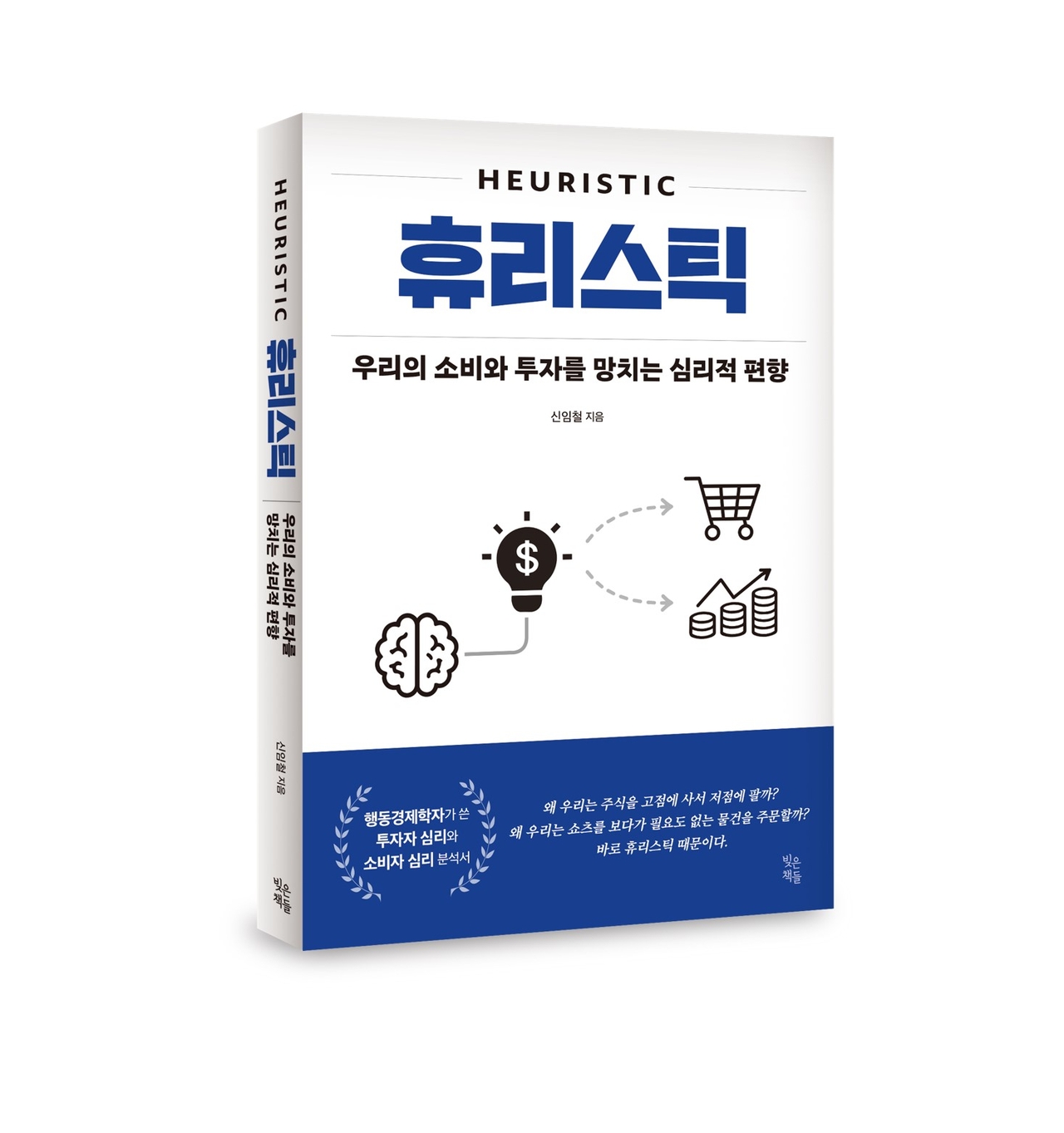
Shin Im-cheol, a behavioral economist and professional manager who serves as chief executive of Aton Mobility, has written "Heuristic: Psychological Biases That Undermine Our Consumption and Investment," due out Nov. 20.
A heuristic is a rule of thumb or intuitive mode of thinking used to make quick judgments about complex problems. While heuristics speed up decision-making, they can also lead to flawed conclusions.
The book argues that, contrary to the traditional economics assumption that people reason rationally, real-world economic choices are routinely steered by a range of psychological biases.
Loss aversion is a prime example. Consider a credit card that offers a 12,000-won ($9) discount when monthly spending exceeds 300,000 won. As the end of the month approaches, a cardholder who has not yet hit the threshold may buy things they do not actually need just to secure the benefit — treating the prospect of missing the discount as a loss, and ending up spending more than they save.
The same dynamic plays out in stock investing. Investors tend to sell winning positions quickly to lock in gains, while clinging to losing ones in the hope of a rebound — reasoning that an unsold position has not yet produced a realized loss. Behavioral economists call this the disposition effect.
Confirmation bias — the tendency to seek out only information that supports one's existing beliefs — is another pattern that cuts across both consumption and investing. After buying a product, people gravitate toward positive reviews; after buying a stock, they pay attention only to bullish forecasts. By ignoring evidence that their choice may have been wrong, they repeat the same errors in judgment.
Through everyday examples like these, the book explains the mechanics of key psychological biases including loss aversion, the endowment effect, mental accounting and herd behavior.
The book is organized into three sections covering behavioral economics theory, consumption and investment. The opening section introduces the foundational concepts of psychological bias; the subsequent sections explore how those biases manifest in everyday spending and financial decision-making.
The book also examines how companies exploit these tendencies to drive purchases — analyzing familiar marketing tactics such as discounts, free delivery and subscription services, as well as authority-based advertising and sales techniques that tap into herd behavior, all through a behavioral-economics lens.
Shin also argues that psychological biases need not be viewed as purely negative. Mental accounting — the tendency to assign different values to money depending on its source or intended use — can fuel impulsive spending, but deliberately separating funds by purpose, such as maintaining distinct accounts for tuition and retirement savings, can actually help people control their expenditure.
Shin graduated from Korea University with a degree in political science, earned a master's degree in public administration from Seoul National University and an MBA from Yale University, and later received a doctorate in business administration from Sungkyunkwan University for research in behavioral economics. While at Yale, he studied behavioral economics and behavioral finance under Robert Shiller, the Nobel laureate in economics.
Shin has worked in strategy, marketing and finance at Samsung, Hyundai, GS and Woori Financial Group, and previously served as chief executive of GS Connect and GS Chargev. He currently leads Aton Mobility, a used-car listing platform. His earlier books include "My First Encounter with Behavioral Economics" and "My First Encounter with Financial Engineering."
pooh@heraldcorp.com