Legal advice sought on blocking industrial accident insurance and additional compensation claims
Consultation conducted while 'The Magic Flute' accident victim was still fighting for life
Law firm also warned against restricting damage claims
Stage structure collapse and missing guardrail reported to council as 'performer carelessness'
Guest artists left out of safety statistics; member calls for corrected reports and mandatory coverage
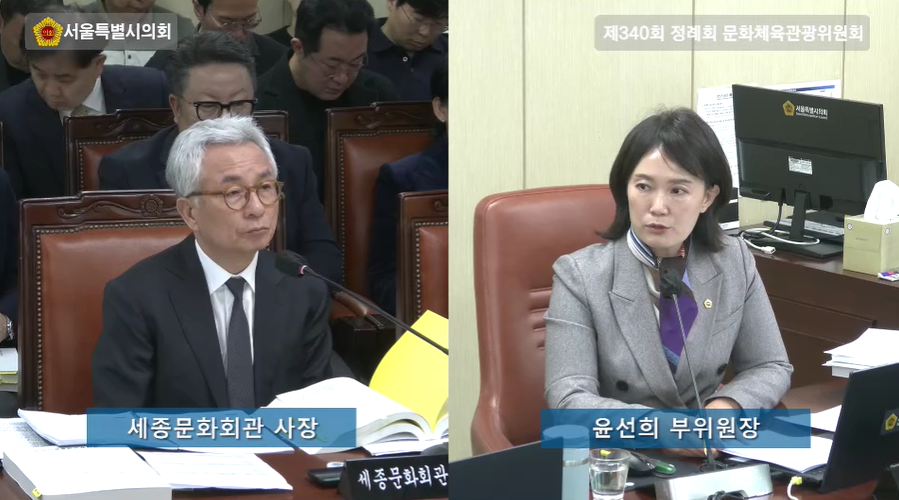
The Sejong Center for the Performing Arts sought legal advice from a major law firm on how to exclude industrial accident compensation insurance for artists injured during performances and block additional damage claims, a Seoul Metropolitan Council administrative audit revealed Thursday.
The disclosure drew sharp criticism, given that the center has publicly championed improved safety and treatment for guest artists while quietly exploring ways to minimize its legal liability in contracts.
Yoon Seon-hee, vice chairperson of the council's Culture, Sports and Tourism Committee and a Democratic Party of Korea member representing Jongno District 1, presented legal consultation documents and accident reports submitted by the center during Thursday's audit, pressing officials on systemic failures in artist protection. Yoon particularly highlighted discrepancies between the center's internal accident records and those submitted to the council, and called for a comprehensive overhaul of safety management covering guest performers.
According to documents Yoon made public, the center consulted law firm Yulchon in July last year in connection with the performance contract for the opera "Aida," seeking advice on how to prevent additional compensation beyond insurance payouts in the event of injury during performances or rehearsals. The consultation also examined whether to explicitly state in service contracts that industrial accident compensation insurance does not apply.
The consultation took place while An Yeong-jae, a guest chorus member critically injured during a rehearsal for the opera "The Magic Flute" at the center's main hall in 2023, was still undergoing treatment and pursuing litigation.
An suffered severe injuries when a stage structure weighing approximately 400 kilograms fell during the rehearsal, leaving him paralyzed from the waist down. He died in October last year at the age of 30. Police referred Sejong Center officials to prosecutors in July last year on charges of professional negligence causing bodily harm in connection with the accident.
Yoon said it was deeply troubling that the center had been exploring contract clauses to limit its compensation liability to injured artists under those circumstances.
Yulchon itself advised caution, noting that clauses requiring performers to waive damage claims exceeding insurance payouts or agree not to file suit were unlikely to be recognized as legally valid and would probably be voided.
When asked whether those clauses had in fact been included in the "Aida" performance contract, the center said they had not been applied. But when Yoon pressed further — asking whether the clauses had been left out by choice or because they could not be used — the center acknowledged, "We could not."
"Last July was when An Yeong-jae was fighting for his life and pursuing a lawsuit," Yoon said. "At that very moment, instead of apologizing to the victim or putting together measures to prevent a recurrence, the center was consumed with figuring out how to exclude workers' compensation and cut off any additional claims at the source."
Sejong Center President Ahn Ho-sang said he had not been aware of the consultation, but added, "I think it was deeply inappropriate. I am sorry."
Problems also emerged in how the center records and manages performance-related accidents. The same incidents were described with different causes in internal documents versus those submitted to the Seoul Metropolitan Council.
Legal consultation materials and litigation status reports the center sent to the law firm described the "The Magic Flute" accident as a stage equipment incident caused by a collision between a chorus member's cane and a falling stage structure. The official accident summary submitted to the council, however, listed the cause as "injury due to carelessness during rehearsal."
A fall during a rehearsal for the opera "Faust" in April last year was cited as a similar case. The center's internal safety accident report recorded that the fall occurred because no guardrail had been installed on a revolving stage staircase 1.25 meters high, but the document submitted to the council described it as "a wrist fracture due to performer carelessness."
According to Yoon, all four documented accidents involving external performers in opera productions — including a coccyx fracture sustained by a performer in "Turandot" and a lip laceration suffered by a stunt actor in "Tosca" — were classified as performer negligence in the materials submitted to the council. Three of the four had no formal safety accident report on file at all.
The exclusion of guest artists from the center's safety and health management statistics also came under fire.
The center's basic safety and health management plan categorizes accident management targets as workers and members of the public, with no separate provision for external guest performers or artists. As a result, Yoon noted, the 2026 safety and health management plan — approved after An's death — recorded zero industrial accidents over the preceding two years.
Yoon said this approach to statistical management makes it nearly impossible to accurately assess the actual accident situation for external artists participating in productions, and could limit the center's ability to develop effective prevention policies.
Yoon called on the center to correct the reported causes of the "The Magic Flute" and "Faust" accidents — to a falling structure and a missing guardrail, respectively — in line with its own internal reports, and to resubmit the corrected records to the council.
Yoon also urged the center to create a separate category for guest performers and external artists in its safety and health statistics, make industrial accident insurance enrollment mandatory for external performers across all venues it operates, and establish clear compensation standards for when accidents occur.
At the close of questioning, Yoon drew on her own background as a vocal music major to argue that the labor and safety of artists who bring performances to life behind the scenes deserve proper protection.
"I also majored in vocal music, but I ran away when I faced the bleak reality of the pure arts," Yoon said. "I ran, but these people stay true to their calling and hold the stage even in that dark and uncertain reality — and for that, I respect them deeply."
"The star onstage can shine only because of the countless people in supporting roles working behind them," she added. "Stop treating those people like ghosts, and stop abandoning guest artists."
7toy7@heraldcorp.com