Lee Jae Myung chairs capital market policy forum in Yeouido
Experts call for two-stage structural reform beyond semiconductor rally
Targeted tax on share-price suppression, Kosdaq overhaul among proposals
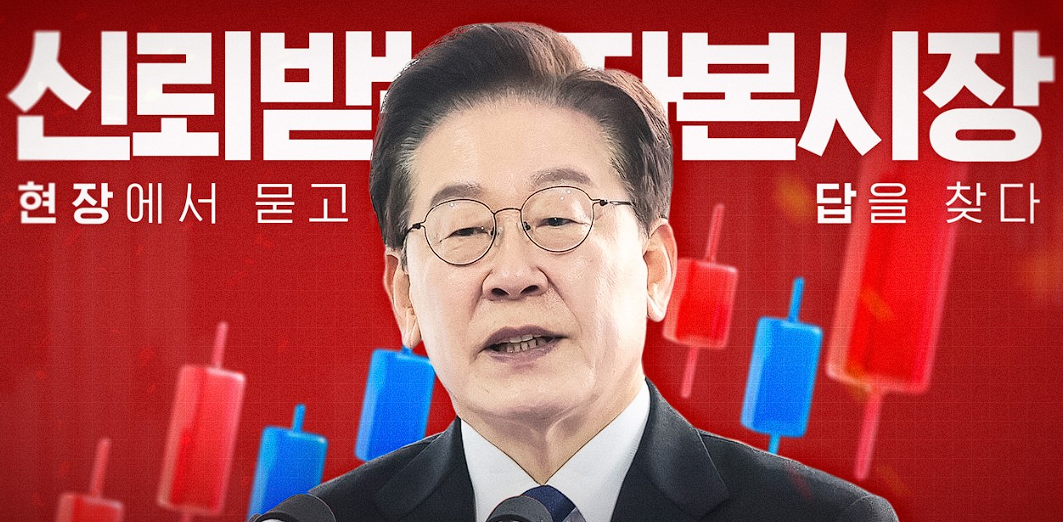
After the Kospi surged to 9,000 following the launch of the Lee Jae Myung administration only to fall back to the 5,000 range, President Lee traveled to Yeouido on Friday to personally review capital market policy. The visit came as market volatility reached an extreme despite a series of stimulus measures, and key tasks such as improving the Kosdaq's structural health struggled to gain momentum.
Lee chaired a capital market policy forum in Yeouido, Seoul, under the theme "A Trustworthy Capital Market: Asking Questions and Finding Answers on the Ground." Experts at the forum identified three core tasks for broadening corporate value reassessment beyond the semiconductor-driven rally: improving corporate governance and normalizing the mergers and acquisitions market; comprehensively redesigning the Kosdaq in tandem with the venture ecosystem; and expanding the long-term retail investor base.
The forum's first presenter, Lee Hyo-seop, a senior research fellow at the Korea Capital Market Institute, said the Korean stock market remains undervalued relative to major peers even after breaking out of its long-running trading range. As of Oct. 20, South Korea's price-to-book ratio stood at 1.74 times, well below the United States (5.67 times), Taiwan (5.55 times), the United Kingdom (2.41 times) and Japan (2.03 times). He noted that 70.1 percent of Kospi-listed companies (560 firms) and 51.9 percent of Kosdaq-listed companies (877 firms) still trade below book value, with a PBR of less than one.
"While the Kospi has risen 100.4 percent since the new administration took office, the Kosdaq's return was limited to 4.2 percent," Lee Hyo-seop said. "The semiconductor-led rally must be broadened into a wider reassessment of corporate value across the market."
Lee Hyo-seop identified three main obstacles to corporate value improvement — deliberate share-price suppression by controlling shareholders, the monopolization of M&A control premiums by dominant shareholders, and the absence of external checks — and proposed combining financial discipline with tax measures. Specifically, he called for strengthening the stewardship code, including easing the 5 percent rule for institutional investors; normalizing the M&A market through fair merger valuation rules (set to take effect Dec. 9), the introduction of a "Korean-style bear hug," and a mandatory tender offer regime; and imposing a selective surcharge of at least 30 percent on companies found to be deliberately suppressing their share prices.
Lim Hyeong-jun, a research fellow at the Korea Institute of Finance, attributed the Kosdaq's chronic credibility problem to a structure of easy entry and minimal exit, as well as distorted exit patterns among venture capital firms. Over the past 20 years, 1,353 companies entered the Kosdaq while only 415 were delisted. As a result, the share of marginal companies on the Kosdaq reached 32.6 percent last year, and 392 companies had a market capitalization below 30 billion won ($22.5 million).
A particular concern was that initial public offerings accounted for 37.3 percent of domestic venture capital exits — far above the United States (4.7 percent) and Europe (9.0 percent). With M&A and secondary markets underdeveloped, immature companies are being pushed into premature listings, only to see their earnings collapse and share prices plunge after listing, perpetuating a vicious cycle.
"To build a dynamic ecosystem of many births and many deaths, pre-listing exit routes must be widened by rationalizing regulations on holding-company corporate venture capital and by establishing M&A and secondary funds," Lim said.
Lim added that at the listing stage, underwriter accountability should be strengthened and the cornerstone investor system should be institutionalized. On the proposed segment separation — a tiered promotion-and-relegation structure under discussion as part of market restructuring — Lim said the expected benefits of retaining quality companies and attracting institutional capital coexist with concerns about a stigma effect on lower-tier groups, making the setting of objective criteria and careful post-implementation management the critical factors.
Kim Hak-kyun, head of the research center at Shinyoung Securities, outlined what it would take to make the market attractive to investors from a supply-demand and long-term returns perspective. He assessed this year's market as one in which retail investors and companies buying back their own shares were net buyers, while foreign and institutional investors were net sellers. Cautioning that past waves of retail stock investment enthusiasm had always appeared near index peaks, Kim said individual investors need to accumulate a "collective success experience" in the domestic market if household money that has flowed in is to stay.
Kim noted that individuals net purchased 46 trillion won worth of US stocks last year and 36 trillion won this year, even while absorbing a 22 percent capital gains tax — evidence that the market's own upward trajectory, rather than tax incentives, drives investor choices.
Kim identified stingy dividends and extreme polarization among listed stocks as fundamental weaknesses of the Korean market. South Korea's dividend payout ratio, he said, ranks near the bottom compared with Northeast Asian peers such as Taiwan, China and Japan, all of which are also manufacturing-oriented economies. He also said that even though the Kospi rose 185.3 percent over the past decade — from 2,008 points to 5,730 points — the number of stocks that declined (1,304, including 156 delistings) was more than double the number that rose (566), making it structurally difficult for long-term investors to generate returns.
As a remedy, Kim proposed allowing minors to open ISA accounts and developing the product into a lifelong asset management platform linking the Child Independence Fund, general ISA and pension accounts in sequence, with tax incentives proportional to the holding period. He also recommended creating a management and distribution ecosystem that prioritizes long-term performance and low-cost competitiveness over short-term sales figures or returns, so that publicly offered funds — better suited to long-term diversified investment and reducing emotional strain on investors — can be revitalized.
The Financial Services Commission said it will carefully review the expert opinions presented at the forum and actively incorporate them into follow-up capital market policies that citizens and market participants can tangibly feel.
jiyun@heraldcorp.com