Linking power equipment, technology demonstration and business attraction to strengthen semiconductor and AI industry supply chains
Roundtable with 18 industry, academia and education officials addresses workforce development and settlement conditions
Local education institutions to drive specialist training, laying groundwork for business growth and job creation
Naju, a city in South Jeolla Province, is moving to establish itself as a key industrial support hub for the Honam semiconductor cluster, leveraging its concentrated power and energy industry base to connect with advanced industries taking shape across the region.
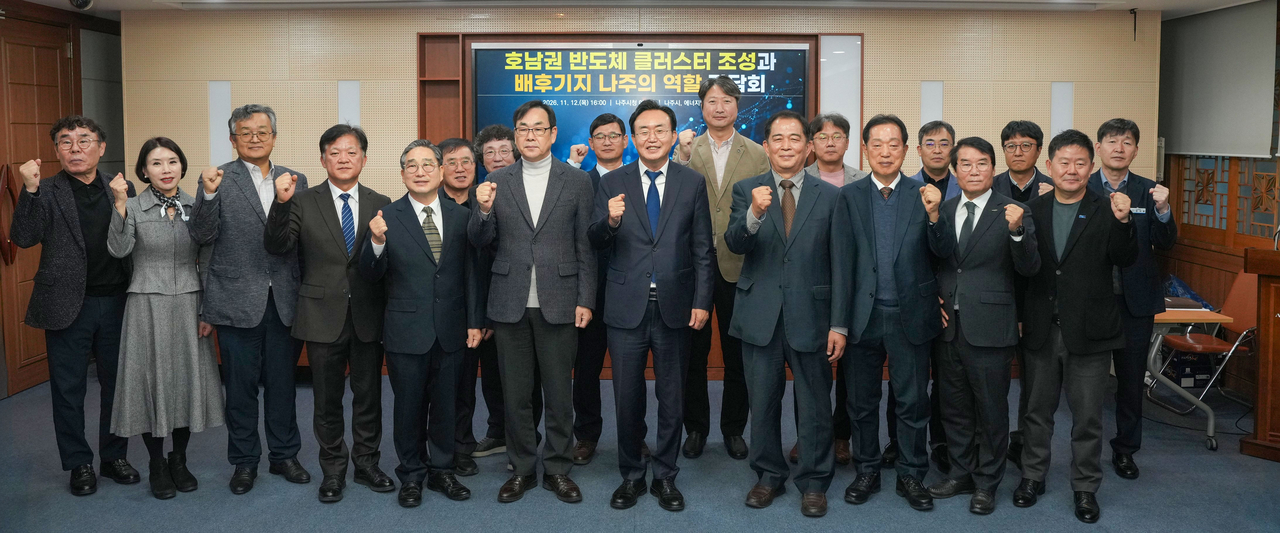
According to Naju city officials, Mayor Yun Byeong-tae convened a roundtable Thursday at Naju City Hall, bringing together 18 participants from the city council, universities, public institutions, education bodies and businesses to discuss the role of Naju as a support base for the Honam semiconductor cluster.
The meeting was held to explore ways to deploy Naju's energy industry infrastructure and research and development capabilities in support of the emerging semiconductor cluster, and to map out a comprehensive strategy covering industrial cooperation, workforce development and residential conditions.
Discussions focused on defining Naju's role as a central power and energy hub linking Gwangju's semiconductor fabrication facilities with an AI data center in Haenam, and on channeling the resulting industrial growth into opportunities for local businesses and quality jobs.
The city envisions reinforcing the power equipment supply chain, advancing technology demonstration, cultivating specialist workers and improving settlement conditions — all in support of semiconductor and AI industry growth and as a new engine for the local economy.
"The development of the Honam semiconductor cluster is a pivotal opportunity to reshape the region's industrial landscape, and it is a moment when Naju's role and responsibility grow even greater," Mayor Yun said at the roundtable. "We must connect the energy industry base we have built around Korea Electric Power Corporation, the Korea Institute of Energy Technology and Energy Valley to advanced industries such as semiconductors and AI, and develop it into a future growth engine."
A subsequent discussion session chaired by Vice Mayor Kang Sang-gu examined sector-by-sector cooperation plans covering power and energy industry development, specialist workforce training, business support and improvements to residential conditions.
On the industrial side, participants called for strengthening the technological competitiveness of local industries — with a focus on key power equipment such as DC power systems, transformers and switchboards needed to operate semiconductor fabrication plants and AI data centers — while expanding the base for attracting related businesses, demonstrating technologies and commercializing products.
Participants also discussed expanding the scope of a planned materials, parts and equipment specialized complex — currently centered on distribution equipment — to encompass the semiconductor and data center sectors, with the aim of building an integrated upstream and downstream supply chain for those industries.
The meeting also highlighted the need to establish a comprehensive support system drawing on the Korea Institute of Energy Technology's power semiconductor research capabilities and reliability testing infrastructure, linking local companies through the full cycle from technology development and testing and certification to demonstration, commercialization and market access.
Participants raised the need to prepare measures to help small and medium-sized enterprises secure workers and maintain stable employment, in anticipation of rising demand for specialist labor as large-scale semiconductor industrial complexes take shape and the risk that large conglomerates could absorb a disproportionate share of the available workforce.
On workforce development, participants discussed ways to pool the capabilities of local education and research institutions to systematically train practice-oriented specialists suited to the needs of industry.
The direction agreed upon calls for the Energy Valley Industry-Academia Convergence Institute, the South Jeolla Province-Gwangju Integrated Special City Office of Education, Korea Polytechnics and Naju Technical High School to collaborate on expanding curricula in the semiconductor and power and energy fields, and on strengthening on-site training and employment-linkage programs tailored to business demand.
Specific measures discussed included operating Naju Technical High School as a contract-type specialized high school in the energy field from 2027; restructuring Naju Commercial High School's departments around new industries and technologies from 2028; revamping the power technology curriculum at Korea Polytechnics' Power Technology Education Center to cover semiconductor equipment and cooperating on building a semiconductor practice facility known as a "mini-fab"; and developing customized talent programs for high schools, universities and businesses in connection with the Ministry of Education's supra-regional growth engine talent development project, K-Grid RE100.
Participants also called for simultaneous improvements to residential conditions, identifying as key priorities the swift establishment of an international school in Naju, the operation of a civic university program linked to local universities, and lifestyle-oriented support measures for young workers including housing assistance, employment incentive payments and cultural vouchers.
Naju city plans to build on the proposals from the roundtable by strengthening cooperation among academia, research institutions, public bodies, education institutions and businesses, and developing the outcomes into joint projects with the South Jeolla Province-Gwangju Integrated Special City and the central government.
Through these efforts, the city aims to build a supra-regional advanced industry ecosystem in which Gwangju's semiconductor industry, Haenam's AI data center and Naju's power and energy industry base are mutually connected, pursuing outcomes that translate into stronger technological competitiveness for local businesses, new investment and the creation of quality jobs.
"For the Honam semiconductor cluster to succeed, it must be backed by a stable power and energy supply chain, materials and parts and equipment companies, specialist workers and a solid residential foundation," Mayor Yun said. "We will work closely with all relevant institutions to grow into the core support hub for advanced industries in the Honam region, and we will do our utmost to ensure that the results feed into the development of local businesses, the creation of jobs for young people and the revitalization of the regional economy."
kkm9971@heraldcorp.com