Seongdong-gu, Gangdong-gu join Gangnam 3 in price declines
Seoul listings up 34%, transactions down 42%
Experts: short-term correction likely, but rate hike impact seen limited
With the government repeatedly signaling that Seoul's housing market may be entering a downturn, attention is mounting over where home prices are headed. Officials point to the spread of price declines from the Gangnam 3 districts — Gangnam-gu, Seocho-gu and Songpa-gu — into parts of the Han River belt, alongside a clear rise in listings and a drop in transactions. Market experts broadly expect a correction to continue, driven by buyer fatigue after sharp price gains and tightening loan regulations, but most stop short of declaring a full-blown bear market.
The government has sent a string of messages in recent weeks suggesting signs of price stabilization in Seoul's housing market. President Lee Jae Myung said at a Cabinet meeting on Nov. 3 that actual transaction prices in key areas were falling "at a surprising rate," pointing to rising apartment listings and falling sales volumes in Seoul.
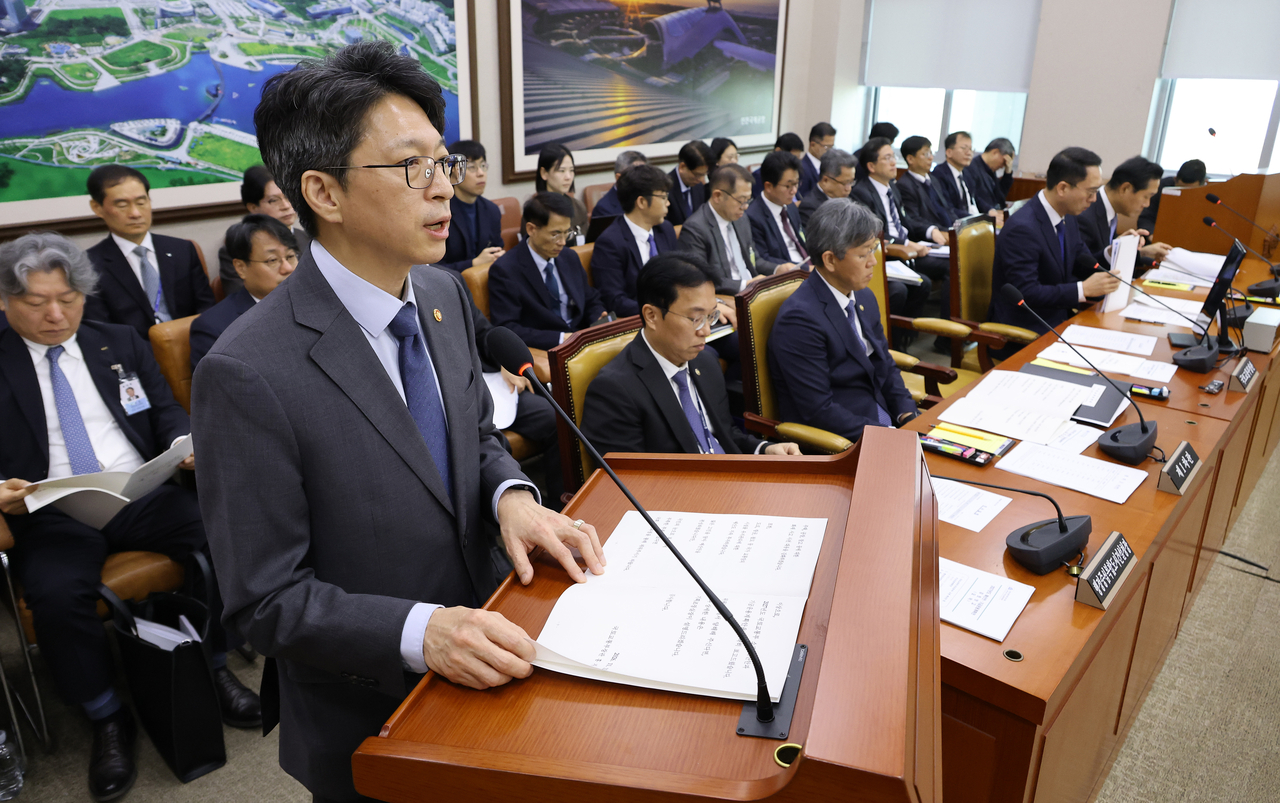
Land, Infrastructure and Transport Minister Hong Ji-seon said Thursday at a plenary session of the National Assembly's Land and Infrastructure Committee that the continued buildup of listings and declining transactions "can be seen as a signal that the housing market may be entering something of a downturn." Hong added that prices in the Gangnam 3 districts "have already been falling steadily," while the pace of gains in outer Seoul has been slowing.
The data back up the government's assessment. According to real estate big data firm Asil, Seoul apartment listings stood at 81,107 as of Thursday — up 34.2 percent from the 60,409 recorded on Aug. 3, the day the government announced its tax reform plan. The Korea Real Estate Board said Seoul apartment transactions totaled 3,915 in September, down 42.4 percent from 6,796 in the same month a year earlier.
Weakness has also spread to Gangnam, which had led the price rally. In the Korea Real Estate Board's weekly apartment price survey for the second week of this month (based on Monday's data), Gangnam-gu fell 0.25 percent and Seocho-gu fell 0.26 percent — each posting a 14th consecutive weekly decline — while Songpa-gu dropped 0.35 percent for a 10th straight week of losses. Seongdong-gu and Gangdong-gu also turned negative, falling 0.02 percent and 0.01 percent respectively — their first declines in 32 and 33 weeks.
The government also expects an increase in upcoming move-in supply to help stabilize the market. About 16,000 units are set to come online in the greater Seoul area in November and December, with roughly 28,000 more expected in the first quarter of next year. Of the approximately 6,000 units slated for Seoul in the first quarter of next year, about 4,000 are in key districts including Mapo-gu, Seocho-gu and Yongsan-gu.
Experts anticipate a period of correction for Seoul home prices, but say it is too early to call a sustained downtrend. Overall Seoul apartment prices rose 0.07 percent week on week — extending a streak of gains to 92 consecutive weeks — with the pace of increase unchanged from the prior week. Outer, mid-to-low-price districts such as Seongbuk-gu (up 0.39 percent) and Gangbuk-gu (up 0.32 percent) actually accelerated, highlighting a divergence across the city.
Ham Young-jin, head of the real estate research lab at Woori Bank, said the price correction originating in Gangnam could spread across the Han River belt, given sluggish transactions, the seasonal slow period and the possibility of an interest rate hike. "However, one should note that in outer Seoul's mid-to-low-price areas, unlike the high-end market, demand is being driven by what you might call 'survival buying' — people purchasing out of necessity for their own residence," Ham said.
Kwon Dae-jung, a chair professor in the real estate department at Hansung University, also forecast that the correction could extend into the first half of next year and spread to outer Seoul. "If interest rates rise, the pace of home price gains could slow," Kwon said, "but it is unlikely to be enough to make would-be buyers who have planned a purchase give up entirely."
Kim Hak-ryeol, director of the Smart Tube Real Estate Research Institute, said jeonse prices — a leading indicator for sale prices — had actually turned upward in Gangnam-gu and Seocho-gu, suggesting home prices could recover. "With monthly transaction volumes currently running at around 3,000 units and trading concentrated in distressed listings where sellers are under pressure to move quickly, it is difficult to read this as a broad, sustained market decline," Kim said.
quq@heraldcorp.com