Flexible display transmits color to the human eye and infrared signals to machines, even in darkness or fog
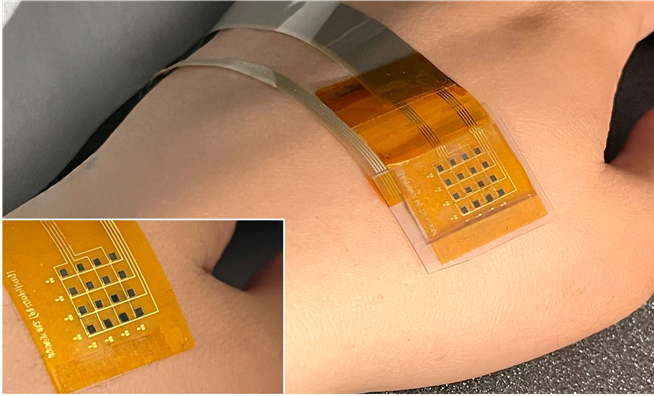
Researchers have developed a new display technology that lets humans read information through color while robots read the same screen using invisible near-infrared light.
KAIST announced Monday that a research team led by Professor Song Young-min of the School of Electrical Engineering had jointly developed a flexible reflective display with a team led by Professor Yoo Ki-jun of Yonsei University. The display can simultaneously show visible-light and near-infrared information on a single screen.
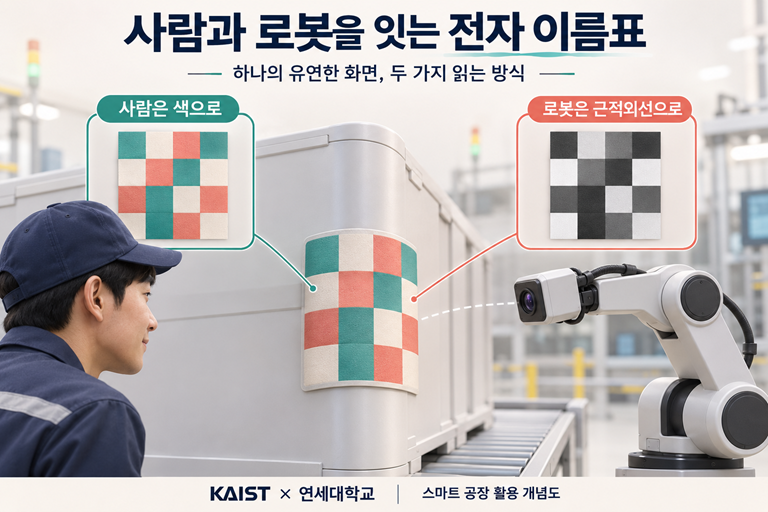
The key feature of the technology is that a single display can be read by humans and robots in entirely different ways. People see the colors shown on the screen, while robots use near-infrared cameras to detect bright-and-dark patterns.
Conventional displays present information tailored to human vision — through color or text — which limits their usefulness in low-light or foggy conditions.
To overcome that limitation, the research team used an electrochromic polymer material called PEDOT, whose light-absorption rate changes with applied voltage. By combining this material with a thin layered structure that reflects light multiple times, the team was able to control both the visible color and the near-infrared reflectance simultaneously through voltage alone.
The display consists of 16 pixels arranged in a 4-by-4 grid. Each pixel is connected to a thin-film transistor, allowing individual control. This enabled the team to display various colors and near-infrared patterns at specific positions on the screen.
The device was designed with a gel-type electrolyte and a flexible substrate so that it continues to function even when bent or attached to a curved surface.
The research team successfully tested the display attached to the back of a human hand, switching the output of individual pixels while in place. A standard camera captured the color changes, while a near-infrared camera independently detected the pattern changes.
The team also demonstrated that a near-infrared camera could read patterns in dark or foggy test environments. However, a separate near-infrared light source is required in low-light conditions.
The technology is expected to find wide application in smart factories where humans and robots work side by side. Attaching the display to a product or a transport container would allow workers to check the product type and process status by color, while robots read the near-infrared pattern to obtain the information they need.
The display could also be attached to robots themselves, allowing other robots to check operational status or error codes. The technology could further expand into next-generation information displays for wearable devices or curved equipment.
The current prototype, however, remains at an early stage with only 16 pixels. Commercialization will require expanding the pixel count, ensuring long-term operational stability, developing encapsulation technology to protect the device from external conditions, and integrating the system with robots' camera-reading platforms.
"The significance lies in expressing, on a single flexible screen, both the colors that humans see and the near-infrared information that machines detect," Professor Song said. "We hope this develops into a display technology capable of conveying information in spaces where humans and robots work together, adapting to ambient light levels and line-of-sight conditions."
The findings were published in the international journal npj Flexible Electronics on Oct. 20.
nbgkoo@heraldcorp.com