12-month forward PER falls to 3.75x, below global financial crisis lows
Rising US rates and foreign selling weaken rebound momentum
LS Securities sees index range-bound through late Q1 to Q2 next year
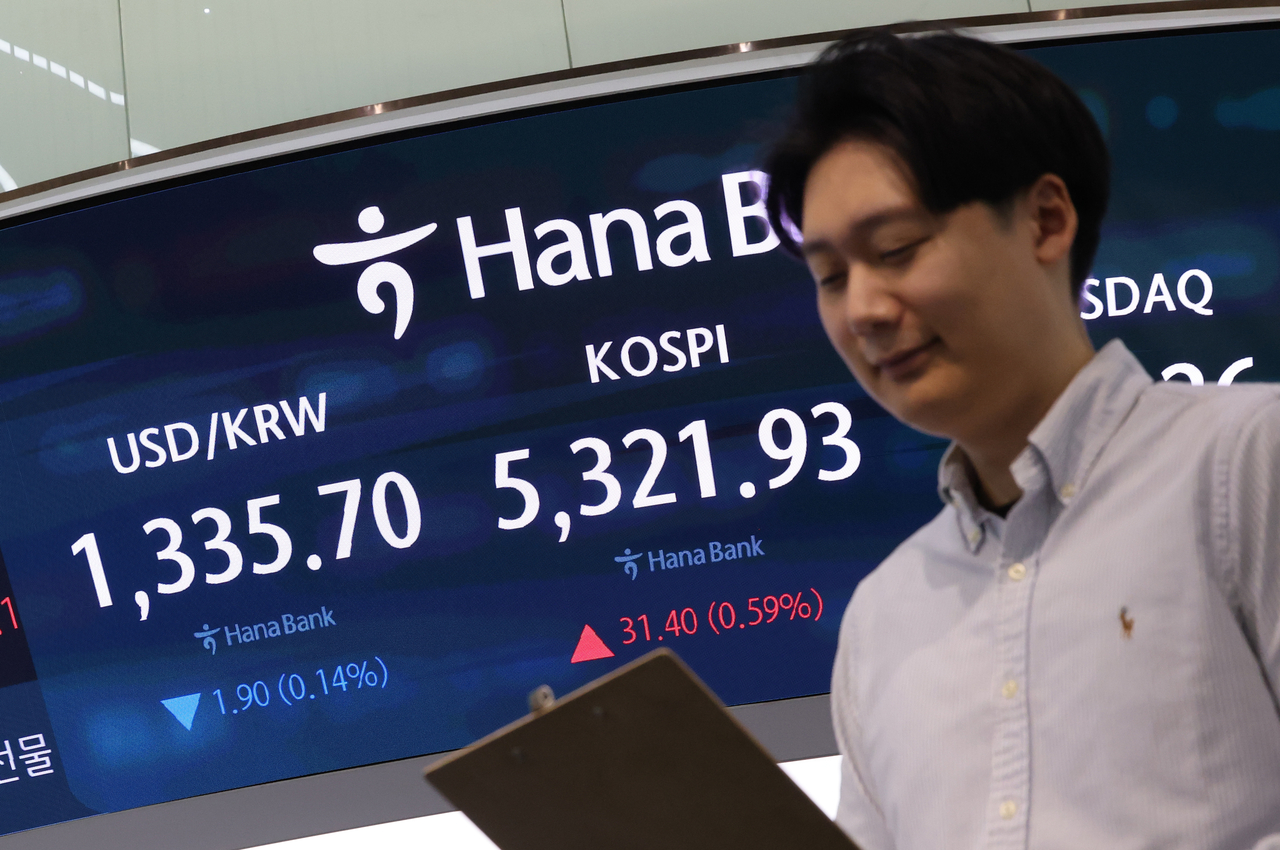
The Kospi has fallen to what analysts are calling historically extreme undervaluation, yet the index is unlikely to break out of its trading range anytime soon. The benchmark's 12-month forward price-to-earnings ratio has dropped to 3.75 times — well below the level seen during the 2008 global financial crisis — but securities analysts say cheap valuations alone are not enough to turn the market around.
According to Korea Exchange data released Monday, the Kospi's PER stood at 8.81 times as of Friday. That is a sharp decline from the 30-times range recorded in May, when the index climbed above the 8,000 level.
The 12-month forward PER of 3.75 times measures how many times the current share price exceeds projected earnings per share over the next 12 months. The reading is far below both the 10-year average of 10.1 times and the 6.3 times recorded during the global financial crisis.
Export-based analysis also points to undervaluation. BNK Investment Securities calculated last month that the Kospi's fair value stands at 6,390, based on won-denominated export figures — about 20.8 percent above Friday's closing level of 5,290.53.
"The Kospi's PER multiple remains at a historically low level, and when compared with export figures, the Korean market appears to be in undervalued territory," said Kim Seong-no, a researcher at BNK Investment Securities.
However, analysts agree that undervaluation alone is insufficient to reverse the index's direction. Kim added that with foreign selling continuing, and considering outflows from equity funds and a decline in customer deposits, there is no momentum on the supply-demand side to resolve the undervaluation.
Rising US Treasury yields add to the headwinds. Jung Da-woon, a researcher at LS Securities, said the medium-term outlook for range-bound trading through late Q1 to Q2 next year — when financial deregulation and liquidity improvements are expected to gain traction — remains unchanged. "The reason the process of confirming the lower end of the range is taking longer than expected is that the liquidity buffer has thinned while the monetary policy safety net has been blocked by an inflation barrier," Jung said.
The US producer price index for October rose 6.5 percent year-on-year, the highest increase in four years, pushing the yield on the 10-year US Treasury note above 5.15 percent.
Markets are pricing in a rate hike at the December FOMC meeting. According to the CME FedWatch tool, Fed funds futures markets are assigning a 93.8 percent probability that the Federal Reserve will raise its benchmark interest rate by 25 basis points at the December FOMC.
Analysts agree that whether the Kospi can find the momentum to escape its trading range depends on key events this week — the release of the October FOMC minutes, Nvidia's earnings report and Anthropic's NASDAQ listing.
"Since October, repeated macro and AI-related headwinds have triggered frequent sharp share price drops, and the market has built up a degree of resilience," said Han Ji-young, a researcher at Kiwoom Securities. "What matters is whether the Kospi can maintain the price recovery needed to keep raising its lows, and that will depend on the outcome of the major events scheduled this week," Han said.
Markets will look to the October FOMC minutes and remarks from Fed officials for clues on the size of a December rate hike. A 25-basis-point increase is already priced in, so the key question is whether other Fed officials will align with Governor Waller's case for a 50-basis-point hike.
The variable that will set the direction for semiconductor shares is Nvidia's earnings, scheduled for Tuesday (local time). "Nvidia's fourth-quarter guidance and gross margin will determine the direction of the index and semiconductor stocks," said Lee Kyung-min, a researcher at Daishin Securities. "Beating revenue is the baseline — what matters is whether guidance exceeds the consensus range of $123.3 billion to $124.5 billion and whether the company can defend a 74 percent gross margin." Also in focus are the outlook for AI accelerator demand and how interim CEO Colette Kress will adjust the business strategy pursued by Jensen Huang.
For Anthropic, which lists on Thursday, the question is whether the subscription frenzy will translate into post-listing share price performance. As of Friday, institutional subscription demand was approximately six times the offering volume. Whether the company can sustain the valuation implied by its IPO price after listing will serve as a gauge of investor sentiment toward AI stocks.

moon@heraldcorp.com