Seoul Metropolitan Government launches 'rapid public transit operation plan' starting Monday
Four express bus routes begin pilot service in Dobong, Gangdong, Sangam and Gangseo
Eight additional Line 9 express trains added during morning rush hours
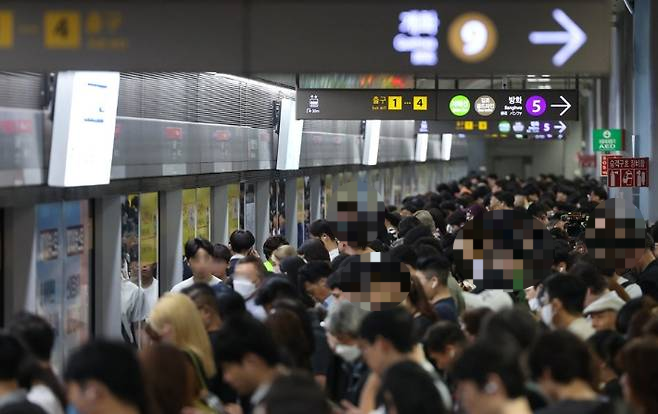
The Seoul Metropolitan Government launched a pilot program Monday for four express bus routes connecting outer districts — Dobong, Gangdong, Sangam and Gangseo — to major business hubs in the city center. The city also expanded express train service on subway Line 9 during rush hours to ease overcrowding.
The measures are part of the city's newly introduced "rapid public transit operation plan," which took effect Monday.
The express buses follow the same routes as existing services but stop only at major stations. The city expects the reduced number of stops to cut travel times by about 10 percent.
The four pilot routes are Express 150 (Dobong Garage to City Hall Station), Express 370 (Gangdong Garage to Chungjeongno Station), Express 470 (Sangam Garage to City Hall Station) and Express 605 (Gangseo Garage to Yeongdeungpo Station). Each route operates three times a day on weekdays, during the early morning and morning rush hours.
Existing regular bus services will continue to run as before, allowing passengers to choose between express and regular buses depending on their destination.
To help riders identify express buses at a glance, the city has added route designations such as "Express 150" and "Express 370" to the destination boards on each vehicle. Inside the buses, route maps clearly mark which stops are served and which sections are non-stop.
Line 9 train schedules have also been revised. Between 5:40 a.m. and 7 a.m., the ratio of express to regular trains running from Gaehwa Station toward Central Veterans Hospital Station has been adjusted from one express to one regular train to two express trains for every one regular train.
The start of peak-hour service concentration has also been moved earlier. The morning rush-hour deployment now begins at 5:40 a.m., 50 minutes earlier than the previous 6:30 a.m. start. The evening rush-hour deployment has been brought forward from 4:30 p.m. to 4 p.m.
The city said the changes will increase Line 9's total morning passenger capacity by about 5 percent, from 232,344 to 243,408. Peak crowding on express trains heading toward Gaehwa and Gimpo Airport is expected to fall from 192.5 percent to 172.1 percent, while trains heading toward Central Veterans Hospital Station are projected to ease from 182.3 percent to 174.2 percent. During the evening rush, crowding on trains toward Gaehwa and Gimpo Airport is forecast to drop from 180.5 percent to 160.3 percent.
The overhaul will add eight train runs on Line 9 during morning hours and shorten express train headways. From 7 a.m. to 8:30 a.m., the interval between express trains toward Central Veterans Hospital Station will be reduced from 6 minutes and 20 seconds to 6 minutes. Express trains toward Gaehwa and Gimpo Airport will see their headways cut from a range of 6 minutes and 30 seconds to 12 minutes down to between 6 minutes and 30 seconds and 8 minutes.
To minimize disruption during the early rollout, the city said it has strengthened in-station announcements and on-site guidance. Two standby train sets will also be kept on alert to respond to any unexpected situations.
Yeo Jang-gwon, head of the Seoul Metropolitan Government's transportation bureau, said the city would "closely monitor operations in the early stages of implementation and make every effort to manage conditions on the ground so that the new operating system can take stable root."
cook@heraldcorp.com