From technology development and installation in typhoon-prone Japan to community-based "sunshine income villages," Paru has spent more than a decade building toward the moment South Korea's agrivoltaic industry goes mainstream.
With the Agrivoltaic Solar Energy Business Act set to take effect Dec. 17, Kosdaq-listed renewable energy company Paru is moving to scale up its agrivoltaic solar business, drawing on more than a decade of technology development and field experience.
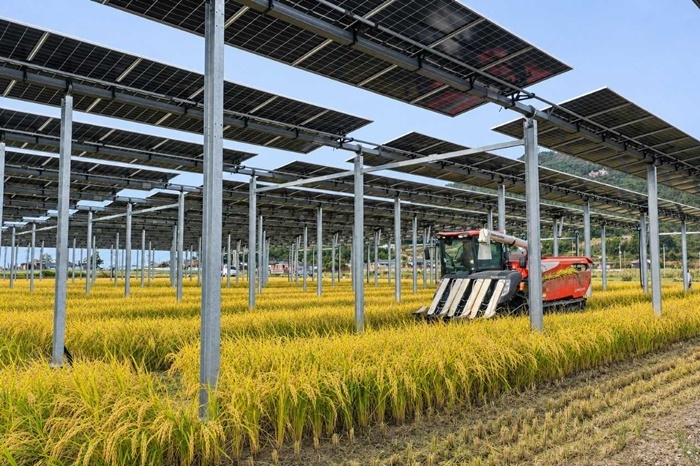
Agrivoltaic solar projects have drawn growing attention as a dual-income model: farmers continue working their land as usual while solar panels mounted on columns at least 4 meters high generate electricity, adding energy revenue on top of existing farm income.
The law — formally titled the Act on the Promotion of and Support for Agrivoltaic Solar Power Generation Businesses — was enacted June 16. It permits solar power generation on existing farmland and is designed to ensure the resulting revenue flows back to rural communities. It takes effect Dec. 17.
The significance of agrivoltaic solar lies in what it is not: it does not eliminate farmland to make way for solar generation. Instead, it preserves agricultural land while raising farmers' incomes and advancing the government's goals of carbon neutrality and broader renewable energy deployment, offering a new income and industrial model for rural areas.
The impending law has sharpened interest among both farmers and the energy industry.
Wider adoption of agrivoltaic solar would not only boost farm household incomes but also significantly expand the country's untapped solar potential, accelerating the rollout of renewable energy.
Paru, a Kosdaq-listed company with a long track record in renewable energy, plans to use the law's launch as a springboard to expand its supply and installation partnerships for agrivoltaic equipment and to participate in projects linked to community-based "sunshine income villages."
At its core, the new law establishes an institutional framework for licensing and supporting projects that combine ongoing agricultural production with solar power generation.
It sets out participation rules for qualifying farmers, resident cooperative associations and agricultural corporations, and lays down approval criteria that account for farm machinery operation and sunlight requirements, as well as the basis for administrative and fiscal support from central and local governments.
The law's stated aim is to preserve the agricultural production base while raising incomes for farmers and rural residents and expanding renewable energy supply.
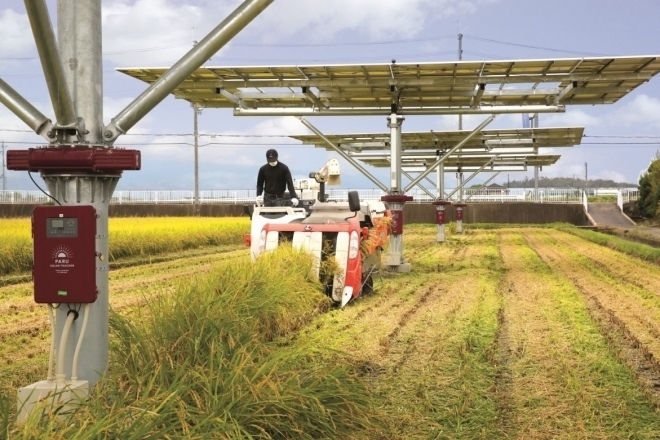
Paru began its agrivoltaic work in Japan in 2014, choosing a market where frequent typhoons and earthquakes made structural resilience a non-negotiable requirement, and has continued developing, installing and demonstrating the technology ever since.
Because agrivoltaic systems must share space with active farming, the company has focused on balancing three factors: ease of farm operations, optimal growing conditions for crops, and structural safety of the installations.
The company has also expanded its demonstration base domestically. It completed an agrivoltaic dual-axis tracking solar power plant in 2017, and in 2019 signed an MOU with the Rural Development Administration's National Institute of Crop Science to conduct agrivoltaic demonstration research.
The installation and demonstration sites in Japan and South Korea have served as a foundation for accumulating design and operational experience in running farming and power generation side by side, the company said.
Central to Paru's approach is a solar system engineered for real farm conditions. A key challenge was ensuring enough space for large agricultural machinery — tractors, combine harvesters and cultivators — to move and operate freely.
The company mounts solar panels on columns at least 4 meters high and widens the spacing between columns to accommodate the working radius of large farm equipment, while also allowing drone-based crop spraying.
The system can also be configured to suit different farmland and cultivation conditions. Panels are fitted with sun-tracking technology that adjusts the module angle as the sun moves — much like a sunflower — to maximize photosynthesis and ensure crops receive adequate sunlight.
Paru plans to use the December launch of the agrivoltaic law to accelerate field deployment of the technology it has been developing. The company intends to expand equipment supply, installation and technical cooperation with farmers, resident cooperative associations and business partners, build out region-specific collaboration frameworks tailored to local farming and project conditions, and broaden its scope to include sunshine income villages powered by agrivoltaic systems.
Beyond individual farms, Paru aims to lay the groundwork for village-level projects where farming and energy production can coexist.
"In agrivoltaic solar, it is important to have both an environment where farming can continue and equipment that can operate over the long term," a company official said. "We will use our accumulated technology and field experience to expand the spread of agrivoltaic solar and contribute to broadening the income base for farmers and rural residents through our sunshine income village initiative."
Founded in 1993, Paru is a Kosdaq-listed renewable energy specialist regarded as a leading company in agrivoltaic solar technology.
parkds@heraldcorp.com