Two post-sale Banpo projects show jeonse deposits fall far short of pre-sale prices
Buyers must raise hundreds of millions of won even after collecting jeonse deposits
Down payments alone reach 550 million won, with tight payment schedules adding pressure
Strict lending caps push winners toward private financing — and deposit repayment looms
The emergence of so-called "tenant financing" targeting the upcoming December pre-sale of DH Banpo 124 in Seoul reflects a deeper structural problem in the Gangnam apartment subscription market: even collecting a full jeonse deposit often falls far short of covering the pre-sale price. Subject to the price ceiling on new apartments, the units promise substantial gains over market price — but tight lending restrictions and compressed post-sale payment schedules have pushed some winners to seek additional funds from cash-rich tenants willing to pay above-market deposits.
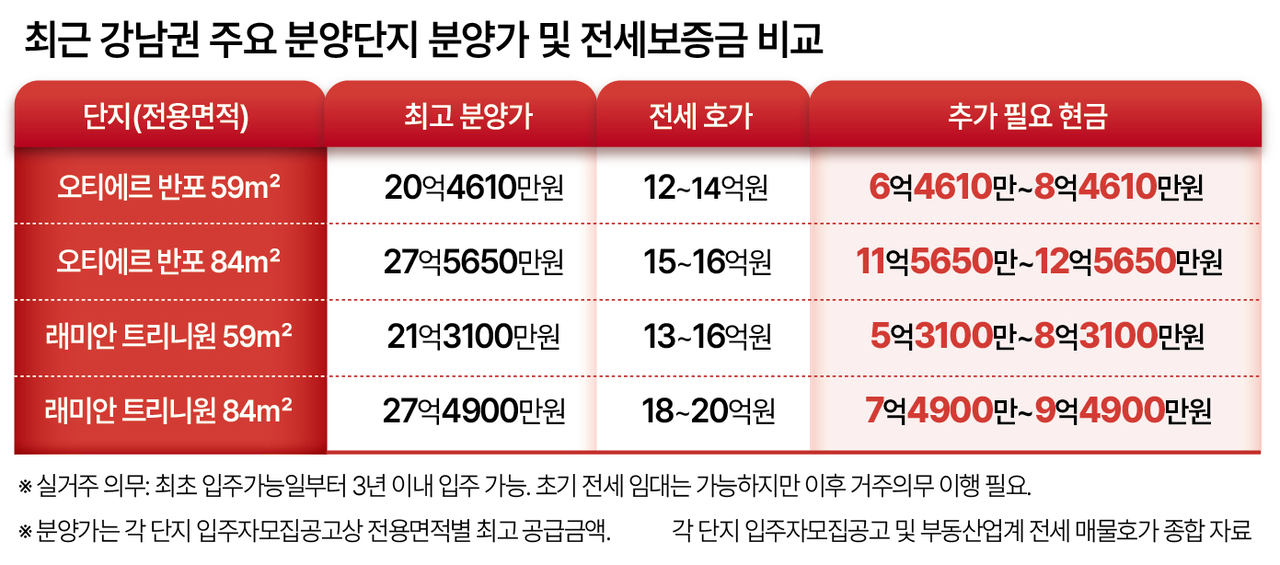
A comparison of pre-sale prices and current jeonse asking prices at two recently sold Banpo developments — Otiere Banpo and Raemian TriniOne — shows that buyers would still need to raise as much as 1.2 billion won ($899,000) on top of the full deposit.
The maximum pre-sale prices for the 84-square-meter units (exclusive use area) at Otiere Banpo in Jamwon-dong, Seocho-gu, and Raemian TriniOne in Banpo-dong were 2.76 billion won and 2.75 billion won, respectively. Both complexes are post-sale apartments subject to the price ceiling on new apartments, launched after the government's Oct. 15 real estate measures last year, with residents moving in in July and August this year. Like DH Banpo 124, they generated strong expectations of market-price gains — but winners had only a short window to raise large sums after being selected.
Residents at both complexes are required to begin living in their units within three years of the earliest available move-in date, meaning winners can initially rent out their units on a jeonse basis and use the deposit to cover the balance. In practice, however, the deposit alone falls well short of the total pre-sale price.
Jeonse asking prices for the 84-square-meter units at Otiere Banpo currently range from about 1.5 billion to 1.6 billion won. Subtracting that from the maximum pre-sale price of 2.76 billion won leaves a gap of roughly 1.16 billion to 1.26 billion won that buyers must cover separately. For the 59-square-meter units, the maximum pre-sale price was 2.05 billion won, while jeonse asking prices range from 1.2 billion to 1.4 billion won — leaving a shortfall of roughly 650 million to 850 million won.
The situation at Raemian TriniOne is similar. The maximum pre-sale price for the 84-square-meter unit was 2.75 billion won; with jeonse asking prices running from 1.8 billion to 2 billion won, buyers face a gap of roughly 750 million to 950 million won. For the 59-square-meter units, the maximum pre-sale price was 2.13 billion won against jeonse asking prices of 1.3 billion to 1.6 billion won, requiring an additional 530 million to 830 million won. These figures are based on a straightforward comparison of maximum pre-sale prices and current jeonse asking prices; actual funding needs will vary depending on floor, orientation and the specific lease terms agreed upon.
Before collecting any jeonse deposit, buyers face another hurdle: both complexes set the down payment at 20 percent of the pre-sale price, meaning winners of an 84-square-meter unit had to produce roughly 550 million won at the contract stage alone.
The post-sale format — which compresses the timeline from subscription to move-in — added further strain. Raemian TriniOne set its move-in schedule roughly 10 months after its recruitment announcement in October last year, while Otiere Banpo did so about four months after its announcement in March this year. Compared with a conventional pre-sale apartment, buyers had far less time to assemble the full amount from down payment to final balance.
Bank lending offered little relief. Under the government's June 27 measures last year, mortgage loans on homes in the greater Seoul area were capped at 600 million won. The Oct. 15 measures tightened the limits further — to 400 million won for homes valued between 1.5 billion and 2.5 billion won, and to 200 million won for homes above 2.5 billion won. With the debt service ratio and other lending regulations also in effect, the amount buyers could actually borrow was often even lower.
Despite these obstacles, the prospect of large gains drew enormous demand. In November last year, Raemian TriniOne drew 54,631 first-round applicants for 230 units, a competition ratio of 237.5 to 1. Otiere Banpo, which went on sale in April this year, attracted 30,540 applicants for 43 units, a ratio of 710.2 to 1.
It is precisely the gap between the expected windfall and the funds needed to secure it that "tenant financing" has moved to fill. Consulting firms targeting the December general pre-sale of DH Banpo 124 are proposing an arrangement in which cash-rich tenants pay above-market jeonse deposits, then collect interest from the winning buyer on the premium amount. The structure mirrors "seller financing" — in which a home seller lends part of the purchase price to the buyer — but applied to the new-sale market, with the tenant stepping in to cover the winner's funding shortfall.
The arrangement has also been shaped by a government ban, introduced under the June 27 measures, on jeonse loans conditioned on a transfer of ownership. That rule blocked the practice of tenants using loan-backed deposits to fund a seller's final balance payment during the ownership transfer process. To use a deposit to cover the balance, a winner now needs a tenant who can pay a large sum without borrowing — making the brokering of cash-rich tenants a service in its own right.
Deferring actual residence does not, however, resolve the financial burden. Winners must pay interest on the additional funds they borrow, and when they eventually move in to fulfill their residency obligation, they must also return the jeonse deposit. Covering the immediate balance is only part of the challenge — a longer-term plan for repaying the deposit and any borrowed funds is equally necessary.
Ko Jun-seok, a professor at Yonsei University's Sangnam School of Management, said apartments subject to the price ceiling on new apartments generate such strong expectations of gain that a "win first, figure out the money later" mentality easily takes hold — even among buyers whose financing plans are not fully in place. "That kind of demand creates fertile ground for a private lending market to form," he said.
Ko added that with household debt approaching 2,000 trillion won, it would be preferable for financial transactions to remain within the regulated system. "If tighter lending restrictions push funding demand outside the institutional framework, it will become harder for financial authorities to monitor and supervise," he said.
quq@heraldcorp.com