20.81 billion won ($15.6 million) allocated for agricultural physical AI project next year
GPS reception problems in mountainous farmland lack concrete fixes
National Assembly budget office urges ministry to flesh out data-use plan
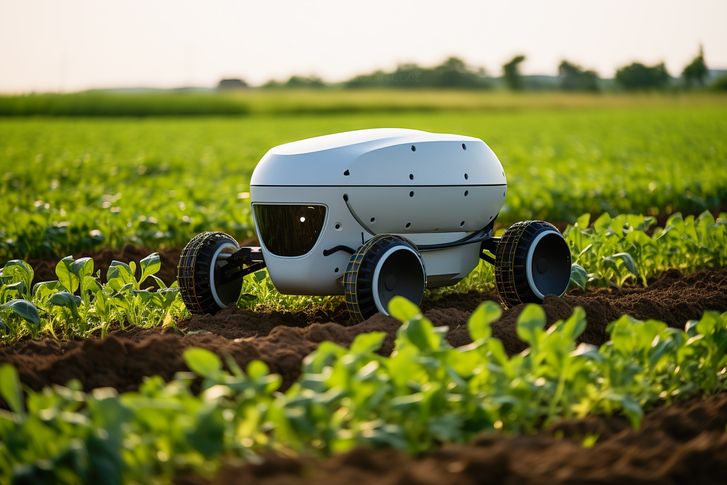
The government plans to spend more than 20.8 billion won ($15.6 million) next year to roll out AI-powered farm machinery and autonomous robots in rural areas, but concrete measures to address the connectivity and GPS reception problems those machines depend on remain largely absent, a budget watchdog has found. The government has also yet to adequately map out how agricultural data generated by the equipment will be collected and used to sharpen AI performance.
According to the National Assembly Budget Office's committee-by-committee analysis of the 2027 budget proposal, the Ministry of Agriculture, Food and Rural Affairs has allocated 20.81 billion won in new funding for next year's "Agricultural Physical AI Demonstration Project."
Physical AI refers to technology that combines artificial intelligence with physical equipment such as farm machinery and robots to carry out tasks in the field. The government envisions deploying it across farming operations, disease prevention and food manufacturing to offset labor shortages and raise productivity.
The project runs from 2027 to 2030, with a total budget of 556.2 billion won — comprising 329.55 billion won in national funds, 205.3 billion won from local governments and 21.35 billion won in private contributions.
The largest share of next year's allocation — 9.76 billion won — goes toward expanding the on-site deployment of AI agricultural robots, supporting partnerships between robotics companies and farms and distributing robots to joint farming cooperatives.
Another 2.25 billion won has been set aside for an AI farm machinery sharing program. The ministry plans to open 15 sharing centers nationwide next year, scaling up to 100 centers by 2030.
Some 7.8 billion won has been earmarked for an integrated farm and regional biosecurity package, covering autonomous disinfection robots, access-control systems and the construction of regional disinfection facilities. An additional 1 billion won will go toward building a physical AI testing environment at the National Food Cluster.
The central concern is rural connectivity. Autonomous farm machinery requires stable access to location data and communications networks to function properly. Yet fields and orchards on hillsides and in mountainous terrain can suffer from weak GPS signals due to topography and tree cover.
The budget office said the Ministry of Agriculture, Food and Rural Affairs had not done enough, at the project site-selection stage, to identify areas with poor connectivity and GPS coverage or to draw up specific plans to address those shortcomings.
Similar agricultural robot demonstration projects have flagged communication and GPS reception failures over multiple years, the office said, underscoring the need to verify on-the-ground operating conditions before distributing equipment.
Data utilization for AI training was also flagged as an unresolved issue. Farm machinery and robots generate a range of data during operations — including travel routes and working conditions — and accumulating and analyzing that data is essential to improving AI performance and adaptability in the field.
Yet according to plans submitted by the ministry, the data collection and utilization framework for the AI farm machinery sharing program is to be reviewed later as needed. Field data from agricultural robots will be collected by participating companies for their own technology development, while a plan for linking that data to public databases is to be worked out at a future date.
The budget office concluded that such arrangements would make it difficult to systematically accumulate and leverage the data produced through the project.
The ministry has separately drawn up an AI transformation data strategy for agriculture and rural areas, which aims to build a foundation for the automatic accumulation of operational data from farm machinery and facility equipment by 2029.
The budget office recommended that "the AI farm machinery distribution project should be linked to that strategy, with measures developed to automatically collect and standardize data, and concrete remedies put in place for areas with inadequate communications infrastructure."
adastra@heraldcorp.com