AI-driven trade seen supporting expansion
Fiscal strains, financial instability pose risks
Korea's semiconductor reliance flagged as vulnerability
The global economy is expected to grow 3.2% next year, buoyed by AI investment and related trade expansion, the Korea Institute for International Economic Policy said Tuesday.
However, the institute cautioned that high interest rates and fiscal pressures in major economies could constrain growth as markets begin to scrutinize the returns on AI investment more closely. It also flagged South Korea's heavy reliance on AI-related industries such as semiconductors as a particular vulnerability, warning that a downturn in the global AI investment cycle could send shockwaves through the broader economy.
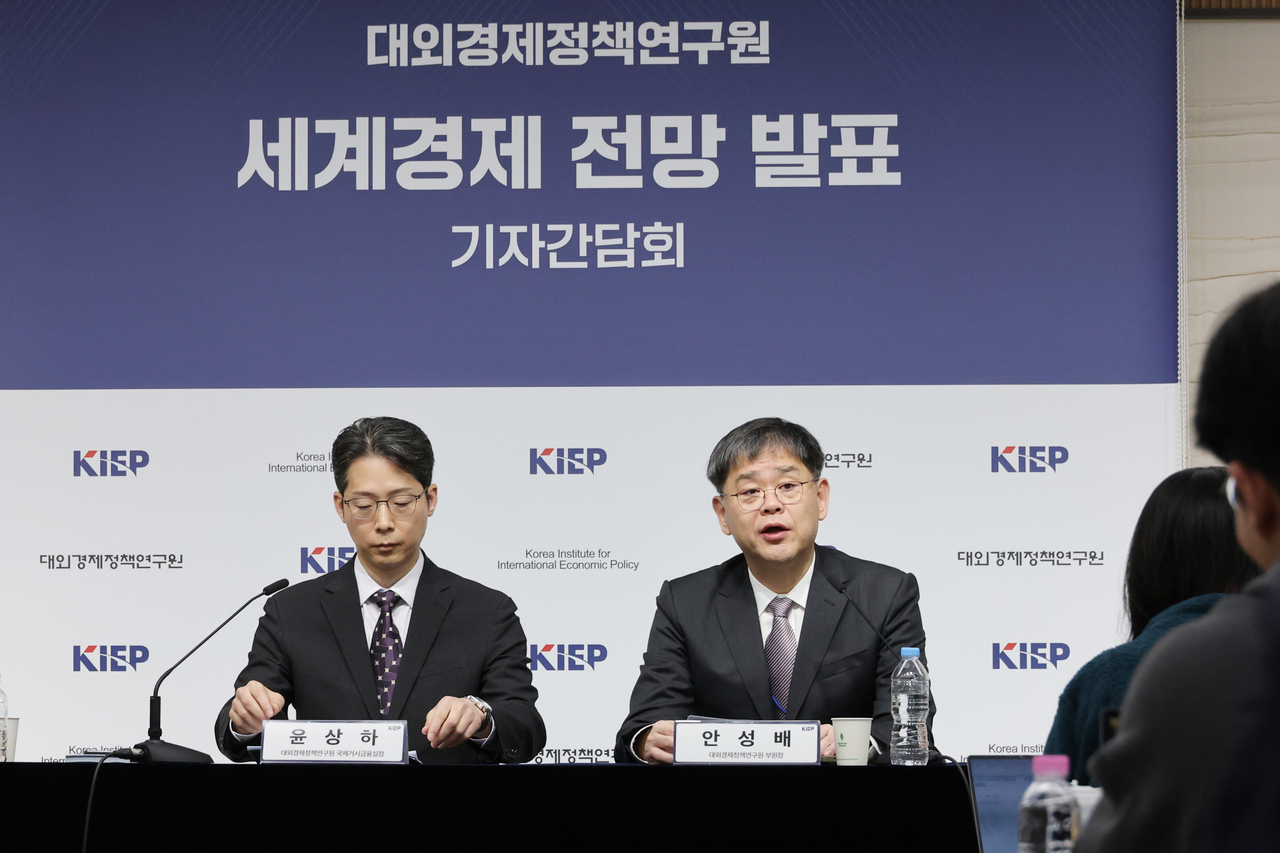
The Korea Institute for International Economic Policy (KIEP) projected global economic growth of 3.2% next year in its "2027 Global Economic Outlook" released Tuesday — 0.1 percentage point higher than its May forecast.
KIEP also revised up its growth estimate for this year by 0.1 percentage point to 3.1%. The institute's projection for next year falls below the IMF's 3.4% forecast but exceeds the OECD's 3.0%.
KIEP summarized the key theme of this outlook as "growth engines under test, costs that persist." While AI-centered investment and trade are sustaining momentum, the institute said whether returns will justify the massive outlays — and whether financing conditions hold — will determine the trajectory of the global economy going forward.
"In extreme terms, you could call it an 'AI one-trick' situation — AI-related trade is having a substantial effect in lifting global growth," said Yoon Sang-ha, head of KIEP's International Macroeconomics and Finance Department. "If you were to exclude that, global growth would have been meaningfully lower."
At the same time, KIEP noted that the expansion of AI investment could amplify downside risks even as it supports global growth.
The institute identified "an AI investment correction and a sharp drop in asset prices" as the top downside risk to the global economy. If AI investment returns fall short of market expectations and technology stock prices decline, it said, data center orders could dry up, slowing global capital expenditure and trade and ultimately dampening household consumption.
Deteriorating fiscal health in major economies and financial market instability were also cited as threats to growth. KIEP warned that mounting fiscal deficits could destabilize government bond supply and demand, pushing up interest rates and tightening credit — squeezing both government spending capacity and private-sector financing conditions.
The institute also listed a renewed escalation of trade friction through tariff hikes and export controls, as well as potential disruptions to key supply chains, among its risk factors.
By country, the United States is forecast to grow 2.1% next year — below this year's projected 2.5%, but still relatively strong among major advanced economies, supported by AI investment and consumer spending.
China, by contrast, is expected to slow from 4.5% this year to 4.2% next year, weighed down by a prolonged slump in its real estate market. KIEP projected next year's growth at 1.2% for the euro area, 0.7% for Japan, 7.0% for India and 5.1% for the five ASEAN nations covered in the report.
KIEP said South Korea is simultaneously positioned to benefit from and be exposed to the risks of expanding AI investment. While rising global AI demand should boost exports of semiconductors and other key products, the institute cautioned that the gains may not translate sufficiently into production, employment and household income across other industries.
Yoon identified South Korea's deep ties to the AI sector as a source of vulnerability. "With uncertainty around AI-related investment rising, any problems that emerge will inevitably hurt not only global growth but South Korea's growth rate as well," Yoon said.
Yoon also expressed concern that overseas assets accumulated by Korean investors — which should act as a buffer through dividend and interest income when the domestic economy falters — are themselves heavily concentrated in big tech, making them susceptible to the same AI cycle.
KIEP added that even if international oil prices fall, the relief on fuel and transportation costs is likely to be limited. With long-term interest rates in major economies having little room to fall further, the institute said improvements in corporate profitability, household purchasing power and domestic financing conditions could all be slow in coming.
y2k@heraldcorp.com