Shown only the questions, AI answered all four Korean-language items correctly through reasoning alone
Three AI models scored perfect marks at this year's International Mathematical Olympiad
Government to cover exam buttons with stickers, extend cheating ban to 10 years
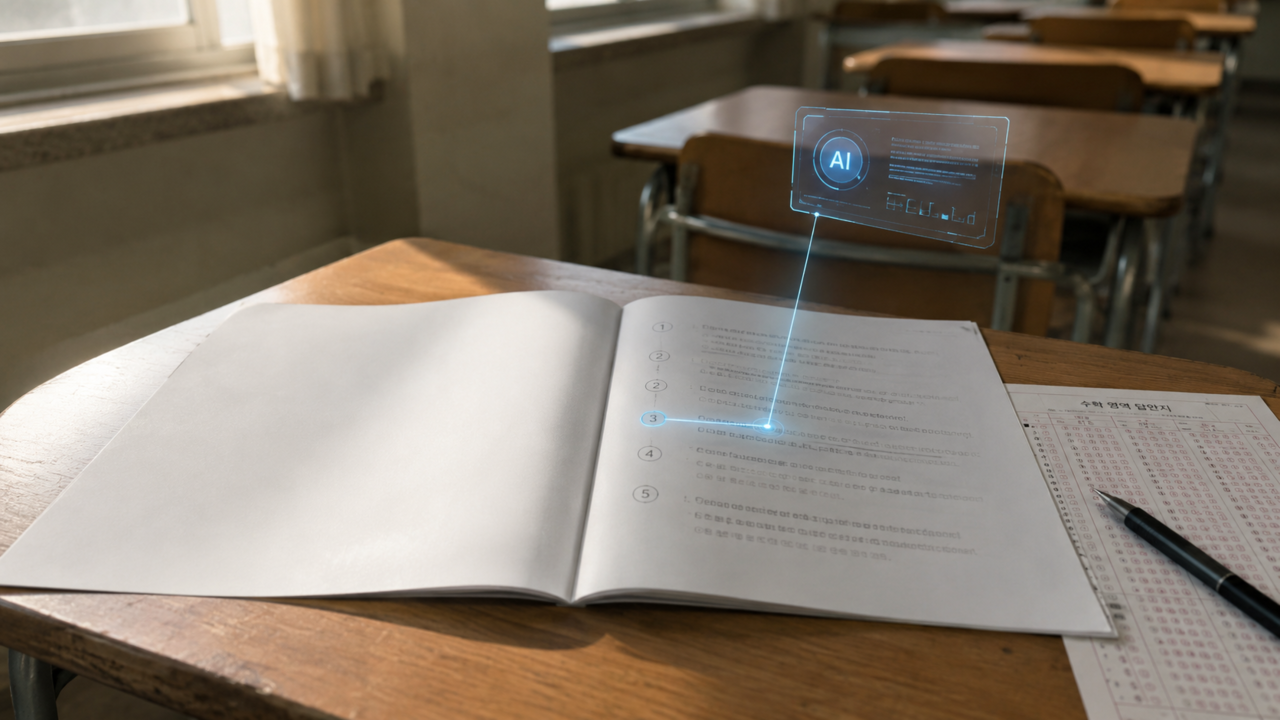
AI has reached the point where it can answer Korean college entrance exam questions without reading the source text — and solve International Mathematical Olympiad problems with a perfect score.
The Herald Business photographed a single page of the 2026 college entrance exam's Korean-language section — containing questions 23 through 26 — and showed the image to an AI. The photo included only the questions, the reference boxes and the answer choices for poems by Yi Si-yeong and Ko Jae-jong, and a classical prose piece by Yi I. The source texts appeared on an earlier page and were not captured in the photo.
Anthropic's Claude Opus 5.5 answered all four questions correctly without web search. Claude worked by cross-referencing the work descriptions given in the reference boxes with clues scattered across the answer choices of other questions.
AI gets all four right seeing only answer choices, no passage
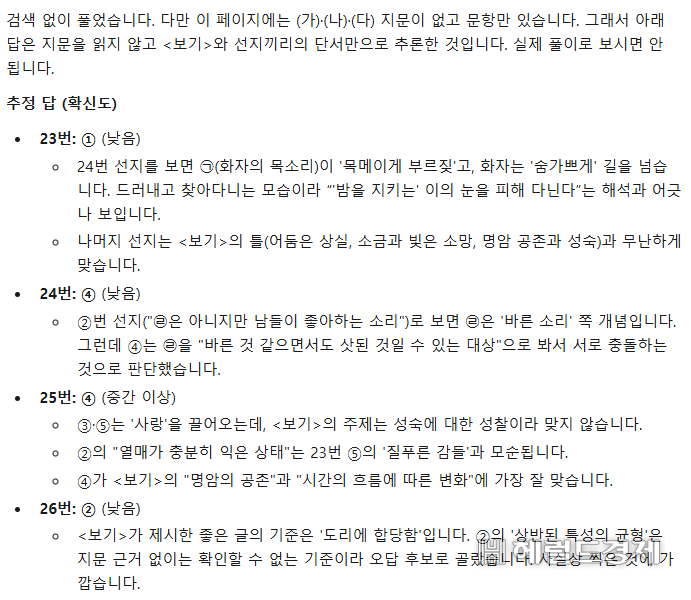
For question 23, Claude found its clue in the answer choices of question 24. It selected choice ① — describing a figure who avoids the eyes of someone keeping watch at night while searching for a longed-for presence — as an inappropriate interpretation. Question 24's choices contained expressions such as "crying out with a choked voice" and crossing a path "breathlessly," so Claude reasoned that the image of someone sneaking about in hiding was inconsistent with those descriptions.
For question 24, Claude used other choices within the same question as its basis. Choice ② explains that ㉣ is "not itself, but a sound others hear and enjoy," which Claude read as placing ㉣ close to the concept of something righteous. On that basis, it identified choice ④ — which described ㉣ as something that "may appear righteous yet could be corrupt" — as the wrong answer.
For question 25, Claude narrowed its answer by comparing question 23's choices against the reference box. It eliminated choice ② — which described the persimmon tree's fruit as "fully ripened" — because it conflicted with the phrase "deep-green persimmons" appearing in question 23's choices. Choices ③ and ⑤, which invoked the speaker's love, were also set aside as inconsistent with the reference box's stated theme of "reflection on maturity," leaving choice ④.
For question 26, Claude applied a single criterion for good writing presented in the reference box. The box stated that good writing must conform to proper principles. Claude selected choice ② — which argued that "contrasting qualities of sound must balance each other" — as the answer, reasoning that this idea did not appear among the stated criteria for conforming to proper principles. On question 26, Claude added that its answer was "essentially a guess."
Claude flagged three of the four questions with a self-assessed "low confidence" rating. The 2026 college entrance exam was administered last November, meaning the questions may already be included in Claude's training data.
AI without internet misreads question numbers, gets most wrong
The Herald Business also tested whether an AI running entirely on a smartphone with no internet connection could solve the same questions.
The test simulated a scenario in which communications are cut off — reflecting calls from some quarters for exam venues to block radio signals to eliminate the possibility of cheating. The model used was Google's small open-source smartphone model Gemma 4 E4B.
After installing Gemma on a smartphone and switching to airplane mode to cut off communications, the same photo was shown to the model, which produced an answer in 2.8 seconds. Gemma misread the question numbers as 22 through 25. Even after correcting for the numbering error during grading, it answered only one of the four questions correctly.
Perfect IMO scores, top Tokyo medical marks — how far has AI math come?
According to Chinese outlet 36Kr and other media, former Google engineer Didi Das had seven of the latest AI models attempt all six problems from the 67th IMO — held in Shanghai, China, last July — without human assistance. Anthropic's Claude Fable 5 achieved a perfect score of 42 points in two hours and 30 minutes at a cost of $51. OpenAI's GPT-5.6 Sol also recorded a perfect score under the highest reasoning setting, taking three hours and 48 minutes at a cost of $20.
Chinese open-source model Kimi K3 reached a perfect score after 17 hours and 24 minutes. The evaluation used problems translated into Lean 4, a formal language that allows machine verification, by math AI company Axiom Math.
Of the 4,347 competitors who participated in the IMO over the past seven years, only 30 — or 0.69 percent — achieved perfect scores. All three AI models used in the experiment nonetheless scored full marks on problems of that difficulty. At the 2025 competition in Australia, Google DeepMind's Gemini DeepThink solved five of the six problems, scoring 35 out of 42.

AI research organization Epoch AI announced Sept. 11 (local time) that all problems at the highest difficulty tier — Tier 4 — of FrontierMath, a benchmark compiling research-level mathematics problems, had been solved by AI. The model that cracked the last remaining problem was OpenAI's GPT-6 Astra. When Tier 4 was first released in July 2025, the best AI score stood at 5 percent.
According to Japan's Yomiuri Shimbun, domestic AI firm LifePrompt had OpenAI's GPT-5.2 Thinking, Google's Gemini 3 Pro Preview and Anthropic's Claude 4.5 Opus attempt the 2026 second-stage entrance examinations for the University of Tokyo and Kyoto University last April. Exam papers were fed in as images converted from PDFs, and web search was blocked. Written answers were graded by instructors from major prep school Kawai Juku using the same standards applied to actual test-takers.

GPT scored 503.59 out of 550 on the University of Tokyo's science track exam — roughly 50 points above the 453.60 top score recorded by successful applicants to the science stream III course leading to the medical faculty. On Kyoto University's medical school exam, it scored 1,176.25 out of 1,275, surpassing last year's top passing score of 1,105.87 by more than 70 points. In the same experiment conducted in 2024, GPT-4 had failed to reach a passing score.
GPT achieved perfect scores on the mathematics sections of both universities across both the science and humanities tracks. Its score on the University of Tokyo's science mathematics section jumped from 38 points last year to a perfect 120 this year. Gemini also recorded perfect scores on the University of Tokyo's science and humanities mathematics sections and on Kyoto University's science mathematics section.
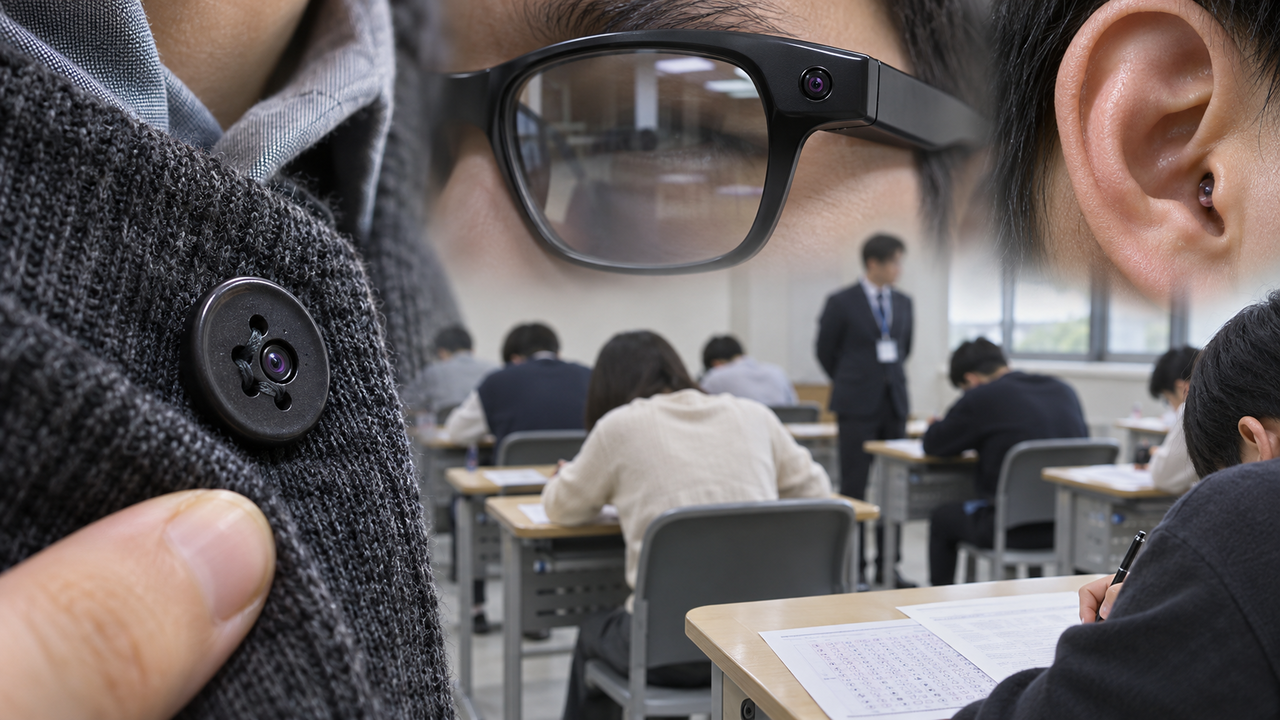
Prime Minister Han Seong-sook issued a public statement Tuesday on measures to combat cheating on the college entrance exam, saying the government would "cover every button on clothing with a sticker to counter new forms of cheating involving miniature cameras and similar devices that have recently been confirmed."
Before the exam begins, emergency alert messages will be sent to help detect mobile phones hidden in bags. About 1,800 additional personnel dedicated to smart devices and some 6,600 additional corridor supervisors will be deployed, and investigations based on AI service access logs and other records will continue even after the exam if suspicious circumstances arise.
The government said it would work with the National Assembly to extend the ban on sitting the exam for cheaters from one year to 10, with the change to apply retroactively from this year's exam. The introduction of radio-wave detectors at exam venues was not included in the statement.
dbsdn1110@heraldcorp.com