"His language builds no walls. It builds bridges — from language to language, from culture to culture, and from heart to heart."
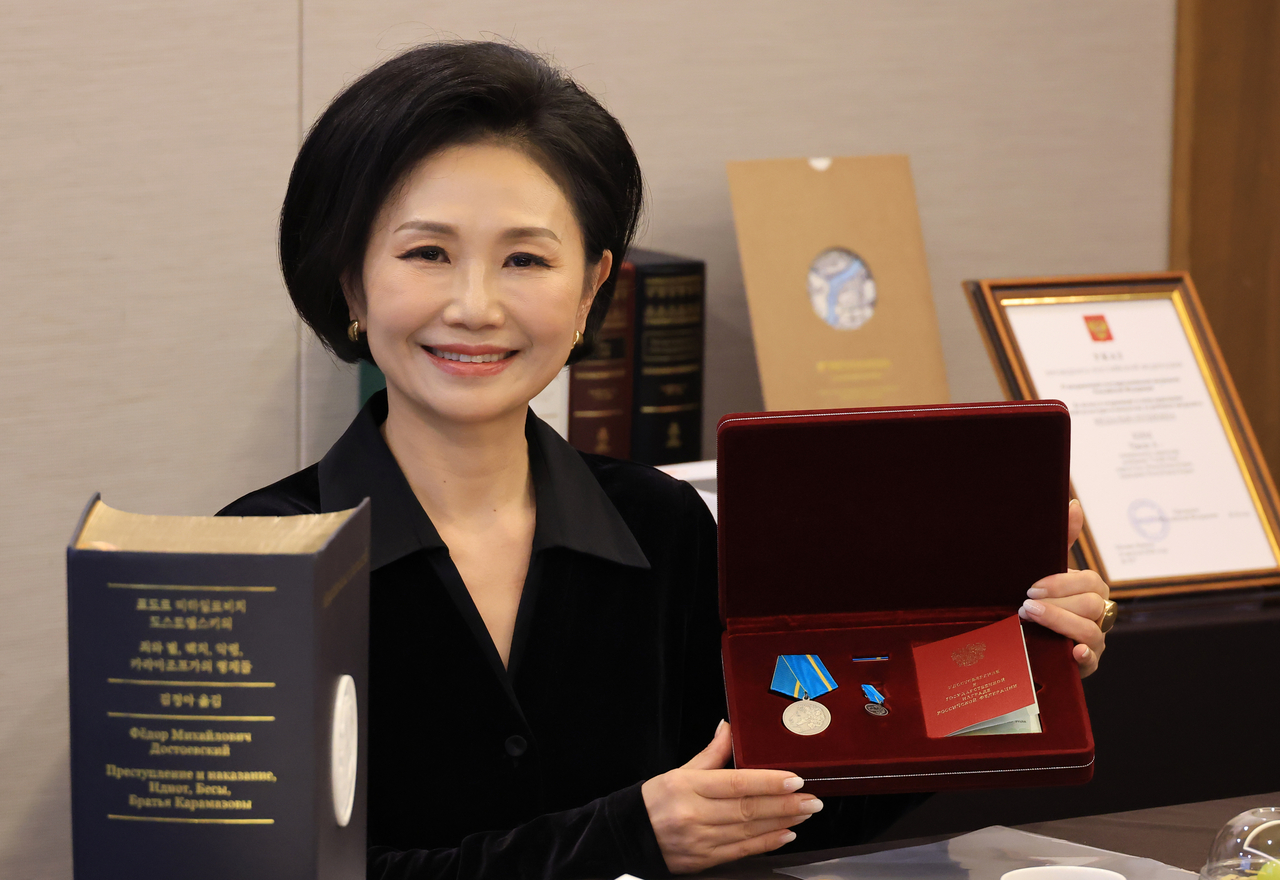
Kim Jeong-a, 57, who received the Pushkin Medal for her complete solo translation of the four major novels of Russian literary giant Fyodor Dostoevsky (1821–1881), made the remarks Tuesday at a press conference at the Korea Press Center in Jung-gu, Seoul. "In a world where walls between nations grow higher and differing beliefs drive people apart, we need literature now more than ever," she said.
Kim received the medal from Russian President Vladimir Putin at the Yekaterina Hall of the Moscow Kremlin on Nov. 4 (local time), in recognition of her achievement as the first Korean to produce a complete solo translation of Dostoevsky's four major novels: "Crime and Punishment," "The Idiot," "Demons" and "The Brothers Karamazov."
Established in 1999, the Pushkin Medal is a state decoration awarded to individuals who have made outstanding contributions to the promotion of Russian culture, the arts and the humanities, as well as to cultural exchange between nations.
It is considered highly unusual for a national of a country designated by Russia as "unfriendly" — or adversarial — to receive the Pushkin Medal.
Kim graduated from the Department of Russian Language and Literature at Seoul National University and its graduate school, then earned a doctorate in Slavic languages and literature from the University of Illinois.
Kim also serves as the head of fashion label Space Null. She devoted a full decade to translating the four novels, producing more than 6,700 pages of translated text.
Kim also shared behind-the-scenes details of the award ceremony.
"About a week before the ceremony, at around 10:45 on a Friday night, I got a call telling me to buy a plane ticket to Russia," she said, describing the event as having unfolded "like a scene from a spy thriller." The secrecy was due to assassination threats against Putin stemming from the Russia-Ukraine war.
Kim smiled as she described Putin, who personally presented her with the medal and shook her hand, as "just a warm-handed ajeossi" — an ordinary, friendly older man.
Kim also said she had sent Putin a combined Korean-language edition of the four novels through the embassy in advance, and that she received a reply saying it was "a great honor to have such a beautiful book made in Korea."
She added that reactions in Russia to her translation had been striking. "Many people were amazed that someone who had never lived in Russia could capture 19th-century Russia with such delicacy," she said.
Kim also acknowledged that the award had at times made her feel personally threatened.
"A far-right Ukrainian extremist group registered me as a 'pro-Russia figure' because of the Pushkin Medal, so now I cannot even travel to Ukraine," she said, drawing a clear line between her literary work and any political affiliation. "I simply love Dostoevsky. I am not a politician — I am just a humanities scholar."
Reflecting on the significance of the award, Kim said she felt it may have been Russia's way of reaching out. "In a place where political dialogue between Russia and Korea has broken down and economic exchange has come to a halt, I thought perhaps this was a friendly gesture — a signal that cultural exchange is still something they want," she said.
In her acceptance remarks, Kim said she was certain that "translation is the most peaceful form of diplomacy." She added: "A single book crosses a border, a writer's soul is reborn in a foreign language, and people who have never met in their lives can laugh and cry together over the same sentence. That, to me, is the miracle of literature."
Kim said her favorite among the four novels is "The Idiot," citing its emphasis on the importance of compassion.
She said the novel's two greatest propositions are "Beauty will save the world" and "Compassion is the only law of human existence."
Kim explained that "beauty" in this context refers to Jesus Christ in his most perfect form, and that Christ, through compassion for humanity, was crucified as an act of atonement.
"To say that beauty will save the world is to say that compassion will save the world," Kim said. "Without compassion, one is not truly human. A humanity without compassion can only move toward extinction."
husn7@heraldcorp.com