Korea Tech holds forum marking 35th anniversary, calling for AI-native overhaul of employment services and lifelong vocational education; full AI curriculum transition for instructors set for 2027
As AI reshapes industries and labor markets at an accelerating pace, experts are calling for a fundamental overhaul of vocational training — moving away from occupation-based frameworks toward systems built around specific tasks and competencies. With AI now capable of handling not just routine work but also job design and outcome verification, they argue that both vocational training and employment services must be redesigned from the ground up.
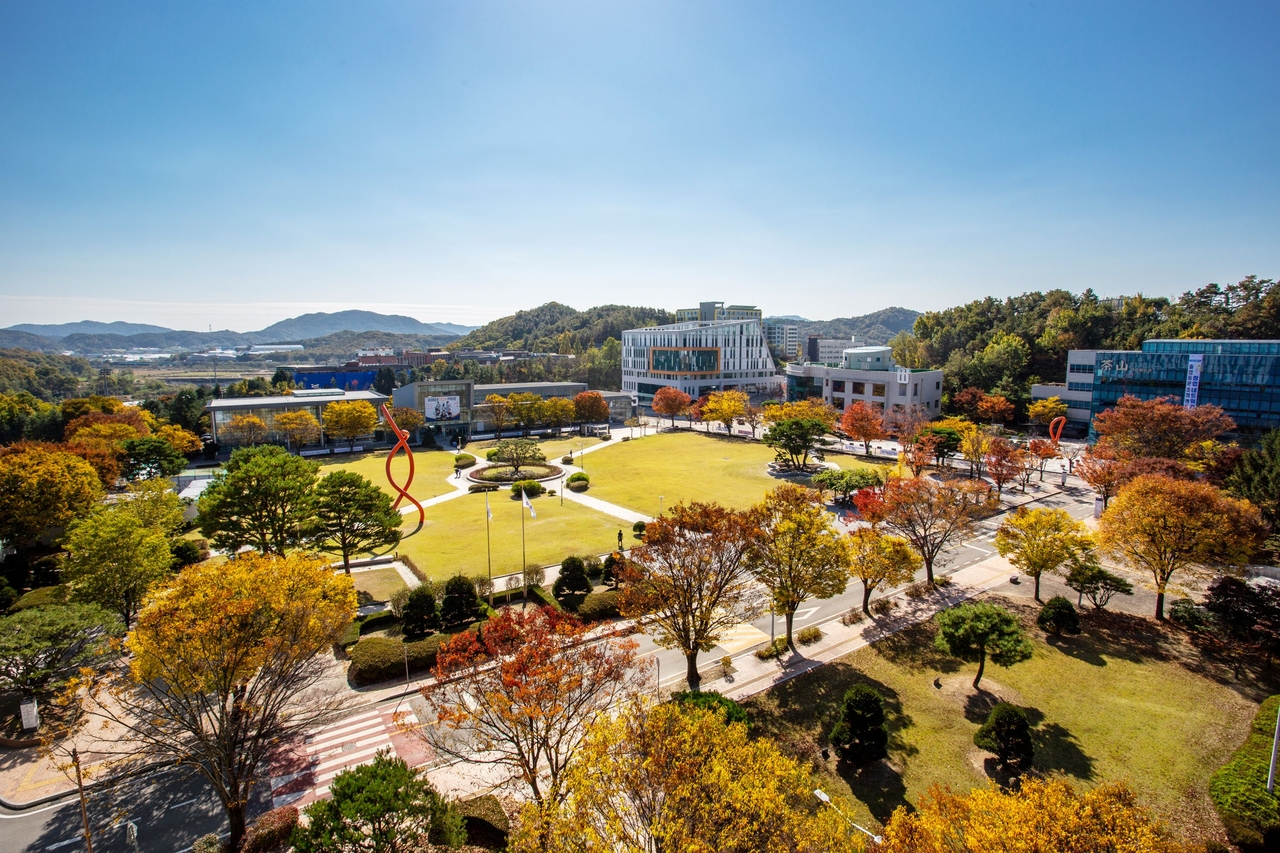
Korea University of Technology and Education, known as Korea Tech, held the "35th Anniversary Forum on Employment and Lifelong Vocational Competency Development" on Wednesday at the Hybrid Sky Hall of its Dadam Future Learning Center on campus, drawing about 120 participants including specialists in employment and lifelong vocational education, representatives from related institutions, and faculty.
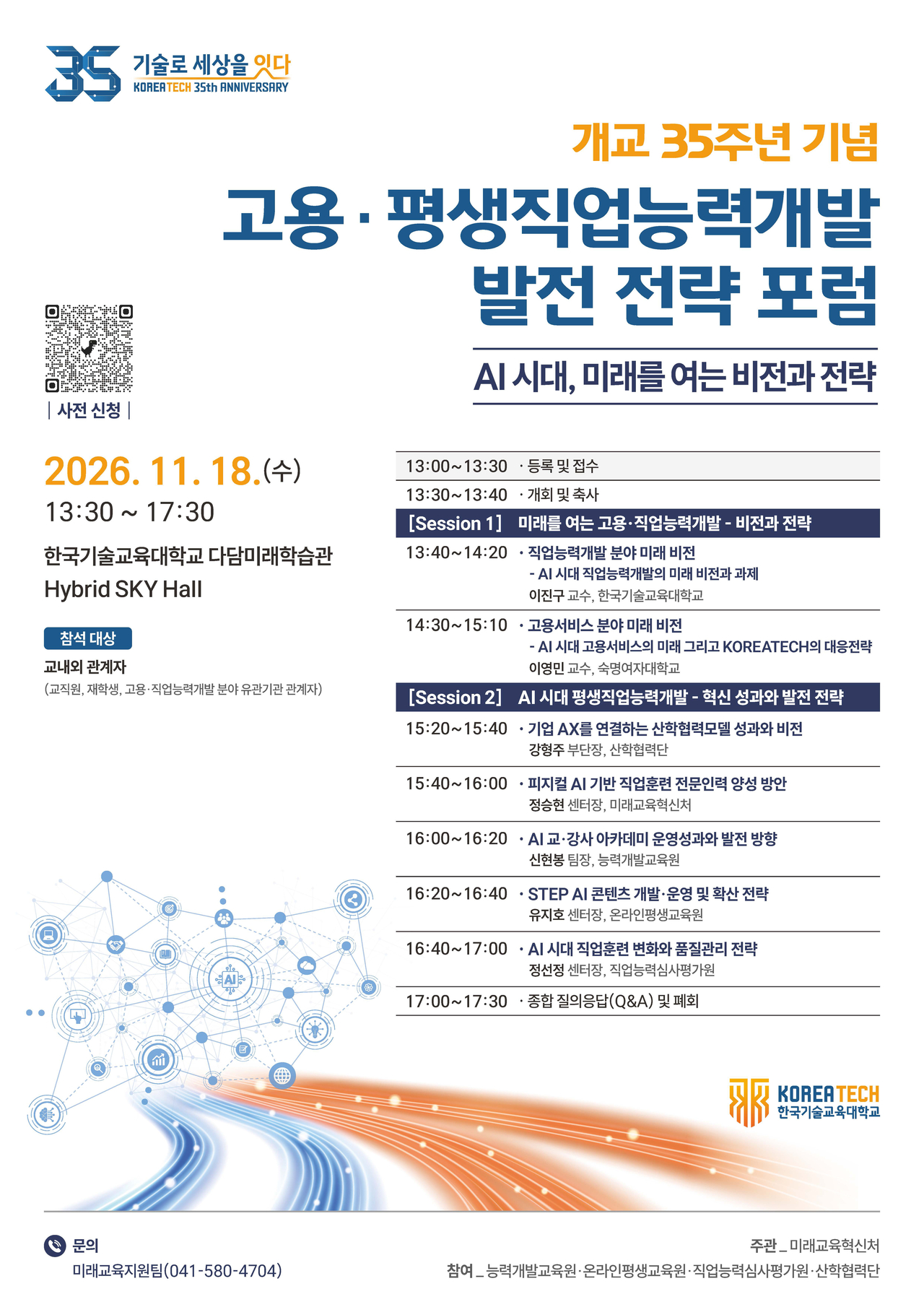
The forum was part of a month-long series of AI and future education innovation events Korea Tech organized to mark its 35th anniversary. It followed an AI convergence forum held Nov. 4 with universities and businesses from the Chungcheong region, and focused on strategies for applying AI across vocational competency development and employment services.
The forum ran in two sessions: "Employment and Vocational Competency Development for the Future — Vision and Strategy" and "Lifelong Vocational Competency Development in the AI Era — Innovation Outcomes and Development Strategies."
In the first session, Lee Jin-gu, a professor at Korea Tech, delivered the keynote address on the future vision and challenges of vocational competency development in the AI era.
Lee diagnosed a complex set of structural pressures — digital, AI and energy transitions, an ultra-low birth rate and rapidly aging population, and a wide gap in training participation between large and small companies. Training participation rates stood at 53.2 percent for large companies and just 5.8 percent for small and medium-sized enterprises, and 68.5 percent of vocational training is concentrated in the Greater Seoul area, Lee said.
Lee said vocational training in the AI era must move beyond the conventional focus on job titles and instead reorganize training units around tasks, skills and workflow.
To that end, Lee said "agent literacy" — the ability to oversee job design and outcome verification rather than simply entering commands — and work-integrated, field-centered learning would be essential.
Lee also proposed three paradigm shifts: from a supply-driven model to one centered on the needs of companies and individuals; from credential-based assessment to real competency certification; and from fragmented operations to an integrated ecosystem linking careers, training, qualifications and employment.
For Korea Tech specifically, Lee proposed a three-way collaborative platform connecting the university's Competency Development Education Institute, its online lifelong education center and its Vocational Competency Assessment and Evaluation Institute — a system designed to link demand identification, content development, instructor training, and quality and outcome feedback into a single coherent framework.
Lee Young-min, a professor at Sookmyung Women's University, then presented on the future of employment services in the AI era and Korea Tech's response strategies.
Lee said the labor market faces a structural shock in which 94 percent of jobs are concentrated in sectors with high AI exposure, compounded by entrenched low growth, the transition to a super-aged society and a shrinking youth population.
In response, Lee proposed a shift to third-generation "AI-native employment services" — a model that goes beyond simply digitizing web portals and instead redesigns the entire service process on the premise of AI integration.
The second session featured presentations from five Korea Tech institutions on their AI-era vocational training innovations and development strategies.
The Industry-Academia Cooperation Foundation presented a model linking a joint training center and an AI transformation demonstration center in Cheonan, South Chungcheong Province, an industry-academia innovation park, and AI-focused local government projects — all aimed at supporting companies' AI transformation.
Project-based learning outcomes were also showcased, including vision AI and closed-network local large language model deployment by Ensquare, an in-house lightweight fire prediction model and patent application by LDT, and a semiconductor process data integration and specialized chatbot built by TSE.
The Future Education Innovation Office presented a Korea Tech-style instructor training framework designed to prepare educators for the physical AI era, in which robots and industrial equipment play a central role.
Focused on manufacturing and robotics, the framework establishes a four-level competency structure — basic hands-on practice, virtual environment learning, integrated real-equipment practice, and new hands-on curriculum development — and plans to expand training linking smart factories, digital twins, collaborative robots, autonomous driving and press processes.
The Competency Development Education Institute reported on the outcomes and future direction of its AI instructor academy. The institute has built a three-track system covering AI understanding and application, competency enhancement, and occupational transition, along with a three-stage competency framework spanning basic, pedagogical and occupational AI. It has also refined an agile curriculum development and delivery system that significantly shortens course development timelines.
Starting in 2027, the institute plans to convert all instructor training programs to AI-based education and establish a national standard for training specialist instructors who can lead AI transformation in industry.
The Online Lifelong Education Institute presented a content portfolio spanning AI literacy to job- and industry-specific AI transformation courses, along with a tailored distribution framework for platforms run by other government ministries, local governments and related institutions.
In March 2027, the institute plans to officially launch an "AI learning assistant" supporting personalized learning, and will link formal education with lifelong vocational competency development through a content coordination body connecting its STEP for KOREATECH platform with other campus institutions.
The Vocational Competency Assessment and Evaluation Institute presented a training quality innovation strategy aligned with the newly established K-Digital Training AI Campus, which reflects the government's push to expand AI convergence training across all industries and occupations.
The institute outlined five strategic pillars: refining institution-level competency assessment, strengthening meaningful corporate participation, advancing pedagogical innovation, shifting to outcome-centered quality management, and supporting institutional innovation capacity — all aimed at reinforcing field-oriented, practical competency training.
Korea Tech President Yoo Gil-sang said the university has contributed to national human resource development over the past 35 years through field-centered technical education and vocational competency development. "As the AI era demands new changes in vocational training and employment services, we will use this forum as an opportunity to share our innovation outcomes and strengthen our role as a hub university leading the future of lifelong vocational competency development," Yoo said.
Meanwhile, Korea Tech will hold its 2026 Edu-Festa from Tuesday through Dec. 3, sharing new project-based learning courses and outstanding student learning outcome cases.
fact0514@heraldcorp.com