Legislation should go beyond 'construction promotion' to cover full lifecycle, experts say
Thorough pre-review must come before speed, military writer warns
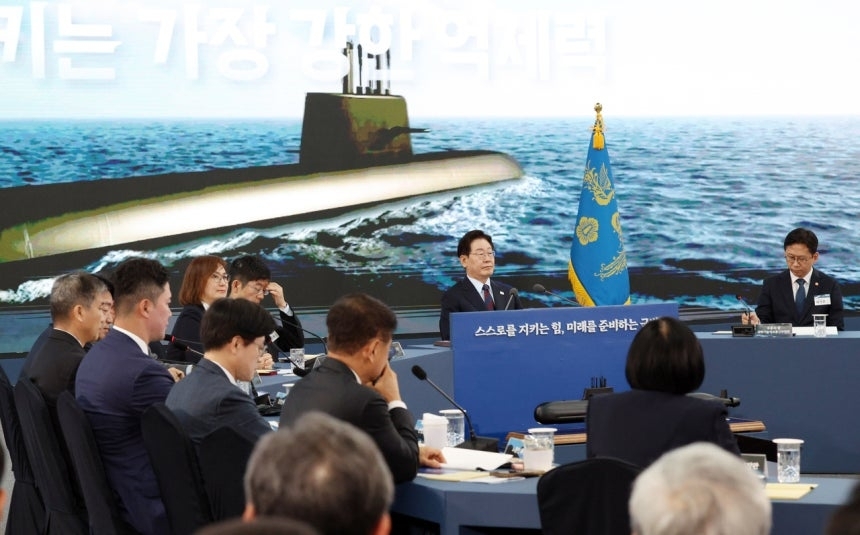
A public hearing on special legislation for nuclear-powered submarines, hosted by the National Assembly's Defense Committee, drew calls Wednesday for a dedicated command structure operating directly under Cheong Wa Dae.
Yoon Jeong-sang, vice chairman of the Korea Submarine League, told the hearing that the program requires either direct presidential oversight or a working group led by the presidential office's national security chief. "Only that kind of structure can immediately resolve cross-ministry disagreements and mobilize the full capacity of the state," Yoon said.
Yoon said acquiring a nuclear submarine is not simply a matter of procuring a single weapon, but is directly tied to the highest levels of state governance — including renegotiating the South Korea-US nuclear cooperation agreement and conducting negotiations with the International Atomic Energy Agency. "It would be difficult for an office at the prime minister level to exercise strong coordination over the Ministry of Economy and Finance, the Ministry of Foreign Affairs, the Ministry of Science and ICT, the Ministry of Trade, Industry and Energy, the Ministry of Climate, Energy and Environment, the Ministry of National Defense and the military," Yoon said.
Moon Geun-sik, a special professor at Hanyang University's Graduate School of Public Policy, also said the integrated organization should ideally report directly to the presidential office, or at minimum be placed under the prime minister to allow it to mediate disagreements between ministries.
Moon also stressed the need for a dedicated special account to fund long-term investment. "Projects such as reactor development and the construction of test facilities must continue regardless of changes in administration or military leadership," Moon said. "Relying entirely on the defense budget risks intensifying budget disputes among the Army, Navy and Air Force — and within branches of the Navy itself — and could delay the program."
Jeong Seong-jang, vice president of the Sejong Institute, said the special legislation should go beyond being a "construction promotion law" and become a "national responsibility law covering the full lifecycle."
"The state's responsibility for the entire lifecycle of a nuclear submarine must be made explicit — from research and development through decommissioning and dismantlement to the long-term management of spent nuclear fuel, all connected as a single system," Jeong said. "The current bill still has gaps between its stages."
Yoo Guk-hee, an endowed professor of energy engineering at Dankook University, emphasized the importance of proper safety regulations for nuclear submarines.
"Radiation poses dangers that our five senses cannot detect, which is why it must be strictly controlled and managed," Yoo said. "Safety must be an absolute prerequisite for any use of nuclear energy, and nuclear submarines are no exception."
Military writer Lee Jong-seon said the depth of verification, not speed, must be the top priority for a program on which the nation's fate hinges. "To avoid passing an unbearable burden to future generations, what is needed now is not a race against time but a calm and thorough pre-review," Lee said.
youknow@heraldcorp.com