Retirement savings built for tax efficiency may raise health insurance costs
Private pensions could push retirees off dependent coverage
Losing dependent status adds property-based premiums too
Draw from IRP before national pension kicks in — keep income below 20 million won
Low-coupon bonds and tax-exempt insurance also worth considering
We are all prospective retirees — are you prepared? Life after retirement should be richer than ever. Explore content on retirement planning for everyone in our series on useful insights for prospective retirees.

Concerns are spreading among prospective retirees that financial products chosen for their tax benefits could end up raising their national health insurance premiums after retirement. The worry stems from proposals — not yet finalized — to extend premium assessments to some separately taxed income that has until now been excluded from the calculation.
An analysis conducted with advice from tax professionals found that the burden would not stop at premiums on additional income. If private pension income is factored into the criteria for dependent coverage, some retirees could lose that status and be reclassified as individually enrolled subscribers, facing higher premiums — and potentially an additional levy based on the assets they hold.
Experts say the policy design must be handled carefully to avoid turning retirement savings built for tax efficiency and stable living expenses into a variable that increases insurance costs.
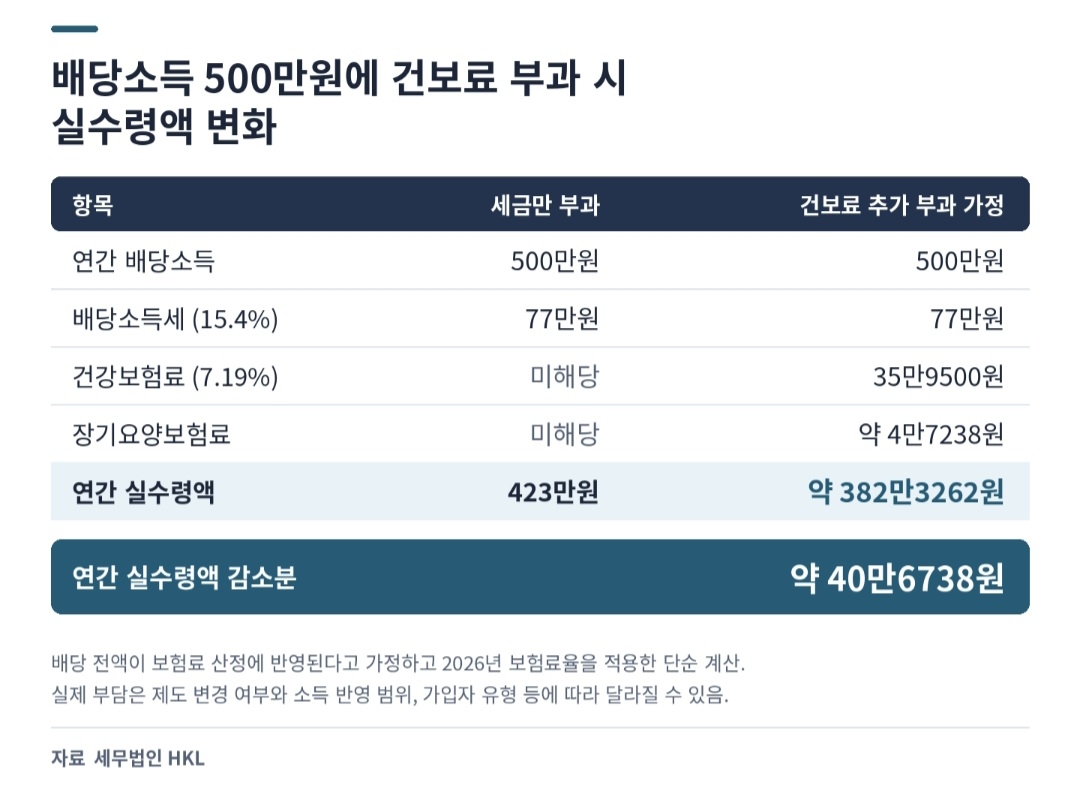
Assuming the proposed change takes effect, a calculation by tax firm HKL found that if national health insurance premiums were assessed on the full 5 million won ($3,730) in annual dividend income, the net amount received would fall by about 410,000 won compared with paying tax alone. Applying only the 15.4 percent dividend income tax rate leaves 4.23 million won after 770,000 won in tax. Once health insurance premiums are factored in, that figure drops to about 3.82 million won — because the subscriber would also owe 359,500 won in health insurance premiums and about 47,238 won in long-term care insurance premiums under the 2026 premium rate. The actual burden will vary depending on the scope of income included and the type of subscriber.
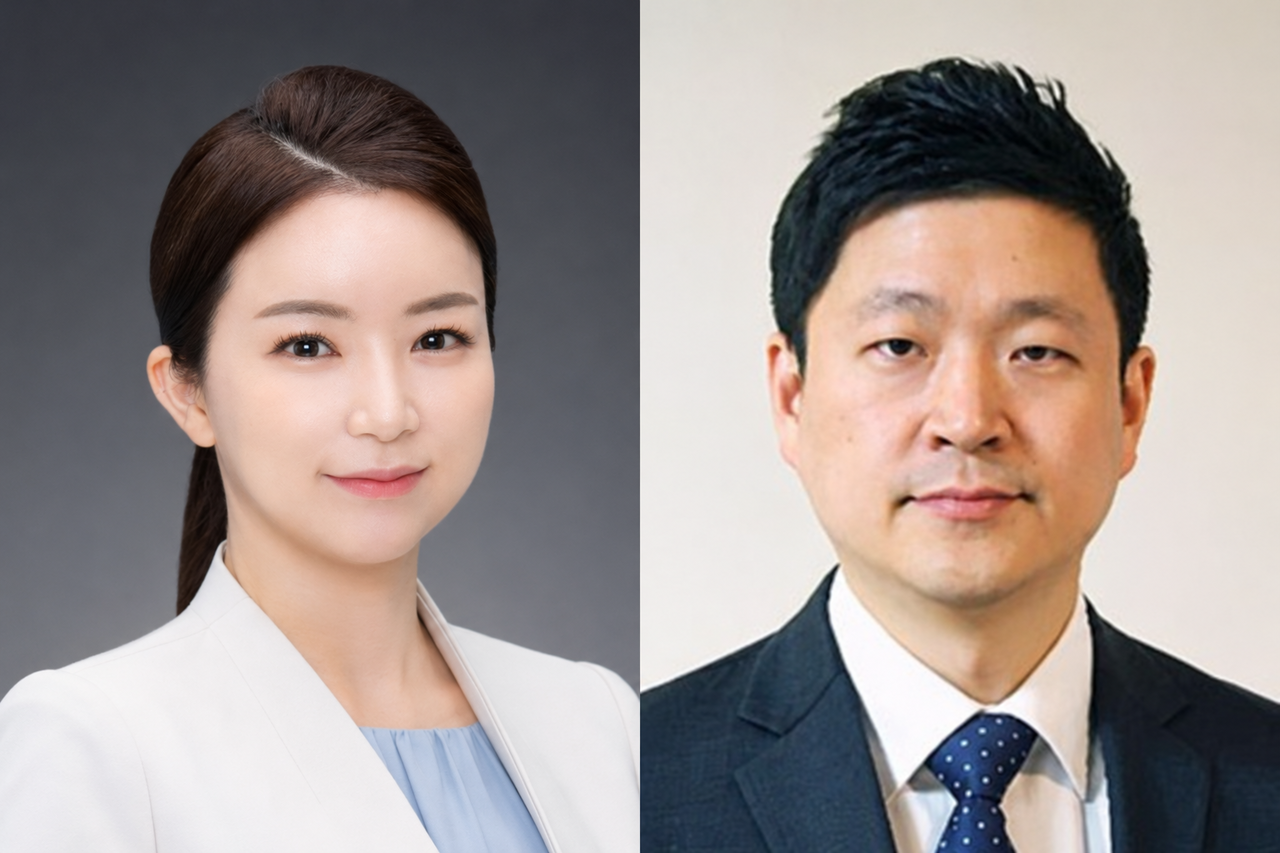
Kim Hye-ri, a certified tax accountant and head of HKL who previously served as a National Tax Service investigation team leader, said that if premiums are imposed on separately taxed income, "the way people compare tax-advantaged accounts and high-dividend products will inevitably have to change — it won't be enough to look at taxes alone." Kim added that retirees in particular could find retirement fund management considerably more complicated, as the timing and amount of pension withdrawals would affect their insurance burden as well.
Earlier, the National Health Insurance Service presented "pursuing premium assessment on non-assessed (separately taxed) income" as a key task in its work report to the National Assembly's Health and Welfare Committee national audit last month. Currently, premiums are assessed on a limited range of income, including rental income below 20 million won a year and financial income exceeding 10 million won annually. A substantial portion of separately taxed income — which is not aggregated into comprehensive income under tax law — remains exempt from premium assessment.
If the scope of assessment is expanded, investment returns from ISA accounts, individual investment bonds and shares in high-dividend companies could also become subject to premiums. However, the Ministry of Health and Welfare said "whether to impose premiums on separately taxed income has not been specifically reviewed or decided."
For retirees, the bigger anxiety is losing dependent coverage status.
If private pension income is eventually included in the income criteria for dependent status, retirees receiving multiple pension streams simultaneously could exceed the income threshold and lose their eligibility. Dependents must have combined annual income of no more than 20 million won, and currently only public pension income counts toward that figure. Should a future policy overhaul add private pensions such as individual retirement pension (IRP) and pension savings accounts to the calculation, retirees registered as dependents under a working child's coverage could be reclassified as individually enrolled subscribers and face higher premiums.
For retirees, whether they lose dependent status and are reclassified as individual subscribers can matter more than the premium rate itself. Consider a retiree receiving 18 million won a year from the national pension and financial income, who then begins drawing an additional 6 million won from a private pension. If private pension income is fully counted toward the dependent income threshold, combined income would reach 24 million won — exceeding the current annual ceiling of 20 million won.
Assuming the full 24 million won in income is reflected in the premium calculation after reclassification as an individually enrolled subscriber, the monthly health insurance premium under the 2026 rate would be 143,800 won. Adding long-term care insurance, the monthly burden would come to about 162,695 won. This is a simplified estimate that does not apply the current 50 percent income reflection rate for public pensions, instead treating the full amount as assessable.
Retirees should also be aware that property-based premiums could add to the burden. For example, if the property tax base for a home is 230 million won with no other assets or additional deductions, a property assessment score of 490 points would be applied to the amount after subtracting the 100 million won basic deduction. At 211.5 won per point, that adds about 104,000 won a month in health insurance premiums. Including long-term care insurance, the additional monthly burden from property alone would be about 117,000 won.
Kim said that because premiums after losing dependent status vary by household income and assets, "it is necessary to check in advance of retirement — for example through the insurance service's simulation tool."
Jung Jin-hyung, a certified public accountant with KB Kookmin Bank's Star Advisory Group, said the strategy of using the "income gap period" before national pension payments begin will become increasingly important. The approach involves drawing down retirement pay and private pension funds during that window first, then calibrating private pension withdrawals after the national pension kicks in — taking into account the fixed national pension income alongside other earnings.
For example, a retiree surnamed Kim who draws 19.5 million won a year from an IRP between ages 60 and 64 for living expenses, then receives 15 million won from the national pension and 4.5 million won from a pension savings account from age 65, can keep total annual receipts at 19.5 million won. Even if private pension income is eventually counted in full toward the dependent income threshold, combined income could remain below the current annual ceiling of 20 million won — provided there is no other income.
Experts also suggested covering part of living expenses with pension account contributions that did not receive a tax credit, tax-exempt insurance proceeds, or the tax-exempt portion of ISA withdrawals — sources that are not counted as income — to spread the burden of pension withdrawals. Jung said retirees "may also want to consider building pension assets separately in each spouse's name before retirement, to distribute the income received."
Advisers also recommend drawing up a cash flow statement covering projected income and expenditure over the next three years. The first step is to identify the income category and tax timing for each product and to check the income reflection criteria and timing under one's own type of health insurance enrollment. From there, the process involves recording deposit interest payment dates, dividend payment months and public pension amounts, securing living expenses and emergency funds, and then adjusting deposit maturities and private pension withdrawal amounts accordingly.
Kim said retirees should "pay particular attention to when deposit interest is paid — not just when the principal matures — and factor in the time lag before income is actually reflected in health insurance premiums."
Jung said that if the premium assessment scope expands to cover separately taxed income, capital-gain-oriented assets are likely to attract more attention than portfolios centered on interest and dividends. "Income recognized as 'earnings' — such as dividends or interest — can trigger the health insurance threshold no matter how low the tax rate," Jung said, emphasizing a portfolio approach centered on capital-gain assets.
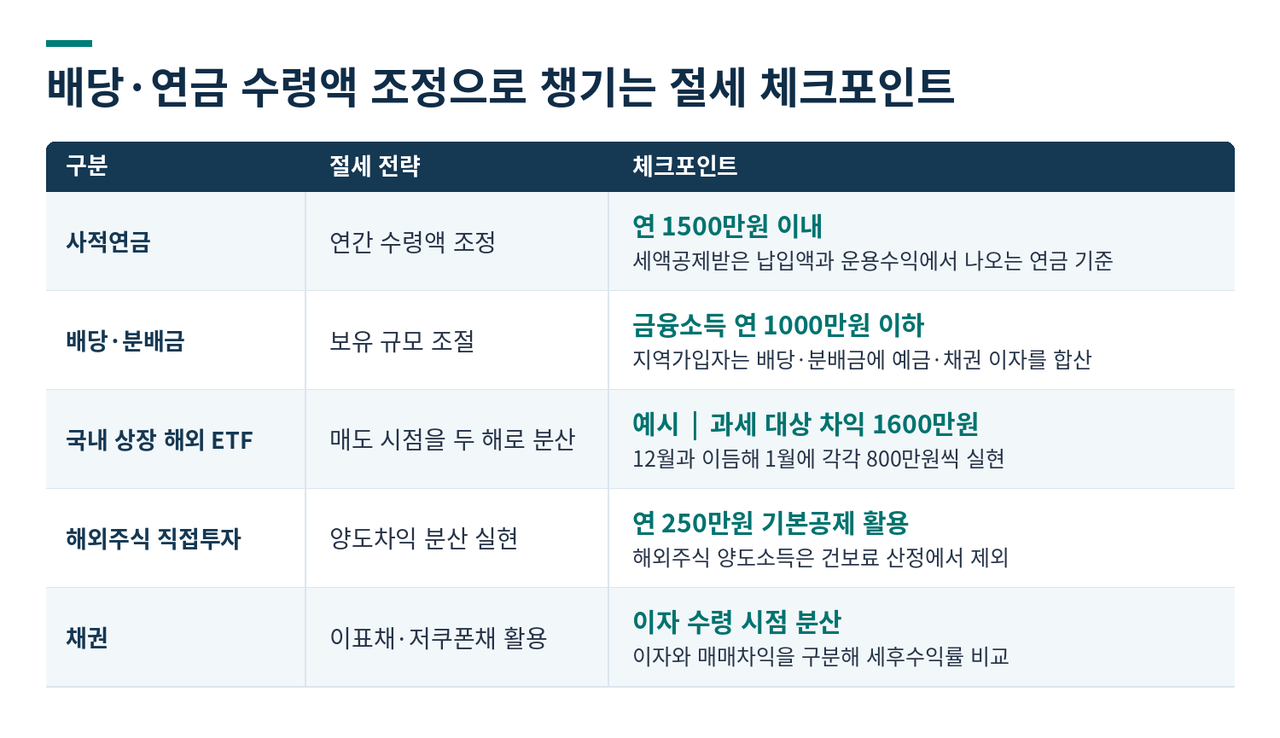
Splitting the timing of sales is another option. If taxable gains from a domestically listed overseas ETF are expected to reach 16 million won, selling in December and the following January allows 8 million won to be realized in each calendar year. Even then, other interest and dividend income received in each year must be added to check whether total financial income exceeds 10 million won. For direct investments in overseas equities, spreading capital gains realizations across years allows use of the annual basic deduction of 2.5 million won. Capital gains from overseas equities are excluded from health insurance premium calculations.
For bonds, using coupon-bearing bonds instead of products that pay all interest at maturity can spread out the timing of interest receipts. When considering low-coupon bonds, it is advisable to examine both the face rate and the purchase price to distinguish between taxable interest and capital gains, and to compare after-tax yields. Because individual bond trading and redemption gains are generally tax-exempt, this approach can reduce the proportion of taxable coupon interest.
Savings-type insurance products can serve as a source of funds that reduces the health insurance burden, as the insurance gain is tax-exempt when certain conditions are met — most notably paying monthly premiums of no more than 1.5 million won for at least five years and maintaining the policy for at least 10 years, or making a lump-sum premium payment of no more than 100 million won and holding the policy for at least 10 years. However, the specific tax-exemption conditions should be verified, and administrative costs, mid-term surrender values and the period during which funds are locked up must all be weighed together.
forest@heraldcorp.com