Historic meeting on sidelines of APEC in Shenzhen; joint statement still being finalized
Nuclear arms control, AI military use on agenda; Ukraine war inclusion uncertain
US-China bilateral to cover tariffs, rare earths, semiconductor curbs
Trump-Kim surprise meeting possible, but Rubio says nothing confirmed
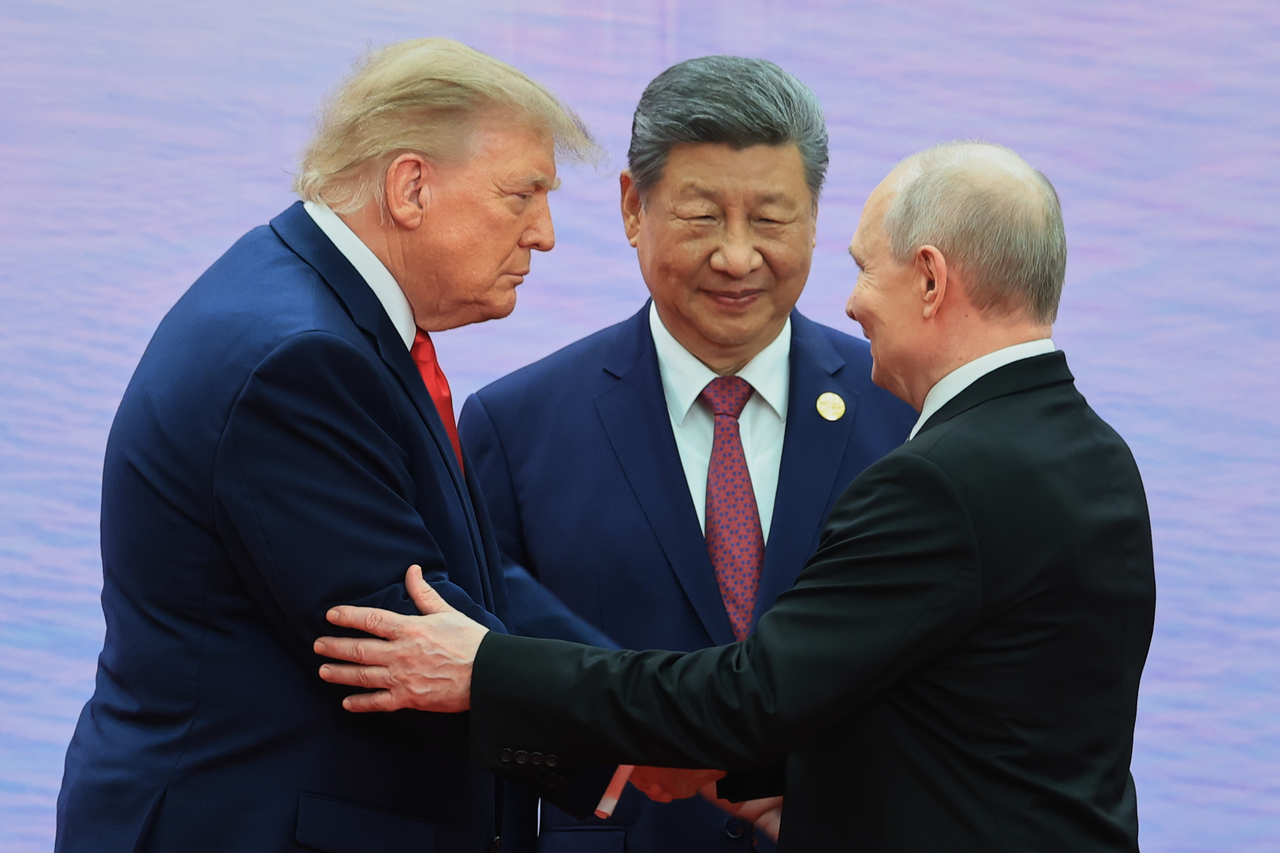
The leaders of the United States, China and Russia are holding their first-ever trilateral summit Thursday (local time) in Shenzhen, Guangdong Province, China — a historic gathering of the world's three major powers to discuss international security issues including nuclear arms reduction, the military use of AI and the Iran question. With the three countries holding divergent interests over the war in Ukraine, the world is watching closely to see whether the meeting will break new ground in easing great-power tensions or amount to little more than a symbolic encounter.
President Donald Trump, Chinese President Xi Jinping and Russian President Vladimir Putin are meeting at the Qilin Mountain Villa in Shenzhen on the sidelines of the Asia-Pacific Economic Cooperation summit. Guo Jiakun, a spokesperson for China's Ministry of Foreign Affairs, said at a regular briefing Wednesday that "the three leaders will hold in-depth exchanges on important issues related to world peace."
The three countries have been working through final details on the wording of a joint statement ahead of the summit. Yuri Ushakov, the Kremlin's foreign policy adviser, said Monday that intensive consultations on the statement's language were underway and that Russia had conveyed its positions to China. However, it has not been confirmed whether a joint statement will be adopted. If no agreement is reached, each country may separately brief the outcome of the talks.
The summit's core agenda items are expected to be nuclear arms reduction and limits on the military use of AI. The South China Morning Post recently reported that the three countries have been discussing ways to restrict AI use in nuclear command-and-control processes and that an agreement in this area is possible. Such a measure would reduce the risks of AI involvement in nuclear weapons operations and is considered more achievable than other security issues where the three sides are sharply divided.
Nuclear arms reduction is also a major topic. Trump has expressed interest in negotiations involving the US, China and Russia on reducing nuclear arsenals. China, however, has remained reluctant to join trilateral nuclear reduction talks, citing its smaller stockpile compared with those of the US and Russia. Even if the three countries agree on the need for arms control in principle, reaching consensus on specific reduction targets and verification mechanisms is expected to be difficult.
The war in Ukraine and the Iran question are also on the table. Trump has indicated he wants to discuss ending the war in Ukraine, but it remains uncertain whether the issue will formally make it onto the agenda. Disagreements persist over territorial questions and security guarantees between Russia and Ukraine, and China's position adds another variable. Iran is also cited as a potential discussion topic given its impact on Middle East security.
There is also interest in whether the summit will address new arms-control approaches on the Korean Peninsula, including a freeze on North Korea's nuclear capabilities. With Pyongyang refusing negotiations premised on denuclearization, capping its nuclear expansion has been floated as an alternative. The South China Morning Post, citing Chinese experts, said the three countries have been shaping the agenda around areas of shared ground rather than contentious issues such as Korean Peninsula denuclearization. No announcement has been made that a nuclear freeze has been included as a formal agenda item.
Some observers have drawn comparisons between this summit and the 1945 Yalta Conference, at which the US, Britain and the Soviet Union discussed the postwar international order. The South China Morning Post, however, cited Chinese experts as saying the meeting is more likely to be a forum where each leader pursues different diplomatic goals than a second Yalta reshaping the global order. The significance of the gathering, they suggested, may lie in the leaders meeting for the first time rather than in any concrete agreements reached.
A bilateral summit between Trump and Xi ahead of the trilateral meeting is also a key diplomatic event. The two leaders are meeting for the first time since their Washington summit in September — roughly two months ago — to discuss trade tensions, rare earth export controls and advanced semiconductor regulations. The central question is whether the two sides can review the implementation of their existing trade truce and reach additional agreements. Taiwan, which China has designated a "red line" in the bilateral relationship, is another variable.
Attention is also focused on whether Trump and North Korean leader Kim Jong-un will hold a surprise meeting. Trump raised the possibility of an encounter with Kim when he set out on his Asia trip Monday, and repeated it the following day in Manila, Philippines, saying, "I think he'd like to. We'll see what happens." Secretary of State Marco Rubio said Wednesday that Trump is serious about meeting Kim but drew a line, saying, "I'm not saying there's going to be a meeting tomorrow."
China's Ministry of Foreign Affairs said it has no information regarding the possibility of a US-North Korea summit. The Kremlin, however, said Kim could meet Putin if he attends APEC. If a Trump-Kim meeting takes place, it would be the first since their encounter at Panmunjom in June 2019 — about seven years and five months ago.
Meanwhile, Xi is chairing the APEC leaders' plenary session Thursday morning, with discussions covering free trade expansion, supply chain stability and digital economy cooperation. Representatives from all 21 member economies — including South Korea, the US, China, Japan and Russia — are attending. China has put forward openness, innovation and cooperation as its three priority areas. The summit is also expected to adopt a separate document on advancing the Free Trade Area of the Asia-Pacific and expanding AI and digital economy cooperation, as well as a "Shenzhen Leaders' Declaration" outlining the direction of regional economic cooperation.
sjy@heraldcorp.com