Policy chief Ha Jun-kyung briefs reporters in Shenzhen
Deal covers content, tourism and legal services; introduces most-favored-nation treatment
19 South Korean firms and organizations, about 40 people, attend APEC CEO Summit
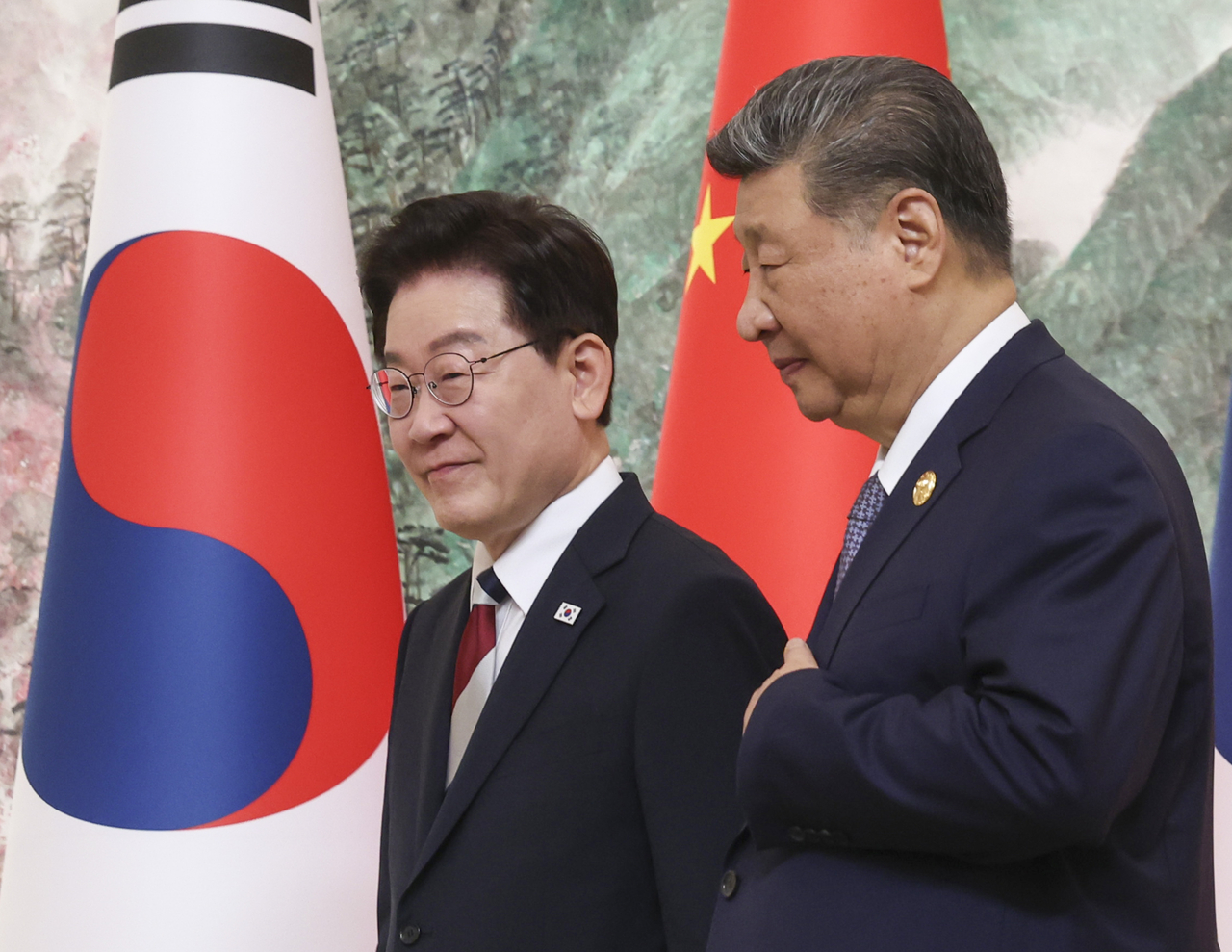
Cheong Wa Dae said Wednesday that the most significant economic achievement of the South Korea-China summit held in Shenzhen was the declaration of a substantial conclusion to follow-up negotiations on services and investment under the bilateral free trade agreement. Talks that had been suspended for more than four years resumed eight months ago and have now borne fruit, laying what officials described as an institutional foundation for economic cooperation between the two countries to advance qualitatively beyond goods trade into the services and investment sectors.
Presidential Policy Chief Ha Jun-kyung held a briefing at a hotel in Shenzhen that evening, saying the declaration of a substantial conclusion to the follow-up FTA negotiations on services and investment was "the biggest achievement in the economic sphere" from the summit.
Ha explained the background to the talks, saying the two countries had agreed when they signed the FTA in 2015 to hold separate follow-up negotiations aimed at raising the level of liberalization in services and investment, and that those talks had begun in 2018 before stalling for more than four years. "However, as South Korea-China relations improved — including through reciprocal state visits between the leaders of both countries since our administration took office — China's position became more flexible," Ha said. "As a result, we achieved a conclusion just eight months after negotiations resumed." He added that the FTA would now cover not only goods but also services and investment in a broad sense, calling it "an achievement that could never have been realized without our government's efforts to fully restore South Korea-China relations."
Under the deal, the two countries agreed to improve conditions for mutual market access across a range of service sectors, including content, tourism and legal services. They also agreed to introduce most-favored-nation treatment obligations — guaranteeing that companies from the other country receive treatment no less favorable than that given to third-country firms — and to strengthen investment protection and regulatory transparency.
Ha said the economic significance of the agreement lay in the natural progression of bilateral cooperation. "Economic cooperation between countries begins with goods trade, but as it deepens, companies enter the other country, invest there, operate under local laws and systems, and provide services such as legal and cultural offerings," Ha said. "In that sense, this conclusion lays the institutional foundation for economic cooperation between South Korea and China to make a qualitative leap."
Ha particularly emphasized the potential for growth in services trade. "China accounts for about 21 percent of South Korea's total goods trade, but only around 12 percent of our total services trade," he said. "Given the significant room for expansion in bilateral services trade, I believe this conclusion on services and investment will serve as an important foundation for broadening the scope of economic cooperation between the two countries."
Ha also shared the outcomes of the APEC CEO Summit, which President Lee Jae Myung attended that afternoon. Ha described the event as "the largest business gathering in the Asia-Pacific region, held annually on the sidelines of the APEC Leaders' Summit, where leaders of APEC member economies and major companies come together to assess economic conditions and discuss avenues for regional economic cooperation."
The event was hosted by the China Council for the Promotion of International Trade under the theme "Co-creating Prosperity and the Future," with discussions covering new cooperation opportunities in the Asia-Pacific region and the building of an AI innovation ecosystem. Ha said more than 2,000 people attended, including leaders from about 12 countries such as China, Russia, Australia, Canada and Vietnam, in addition to South Korea. "No separate economic delegation was organized by business groups, but we confirmed that a total of about 40 people from 19 domestic companies and organizations attended," he said.
Ha went on to say that President Lee, in a special address, called on APEC members to expand trade and investment within the region through openness, innovation and cooperation — and to broaden new growth opportunities for businesses — at a time when global economic uncertainty is rising due to the spread of protectionism and geopolitical tensions.
sunpine@heraldcorp.com