Rate retreated from 1,500s to mid-1,300s, then stalled
Dollar demand via stocks hits $970 million a day in Sept.–Nov.
Twice the $480 million daily average seen in July–Aug.
Foreign investors' share of net selling rises from 68% to 81%
'Semiconductor dollars' unable to offset won weakness
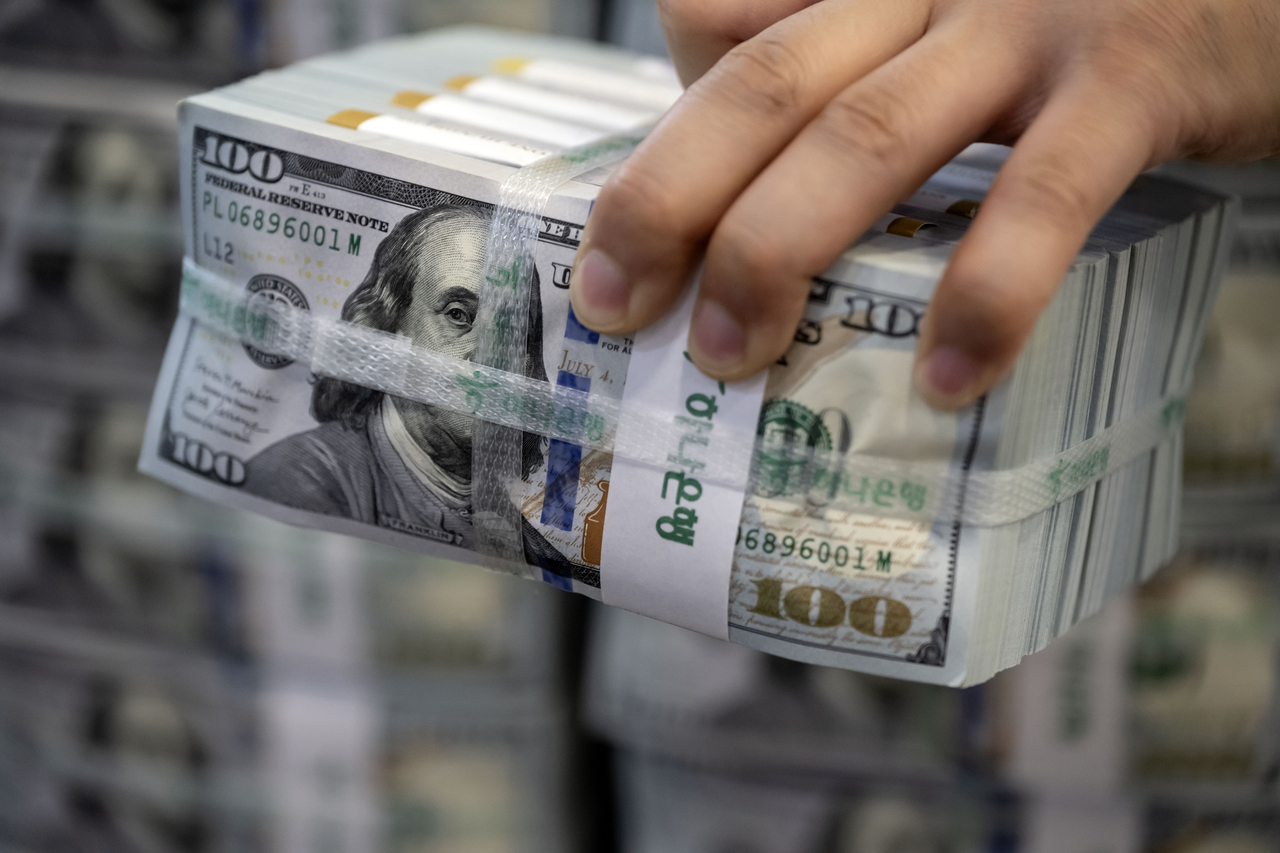
The won-dollar exchange rate peaked at 1,528 won per dollar in June (based on weekly closing prices), plunged to around 1,400 won in August, and has since been drifting sideways in the mid-1,300s from September through November. The main driver behind that stall appears to be dollar demand flowing through the stock market, which roughly doubled between the sharp-decline period of July–August and the sideways period of September–November. Foreign investors' retreat from the domestic equity market has been particularly pronounced, accounting for more than 80 percent of that dollar demand — and largely offsetting the large volumes of dollars entering the foreign-exchange market from a record-breaking current-account surplus led by semiconductor exports.
An analysis based on data from Korea Exchange and the Korea Securities Depository compared two periods this year: the sharp-decline phase of July–August and the sideways phase from September through Nov. 17, during which the rate hovered around 1,340 won. Over the 52 trading days of the sideways phase, foreign investors recorded net selling of 54.4 trillion won ($40.9 billion) in the domestic equity market, which includes the Kospi, Kosdaq, Konex and exchange-traded products such as ETFs, ETNs and ELWs. Net selling refers to a situation in which the value of shares sold exceeds the value of shares purchased.
Assuming all shares sold by foreign investors were converted into dollars, the total comes to approximately $40.44 billion, applying the average exchange rate for the period — or an average of $780 million per trading day. That is 2.4 times the figure recorded during the sharp-decline phase, when foreign investors' net selling translated to $13.82 billion in total, or an average of $330 million per day.
Domestic investors' appetite for overseas equities also grew over the same period. During the sideways phase, Korean investors recorded net purchases of $9.79 billion in foreign stocks, averaging $188 million per trading day — up about 22 percent from the July–August period, when the figures stood at $6.46 billion in total and $154 million per day.
Even when domestic investors buy stocks listed in Japan, Europe or other markets, banks first convert won into dollars before exchanging those dollars into the local currency of the target market. This means overseas equity investment affects the won-dollar rate regardless of the destination market.
Combined, dollar demand from both foreign and domestic investors in equity markets reached $970 million per trading day during the September–November period — roughly double the $480 million daily average recorded in July–August. Foreign investors' net selling of domestic stocks drove the bulk of the dollar outflow, with their share of total dollar demand rising from 68 percent to 81 percent over the same comparison.
Other factors cited as contributors to dollar demand include higher crude oil import payments driven by rising international oil prices, and the Federal Reserve's continued tightening stance.
While dollars earned through exports — particularly semiconductors — have been flowing into the foreign-exchange market in large volumes, the sharp rise in dollar demand from domestic and foreign investors has created roughly balanced upward and downward pressure on the exchange rate.
South Korea's cumulative current-account surplus for the first nine months of this year reached $340.66 billion, more than four times the $83.89 billion recorded in the same period last year. Government encouragement of foreign-currency conversion, combined with corporate demand to convert dollars into won for tax payments and domestic investment, has led more companies to sell dollars. According to data obtained from the Bank of Korea by the office of People Power Party lawmaker Lee Jong-wook of the National Assembly's Finance and Economy Planning Committee, non-financial private companies' net spot and forward dollar selling in the first three quarters of this year was 2.6 times the level seen in the same period last year.
The monthly average won-dollar rate (based on weekly closing prices) peaked at 1,528 won in June before falling for four consecutive months — to 1,488.9 won in July, 1,404.4 won in August, 1,358.8 won in September and 1,336.4 won in October. The pace of decline, however, has slowed markedly: after a 5.7 percent drop in August, the rate fell just 3.2 percent in September and 1.6 percent in October. The rate briefly touched the 1,330s intraday on Sept. 7 — its lowest level in about one year and 11 months — and has been trading sideways in the mid-1,300s for more than two months since.
Looking ahead, the key question is whether concerns over an AI investment slowdown and a stronger dollar will continue to dampen risk appetite, even as downward pressure from semiconductor-related dollar inflows persists. "Despite last week's dollar strength, a steady flow of export-related dollar selling kept the rate stable in the 1,330s," said Lee Min-hyuk, an economist at KB Kookmin Bank. "Among short-term volatility drivers, the flow of foreign capital in and out of domestic financial markets is becoming increasingly important."
Monetary authorities believe there is room for the exchange rate to fall further. Bank of Korea Governor Shin Hyun-song said at last month's monetary policy press briefing that "the won remains weaker than in previous years when measured on an effective exchange rate basis." At the same time, there are signs within the authorities that a sharp decline in the exchange rate would be harmful — dealing a blow to corporate earnings, among other effects — and that the current sideways trend may in fact be preferable.
If the Bank of Korea's Monetary Policy Board raises the benchmark interest rate at its policy meeting on Nov. 26, the narrowing gap between Korean and US interest rates would likely add further downward pressure on the exchange rate.
kimstar@heraldcorp.com