Energy, food and dining account for 78% of savings
Domestic firms' operating profit margin up 1.4 percentage points
Exporters face negative impact on profitability
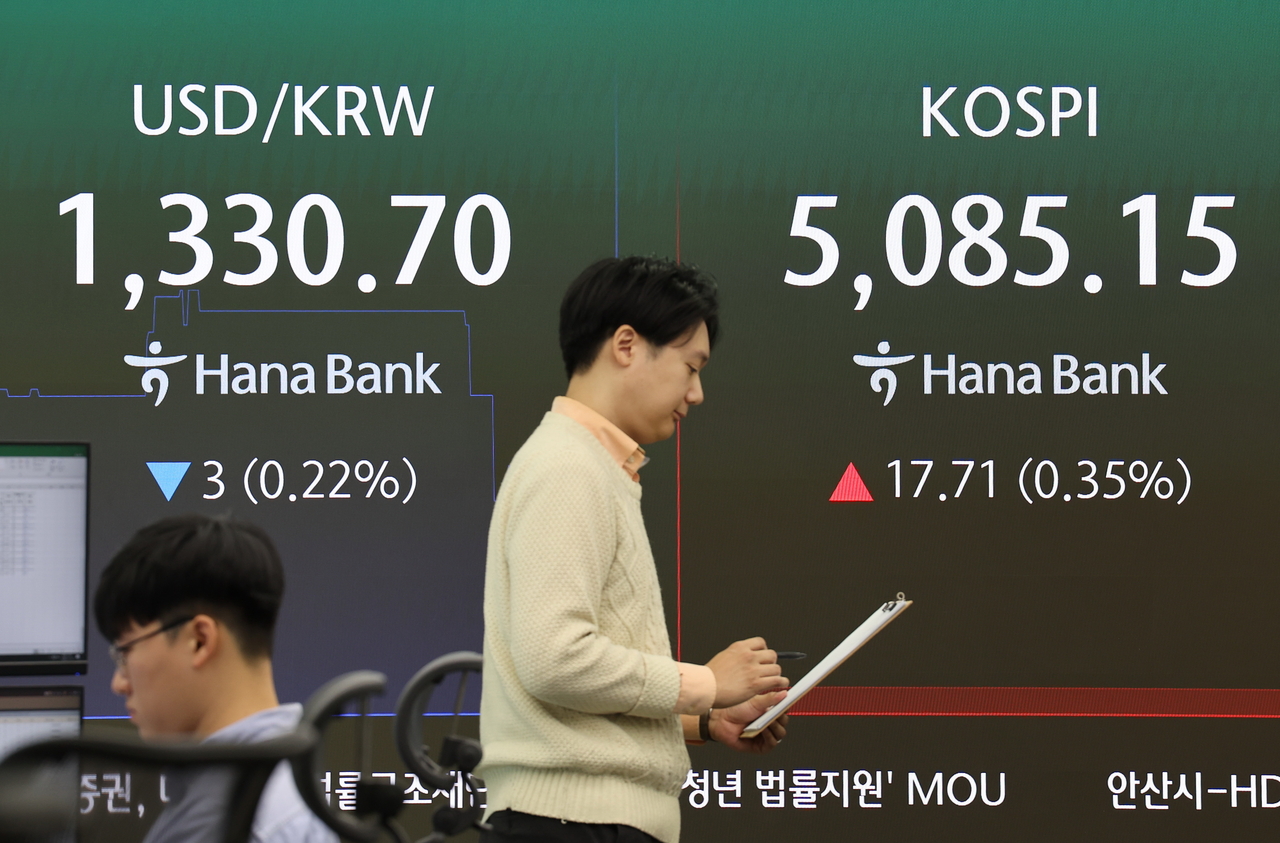
A 10% appreciation of the won would reduce average household living costs by 165,000 won ($124) a year, with lower-income households feeling the effect most acutely, according to a new Bank of Korea report.
Lee Jong-ung, a deputy director at the Bank of Korea's research department, and colleagues published the findings Thursday in a report titled "Economic Effects of Won Appreciation: Differentiated Sectoral Impacts and the Possibility of Easing Polarization," noting that current conditions resemble those of the semiconductor boom of the mid-to-late 2010s.
Taking into account household consumption patterns and the pass-through rate of exchange rate changes to consumer prices by product category, the report estimated that a 10% won appreciation would reduce the annual spending needed to maintain existing consumption levels by an average of 165,000 won per household. That figure represents 0.47% of annual consumption expenditure and 0.32% of disposable income.
By category, energy (36.2%), food and non-alcoholic beverages (28.2%) and dining out (13.7%) together accounted for about 78% of the total projected savings.
The savings effect relative to income was particularly pronounced among lower-income households.
With a 10% won appreciation, households in the bottom income quintile would save 88,000 won a year in living costs — less in absolute terms than the 263,000 won saved by the top quintile, but their savings rate as a share of disposable income would be 0.78%, more than three times the 0.24% recorded for the top quintile.
"Lower-income households allocate a larger share of spending to food and energy, categories with high price pass-through rates, and their consumption-to-income ratio is higher, which is why their savings rate relative to disposable income exceeds that of higher-income groups," the report said.
The report also noted that won appreciation could support an expansion of private consumption by improving the business income of low-income self-employed workers.
Low-income self-employed workers are disproportionately concentrated in domestic-demand industries such as restaurants and land transport, where food ingredient and fuel costs make up a large share of expenses, meaning they stand to benefit significantly from cost reductions. An improvement in the income conditions of lower-income groups would make a relatively large contribution to expanding private consumption, the report said.
In the corporate sector, won appreciation broadly improves the profitability, investment and sales of domestic-demand-oriented firms, while exporters see their export margins narrow.
Analysis using microdata from companies subject to external audits estimated that a 10% won appreciation would raise domestic firms' operating profit margin, investment rate and sales growth rate by 1.4 percentage points, 3.3 percentage points and 7.4 percentage points, respectively.
Compared with exporters in the same industries, domestic firms' operating profit margin, investment rate and sales growth rate were higher by 0.5 percentage points, 3.9 percentage points and 4 percentage points, respectively.
The report attributed the divergence to domestic firms benefiting from lower costs as imported raw materials and intermediate goods become cheaper, as well as from stronger demand as household purchasing power improves — while exporters see cost savings offset by a decline in their won-denominated export prices.
"Since 80 to 90 percent of export proceeds are settled in dollars and dollar-denominated export prices remain fixed for a considerable period, the decline in export volumes during a period of won appreciation is limited," the report said. "However, there is naturally a negative impact on the won-denominated profitability of exporters."
The report added that with IT exports currently driving growth, won appreciation is expected to ease the concentration of growth gains and broaden the domestic demand base. It cautioned, however, that if conditions in the non-IT sector are slow to improve, companies may prioritize using savings on import costs to restore profitability, which could weaken the pass-through of exchange rate changes to prices and delay any improvement in domestic demand.

kimstar@heraldcorp.com