President presents three-point vision for Asia-Pacific community; emphasizes energy and AI cooperation
Lee holds back-to-back meetings with leaders of China, Russia and US ahead of trilateral summit
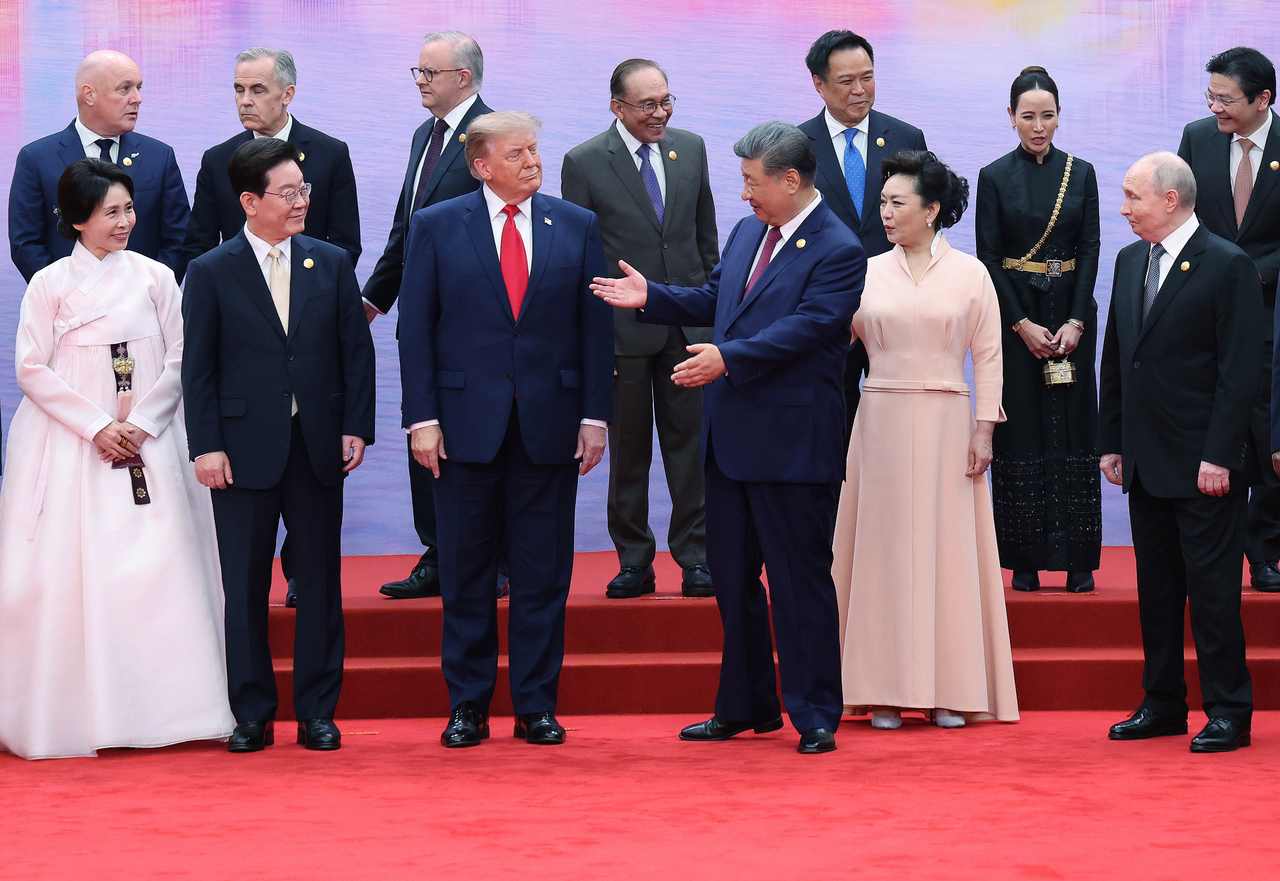
President Lee Jae Myung called on Asia-Pacific leaders Thursday to help reopen dialogue with North Korea and work toward a permanent peace regime on the Korean Peninsula, addressing the plenary session of the Asia-Pacific Economic Cooperation summit in Shenzhen, China. Ahead of a planned trilateral summit among the leaders of the United States, China and Russia, Lee had already met with all three heads of state by Wednesday to convey Seoul's position on the Korean Peninsula situation.
In his opening remarks at the plenary session, Lee said Shenzhen itself stood as proof that APEC's founding goals could be achieved. "Having come here in person, I am struck by how Shenzhen embodies APEC's core objective — shared prosperity through cooperation and solidarity," he said, proposing three priorities: innovation that lifts all members together, stronger resilience for everyone, and cooperation toward an inclusive future.
Lee stressed that a proposed Asia-Pacific AI Center, currently in the planning stages, would serve as a hub for regional artificial intelligence cooperation, pooling members' expertise and driving innovation. He also urged members to institutionalize information sharing, joint energy stockpiling, coordinated response frameworks and emergency supply stabilization measures to shore up the region's vulnerable energy supply chains, adding that the long-term pace of renewable energy expansion and electrification must be accelerated.
"I hope the door to dialogue with North Korea will open again, leading to discussions on ending the long-standing war on the Korean Peninsula and building a permanent peace regime," Lee said, calling on fellow leaders for their active attention and cooperation.
Ahead of the US-China-Russia trilateral summit, Lee held a series of meetings with the three leaders to prepare for diplomatic discussions over the Korean Peninsula's future.
On Wednesday, Lee sat down with Chinese President Xi Jinping for about 35 minutes, discussing ways to advance the South Korea-China relationship and the situation on the Korean Peninsula. Lee asked China to play a constructive role in easing tensions and establishing peace on the peninsula, and Xi was said to have expressed agreement.
Later that same day, near the close of the APEC leaders' dinner, Lee also met with Russian President Vladimir Putin for about 10 minutes. It was the first face-to-face meeting between Lee and Putin since Lee took office in June last year.
The two leaders exchanged views on the need to manage the South Korea-Russia relationship in a stable manner, and were also said to have discussed ways to prevent an escalation of tensions on the Korean Peninsula as well as North Korea's nuclear program. The direct communication between the two heads of state drew attention given the strained state of bilateral ties since the war in Ukraine.
Lee also had multiple exchanges with US President Donald Trump. Earlier, at a dinner held in the Philippines, the two leaders greeted each other publicly for about 40 seconds. The resumption of US-North Korea dialogue, however, was not directly addressed in their conversation. Cheong Wa Dae said the two leaders spoke on several occasions beyond the public greeting.
Lee's contacts with all three leaders ahead of the trilateral summit were seen as significant in that they gave Seoul an opportunity to convey its position on Korean Peninsula issues. Whether North Korea will feature prominently in the actual US-China-Russia talks, however, remains uncertain.
A senior Cheong Wa Dae official said it was unclear how Korean Peninsula issues would be handled in the trilateral discussions, but added that Seoul could be said to have had an appropriate opportunity to put forward its position.
"Our current assessment is that there is some possibility the Korean Peninsula could come up," the official said, "but the main issues are likely to be nuclear disarmament, Iran and Ukraine."
sunpine@heraldcorp.com
sang@heraldcorp.com