Incheon Mayor Park Chan-dae announces all 17 stations across full route included in Ministry of Land, Infrastructure and Transport's comprehensive plan
Final approval expected in December
Underground rail targeted for 2040, above-ground development for 2045
Financing and project viability remain key hurdles
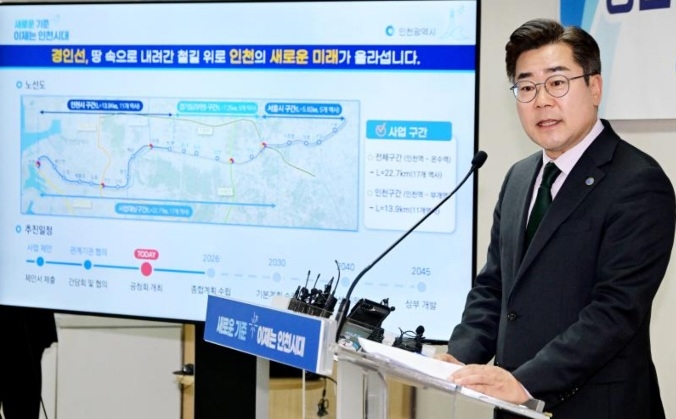
The 127-year-old Gyeongin Line is set to enter a new era after the government included its underground relocation in a national infrastructure plan, paving the way for a sweeping transformation of Incheon's urban landscape.
Incheon Mayor Park Chan-dae held a press conference at City Hall on Thursday and announced that the Ministry of Land, Infrastructure and Transport's draft comprehensive plan for integrated underground rail development includes all 17 stations along the full 22.7-kilometer stretch from Incheon Station to Onsu Station as a new project target.
The inclusion establishes the institutional foundation needed to move the project forward.
"The underground relocation of the Gyeongin Line, which had only ever been floated as a campaign pledge at election time, has now been included in the first comprehensive plan drawn up under the Special Act on Railway Underground Relocation," Park said. "In less than five months since taking office, we have taken the first step toward keeping that promise."
The Ministry of Land, Infrastructure and Transport plans to spend the next two weeks consulting with relevant agencies and gathering opinions from local governments before submitting the plan to the Railway Industry Committee for deliberation and issuing a final decision in December.
If the project proceeds as planned, it will move through the stages of basic planning, design and construction, with the underground relocation targeted for completion by 2040 and above-ground development by 2045.
Incheon city officials have been making the case to the ministry and related agencies for the full-route underground relocation ahead of the plan's adoption.
Lawmakers representing Incheon and Bucheon also visited the ministry to urge inclusion of the project in the national plan, lending political support to the effort.
The underground relocation of the Gyeongin Line has drawn attention as a major urban development project that would reshape the spatial structure of Incheon's city center, which has long been divided by the railway.
Opened in 1899 as Korea's first railway, the Gyeongin Line played a central role in the country's industrialization and modernization as a key transportation artery.
Over 127 years of cutting through the city center, however, it has also acted as a barrier severing the northern and southern residential areas of Incheon.
Residents have had to travel long detours to cross the tracks, while those living near the line have endured noise, dust and other quality-of-life problems caused by train operations.
Inclusion in the national plan does not, however, mean the project will move into actual implementation immediately.
Financing the enormous project cost and generating sufficient revenue through above-ground development are the critical factors that will determine whether the project ultimately succeeds.
Under the railway underground relocation model, the project operator issues bonds to cover the upfront cost of the underground work, then repays those bonds using revenue from developing the vacated above-ground rail sites and transit-oriented areas. The project therefore requires solid economic viability and a stable financing plan.
In response, Incheon city plans to establish a special account for railway underground relocation to manage project finances systematically, while pursuing mixed-use development linking the rail sites and transit-oriented areas to improve commercial viability.
The city also intends to work with the central government and the National Assembly to improve related systems in ways that reduce the fiscal burden on local governments.
How to use the above-ground space is another important policy challenge. After the comprehensive plan is finalized, Incheon city plans to broaden participation by residents and experts from the basic planning stage onward, gathering opinions by district to reflect local characteristics and community needs in the above-ground development plan.
"Resolving long-standing issues that have gone unaddressed for years, one by one, is the starting point for opening a new era for Incheon," Park said. "I will do everything I can to fulfill the promise of putting the Gyeongin Line underground and returning that surface space to the people."
gilbert@heraldcorp.com