Korea's Small and Medium Venture Business Research Institute calls for reforms to local currency vouchers
Issued by 194 local governments nationwide … boosts consumer spending
Won-based settlement of merchant sales limits in-region recirculation
Report recommends expanding business-to-business transactions and introducing reuse incentives
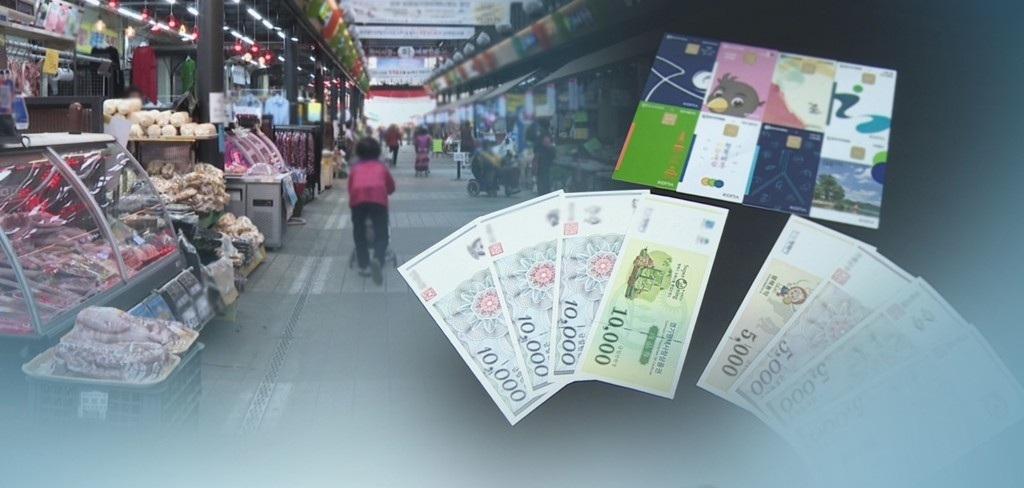
South Korea's local currency vouchers need to do more than simply encourage spending within a region — they should be designed so that money generated locally flows back into the local economy, a new report argues.
A report released Friday by the Small and Medium Venture Business Research Institute, titled "From Local Consumption to Local Circulation: A Comparison of Domestic and Foreign Local Currency Cases and Implications," found that the country's local love gift vouchers have helped boost sales for small businesses and expand spending within communities, but fall short when it comes to keeping that money circulating among local merchants.
As of October last year, 194 local governments across the country issue the vouchers. A revision to the law in August last year made national government funding mandatory, providing a more stable operational foundation.
The problem begins after a consumer makes a purchase with a local currency voucher. Because merchants settle their voucher-based sales in won, the vouchers rarely get reused in transactions between businesses. When merchants source raw materials or products from outside the region, money that flowed in through local spending can quickly flow back out.
In the food service sector, ingredient costs account for 40.7 percent of sales. Among franchise outlets, 72.1 percent of ingredients are supplied by the parent company. This suggests that even as local currency spending grows, its ability to drive broader production and trade within the region remains limited.
The importance of a recycling function lies in the scale of income leakage from local economies. According to the report, an average of about 117 trillion won ($87.9 billion) flowed into the Greater Seoul area annually between 2020 and 2024, while about 89 trillion won drained out of non-metropolitan regions on a net basis over the same period. Keeping money in local economies requires not only steering consumption inward but also building structures that keep funds in place through follow-on transactions.
Several countries have developed mechanisms to encourage local currency reuse. Germany's Chiemgauer imposes a 5 percent fee when converting the local currency into euros, nudging users to spend it locally instead. Italy's Sardex and Switzerland's WIR support intra-regional trade through business-to-business credit transactions and low-interest loans.
France's Eusko and La Gonette take a different approach: the organizations running those currencies connect member merchants with local suppliers, allowing businesses to reuse the local currency they receive from consumers in their own procurement.
Some domestic examples point in a similar direction. Gooddeurae Pay, a local currency in Buyeo-gun, South Chungcheong Province, offers merchants an incentive of about 3 percent when they reuse received vouchers at other member businesses. As of the end of September this year, cumulative circulation reached 762.1 billion won, of which 73.9 billion won — roughly 10 percent — came from merchant-to-merchant recycling transactions.
Rather than mandating a recycling function uniformly, the institute recommended that the government encourage local governments to adopt it voluntarily. The proposed approach involves verifying the results of municipalities that have introduced the function and then spreading proven operational models to other regions.
The institute also said there is a need to expand the enrollment of local suppliers and support businesses in identifying and connecting with trading partners to build a stronger foundation for business-to-business transactions. It added that merchant reuse rates should be used as a performance indicator, and that technical and institutional safeguards against fraudulent circulation should also be considered.
Jang Yun-seop, a senior researcher at the institute, said domestic local love gift vouchers and foreign local currencies are difficult to compare directly because they have developed along different paths and are operated by different entities. "Rather than applying overseas cases wholesale, we should build on the existing local love gift voucher infrastructure to strengthen its circulation function, while separately nurturing private community currencies," Jang said.
Jo Ju-hyeon, president of the Small and Medium Venture Business Research Institute, said the local love gift voucher is "an important policy asset with a broad user base and payment infrastructure," adding that "there is a need to take it a step further — building on its achievements so far to develop it into a policy tool that encompasses circulation within local economies."
boo@heraldcorp.com