Symposium calls for holistic review of 30 billion won market cap threshold
Experts warn blanket standard could force out viable growth companies
Segment system raises fears of capital concentration, market polarization
Calls are growing for institutional safeguards to protect innovative companies as South Korea moves to tighten Kosdaq delisting standards and introduce a market segmentation system. Experts say delisting decisions should weigh a company's financial health and business viability rather than rely solely on market capitalization.
The Korea Venture Business Association held a symposium Friday at the National Assembly Members' Office Building in Yeouido, Seoul, jointly with the LKB Pyeongsan Law Firm's Financial Law Center and the Korea Kosdaq Listed Companies Association. The event focused on legislative approaches to revitalizing the Kosdaq market.
The symposium was co-hosted by Democratic Party of Korea lawmakers Kwon Chil-seung, Min Byeong-deok, Kim Han-gyu, Park Hee-seung and Park Min-gyu, along with People Power Party lawmakers Yoon Sang-hyun, Im Jong-deuk and Woo Jae-jun. Legal practitioners and academics also participated to examine the legislative merits of the proposed delisting criteria and segmentation system.
Participants broadly agreed on the policy goal of swiftly removing insolvent companies from the market, but warned that applying a uniform market cap threshold could push out innovative firms with genuine growth potential.
Ahn Tae-jun, a professor at Hanyang University School of Law, said the sharply raised market cap threshold for delisting may run afoul of the principle of proportionality. He said the standard is excessively harsh on listed companies compared with listing maintenance requirements at major overseas exchanges.
"Rather than triggering an immediate delisting solely on the basis of a market cap shortfall, it would be more appropriate to conduct a comprehensive review of a company's actual condition — including its financial position and business operations — and, even when applying such a standard, to guarantee sufficient opportunity for improvement and a reasonable grace period," Ahn said.
Ahn also urged caution on the proposed segmentation system, which would classify Kosdaq-listed companies into tiers based on set criteria. Forcing companies into upper and lower market tiers, he said, risks spreading negative perceptions of lower-tier firms and dampening investor demand.
As an alternative, Ahn proposed using indexes such as the Kosdaq 150 and related investment products to boost institutional investor participation, and allowing companies that voluntarily meet qualitative standards — including governance and shareholder rights protections — to opt into the upper segment.
The subsequent discussion echoed calls for greater predictability in delisting rules and stronger procedural rights for companies facing removal.
Kim Yu-seong, a professor at Yonsei University School of Law, said the rule using a 30 billion won ($22.5 million) market cap as a standalone delisting criterion — with an accelerated implementation timeline — warrants reconsideration. Kim also proposed codifying in the Capital Markets Act the right of affected companies to submit statements and file objections, as well as a minimum grace period when unfavorable rule changes are introduced.
Kang Han-cheol, an attorney at Kim & Chang, said alternative criteria drawing on a range of indicators — equity capital and operating profit alongside market cap — are needed. Companies above a certain threshold should be given a chance to improve, and adequate transition periods should be guaranteed when rules change, Kang said.
The push to tighten Kosdaq delisting standards is aimed at weeding out insolvent companies quickly to improve market quality. However, opinions remain divided over how far to raise the bar and how much opportunity companies should be given to recover. The segmentation system has drawn both hopes of channeling investment toward stronger companies and concerns that it could deepen the divide between large and small listed firms.
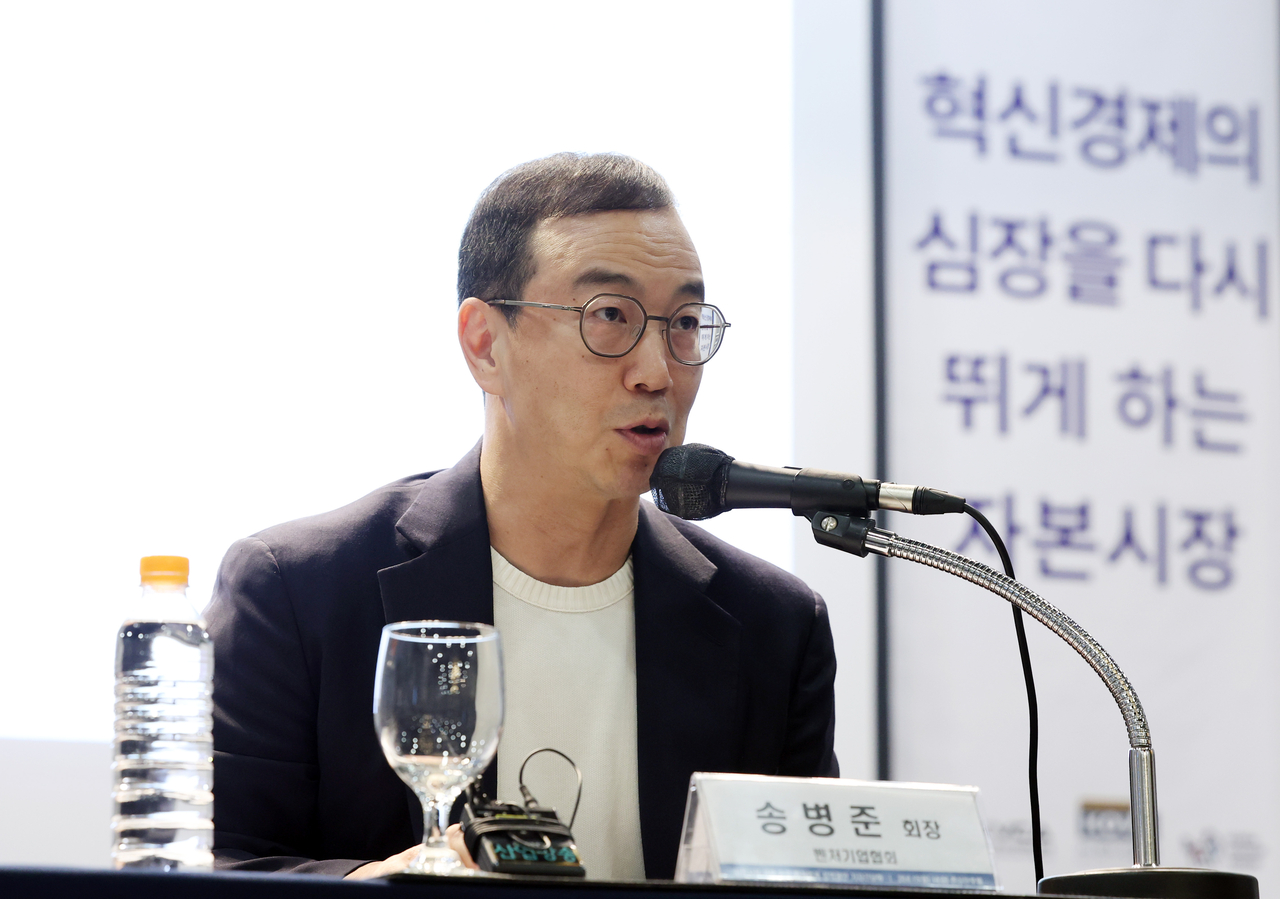
"Since market cap and share price alone make it difficult to distinguish insolvent companies from those operating normally, financial soundness and business viability should also be considered when deciding whether to maintain a listing," said Song Byung-jun, president of the Korea Venture Business Association. "When standards change, companies and investors need time to prepare, and the right to explain themselves and seek improvement must be guaranteed."
Lee Dong-hun, president of the Korea Kosdaq Listed Companies Association, said delisting criteria should account for a company's stage of commercialization and operating performance, with clear timelines and procedures so companies and investors can prepare. "The introduction of a segmentation system must reflect technological capability, growth potential and sector-specific characteristics so that it does not lead to capital concentration and the marginalization of growth-stage companies," Lee said.
boo@heraldcorp.com