Extraordinary shareholder meeting approves Lee as inside director
3-year term begins Saturday; inauguration set for Monday
Year-end subsidiary CEO reshuffles draw close watch
Productive finance target of 110 trillion won, WM and AI transformation on agenda
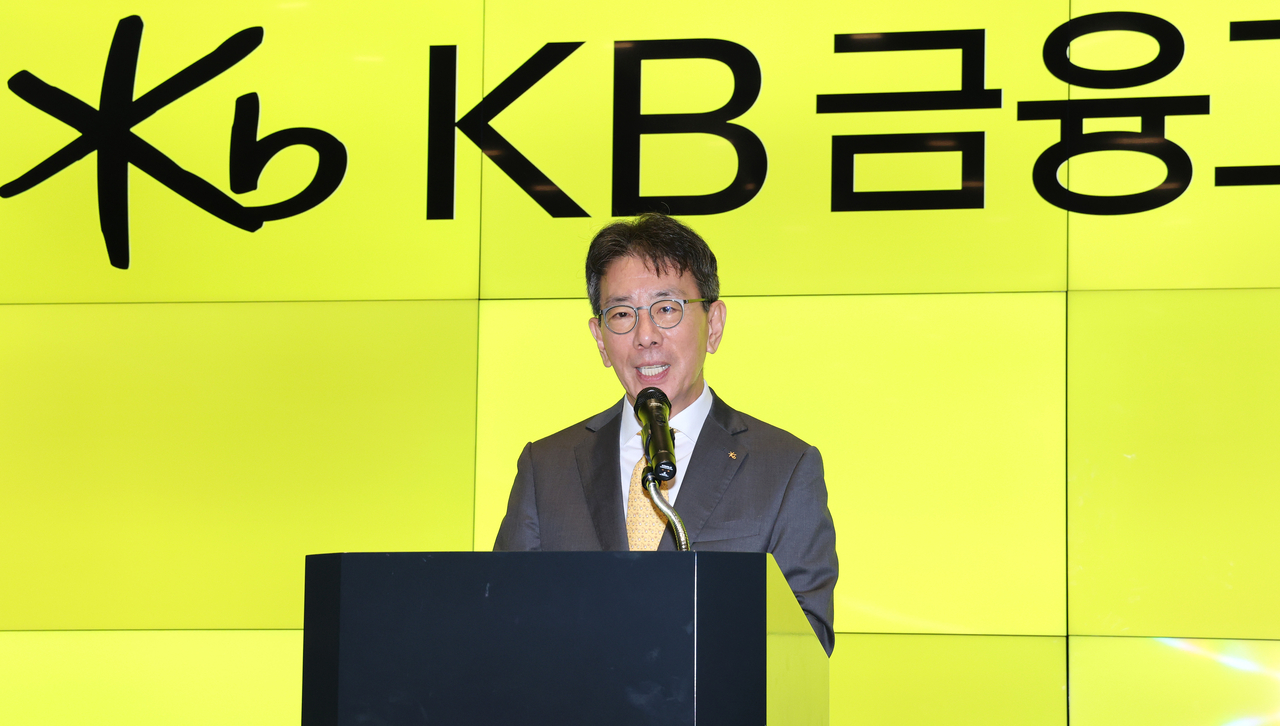
Lee Jae-keun, KB Financial's head of global, wealth management and small and medium-sized enterprise divisions, was formally appointed the group's next chairman Friday. As KB Financial — despite posting record earnings — opts for a generational shift in leadership, attention is turning to year-end CEO reshuffles at its subsidiaries and a broader organizational overhaul. Observers are watching how Lee's emphasis on decentralized management will translate into actual personnel decisions, as well as the direction he will take on key business priorities including productive finance, wealth management and AI transformation.
KB Financial held an extraordinary shareholders meeting at its Yeouido headquarters in Seoul on Friday morning, approving Lee's appointment as an inside director. His three-year term runs from Saturday through Nov. 20, 2029. A formal inauguration ceremony is scheduled for Monday.
Outgoing Chairman Yang Jong-hee said at the meeting, "Trust is the foundation on which KB has grown and a value we must continue to cherish. We will prepare for KB's next phase of growth."
Earlier, KB Financial's chairman candidate recommendation committee nominated Lee as its final pick in September, citing "bold change and generational renewal" as the core rationale. Committee Chairman Jo Hwa-jun said at the time, "Rather than resting on our current strong performance, this is the moment for bold change and a generational shift to strengthen the group's fundamental competitiveness and secure future growth drivers."
Lee served as president of KB Kookmin Bank for three years beginning in 2022, then moved to the holding company last year to oversee the global, wealth management and small and medium-sized enterprise divisions. Having led both the bank and group-level operations, he is seen as well positioned to guide the organization with a broad understanding of both retail banking and the group's wider business.
The cornerstone of Lee's management vision is "systems and processes." Speaking to reporters in September after being named chairman-designate, he said, "I believe the larger a financial group becomes, the more it must operate through systems. Rather than concentrating power in the chairman, I will focus on building an organization that moves through systems and processes — one that is decentralized and sustainable."

On the generational renewal the recommendation committee emphasized, Lee said the concept was "less about age and more about enabling faster and more accountable decision-making," placing the focus on how the organization makes decisions rather than on seniority.
The year-end personnel reshuffle is seen as the new chairman's first major test. With as many as 10 heads of major subsidiaries reaching the end of their terms this year, a significant round of leadership changes is possible. Asked earlier about the prospect of year-end reshuffles, Lee was guarded, saying he had "not yet given it thought." He added that appointments of subsidiary heads would need to go through the relevant recommendation committees.
Alongside the personnel question, attention is also focused on the business agenda Lee's administration must tackle in earnest. KB Financial plans to deploy a total of 110 trillion won ($82.7 billion) by 2030 — 93 trillion won in productive finance and 17 trillion won in inclusive finance.
Of the 93 trillion won earmarked for productive finance, 10 trillion won will go to a national growth fund, 15 trillion won to direct investment through asset management, securities and investment units, and 68 trillion won to corporate lending in strategic industries.
KB Financial's medium- to long-term strategy also includes redesigning its wealth management and pension business model, strengthening its competitiveness in small and mid-sized corporate banking, expanding group-wide corporate and investment banking collaboration, improving insurance competitiveness and driving AI transformation.
The central challenge is sustaining a stable earnings base anchored in banking while lifting growth in capital markets, corporate finance and non-banking segments. Strengthening wealth management, pension and capital market capabilities amid an ongoing shift of funds away from deposits — and translating the productive finance expansion into real profitability — are seen as the defining tasks for the incoming leadership.
rim@heraldcorp.com