Mass die-offs and urban spread emerge amid record heat and drought
310,000 infected trees recorded this year; 1.1 million targeted for removal
Landowner consent delays and legal liability concerns compound the crisis
Province urges national disaster designation, more state funding and new control technology
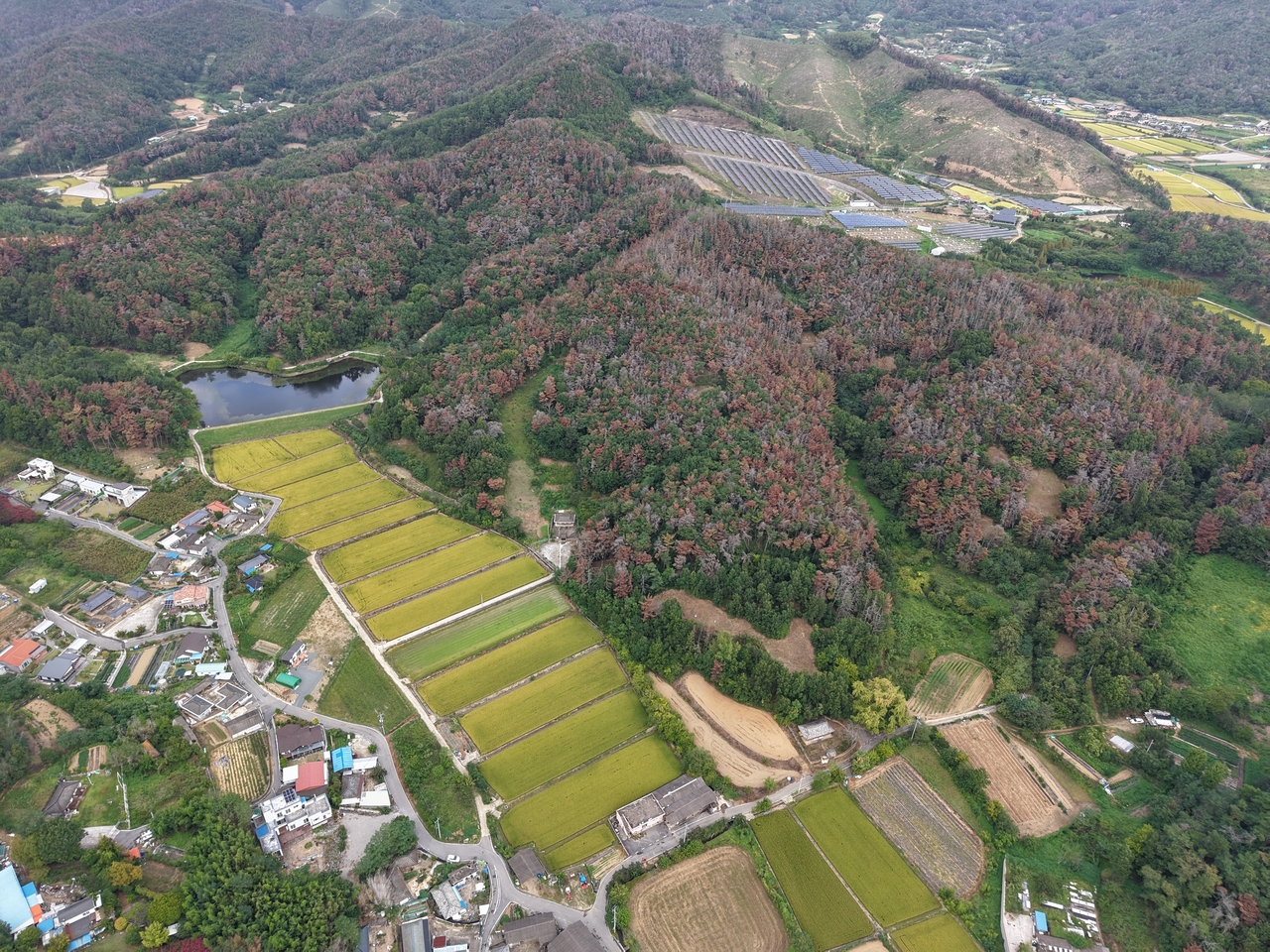
Pine wilt disease is spreading uncontrollably across South Gyeongsang Province, pushing local governments to the edge of their containment capacity. What was once a scattered problem in remote forests has escalated into mass die-offs and encroachment into residential areas, raising alarms that municipal authorities can no longer manage the crisis on their own.
According to provincial data, 310,000 trees in the province have been infected this year, with 1.1 million trees designated for removal — roughly five times the 220,000 targeted in 2022. Nationwide, 1.77 million infected trees have been recorded across 177 cities, counties and districts as of this year, with 82 percent of cases concentrated in 27 municipalities across North and South Gyeongsang Province.
Officials say the nature of the damage has also changed. Until last year, trees typically died one by one or in clusters where roughly three in 10 succumbed. This year, entire zones of forest are experiencing near-total die-offs, with 80 to 100 percent of trees in a given area withering simultaneously.
Analysts attribute the surge to record summer temperatures of 42 to 43 degrees Celsius combined with prolonged drought, which left pine trees severely stressed before infection took hold. Once infected, the nematode population inside a tree can multiply to as many as 200,000, blocking the water-conducting vessels that carry sap. Trees on dry slopes or in shallow, rocky soil deteriorate especially fast.
The damage is also moving from deep forests into urban living areas. Apartment complexes, government office grounds, parks, street trees and urban green spaces have all been affected. The spread now threatens major national heritage sites and ecosystems — including the Tongdosa temple's Mupunghansongnno pine path, the Hadong pine grove and Jirisan — as well as mushroom-producing forests and trees in residential neighborhoods.
Control efforts face compounding obstacles. The province felled about 700,000 of the 1.1 million targeted trees in the first half of this year and is working through the remaining roughly 400,000 in the second half. Clear-cutting operations — which require removing all living trees within 20 meters of an infected tree — and species-conversion projects both require the consent of landowners. However, many plots are held by clan associations or used as burial grounds, and responses from owners are often slow, stalling removal work.
The Serious Accidents Punishment Act adds another layer of difficulty. If a worker dies on the job, the contracting authority, agency head or responsible section chief can face criminal investigation, making swift action harder to authorize. Inconsistent control standards across municipal boundaries and between national park and cultural heritage zones also complicate coordination. Some relief has come recently as an inter-agency cooperation council was formed and Korea Expressway Corporation began treating trees along highways and interchange green spaces.
South Gyeongsang Province has been pressing the central government for support, arguing that local governments cannot handle the crisis alone. Following a petition to the government on Oct. 27, provincial officials raised five demands at a nationwide video conference chaired by the Korea Forest Service chief on Wednesday: designation of pine wilt disease as a national disaster; an increase in the 2027 control budget and a higher national subsidy rate; introduction of treatments, AI, satellite and helicopter-based control technology; resumption and expansion of national aerial spraying operations; and simplification of the landowner consent process for species conversion.
"We will link the government's all-out response with the province's control strategy to halt the spread and improve effectiveness," said Lee Jae-cheol, director of the provincial environment and forestry bureau. "Since the damage has reached residential areas, we also ask landowners and property owners to participate in preventive tree injections."
South Gyeongsang Province Governor Park Wan-su has repeatedly called for national-level action, saying local efforts alone are insufficient to stop the spread. "If we fail to stop this now, we will face an irreversible catastrophe," Park said. "The government and the National Assembly must recognize the gravity of the situation and swiftly pursue effective measures — including a response framework on par with a national disaster, stable fiscal support and fundamental advances in control technology."
ook967@heraldcorp.com