Korea Employment Information Service analysis of 182 occupations finds 62% of jobs stable; aging population and digital shift reshape labor market as skills gap widens
B, a five-year marketing professional at a mid-sized company, said he felt a jolt of anxiety when his employer recently introduced a generative AI tool. Tasks that had kept three team members busy for weeks — data analysis and drafting press releases — were handled by the AI in minutes. "The work has gotten easier," he said, "but I wonder whether our team will still have the same headcount at the next round of hiring."
The fear that AI will steal jobs already feels real to many workers.
Yet a new analysis suggests that over the next decade, the spread of AI and structural shifts in industry will reshape Korea's labor market rather than shrink it.
More than 60 percent of all occupations are expected to hold steady at current employment levels, and not a single occupation was classified as facing outright decline. Researchers warn, however, that the content of work and the skills it demands will change substantially — widening a quality gap within the labor market.
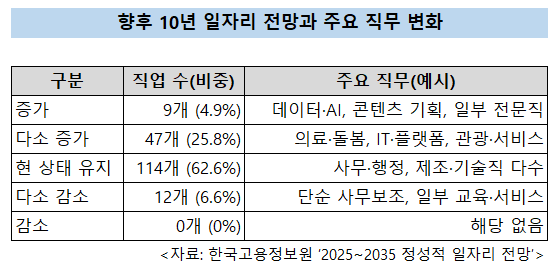
A report published Monday by the Korea Employment Information Service, covering 2025 to 2035, analyzed 182 occupations — all 205 tracked by the agency minus 23 managerial categories. Of those, 114 occupations, or 62.6 percent, were projected to maintain current employment levels. Another 47, or 25.8 percent, were expected to see moderate growth, and 9, or 4.9 percent, were projected to grow outright. Only 12 occupations, or 6.6 percent, were flagged for moderate decline, and none were classified as declining.
The findings run counter to the widespread assumption that AI will trigger mass job losses.
Zero occupations in decline: jobs to be restructured, not eliminated
Researchers Kim Dong-gyu, Kim Hyeong-rae, Lee Eun-su and Yun Mi-hee, who conducted the study, said the changes underway are better described as restructuring than reduction. Job creation and job disappearance are happening simultaneously, they said, driving rapid reorganization of tasks — and the pace and pattern of that change will grow more complex over time.
The central shift, the researchers argue, is not in occupations but in tasks.
Generative AI and digital technology are rapidly eliminating routine, repetitive work while reorganizing the roles and structures of existing jobs — changing what people do rather than eliminating the positions themselves.
In office work, for example, tasks such as compiling data and drafting reports are shrinking in importance, while decision-making, planning and problem-solving are becoming more valuable. In the content industry, the balance is tilting away from production and toward creative direction and concept development.
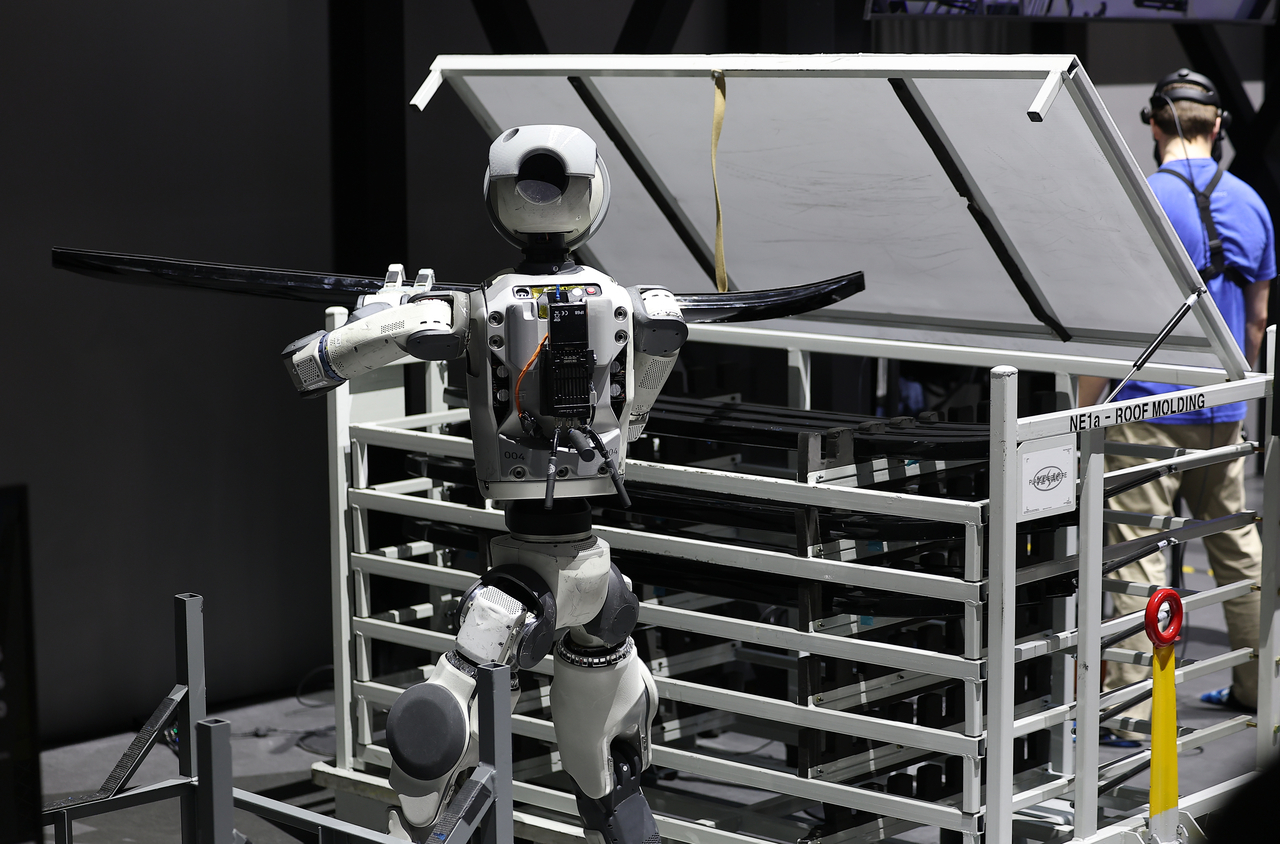
The shift extends well beyond any single sector. IT development, accounting and finance are all feeling the effects, and the researchers expect production and field workers to face significant changes if robot and autonomous driving technology matures as anticipated.
AI's reach is already expanding from office roles into professional fields such as IT development, design and accounting. Should physical AI — robots and autonomous systems — become widespread, manufacturing and on-site workers will be next, the researchers said.
Full job displacement, however, remains unlikely. The research team concluded that AI is more likely to act as a complementary technology, reducing repetitive tasks while raising the value of problem-solving, creativity and interpersonal service — high-value work that machines cannot easily replicate. Even workers in the same occupation may find that what their job actually involves changes considerably.
Care work and data roles grow; repetitive tasks shrink
Which jobs will grow, and which will contract?
The growth picture is relatively clear, driven by two forces: an aging population and digital transformation.
As Korea enters super-aged society status, structural demand is rising in healthcare, caregiving and daily-life support. Nursing, elder care, rehabilitation and mental health roles are among the most prominent examples.
Digital transformation is an equally powerful driver. Data analysis, platform operations and information security are seeing growing demand across industries. Expansion of the content industry and a rebound in tourism are also cited as factors supporting job growth.
Contraction pressure, by contrast, is concentrated in highly repetitive work. AI and automation are expected to reduce demand for basic clerical support, some customer service roles, call center work and routine service tasks. A declining school-age population driven by the low birth rate is also expected to soften demand for some education-related positions.
Ultimately, it is the nature of the work — not the job title — that will determine who fares well.
The research team identified job quality, not job quantity, as the defining variable in the labor market ahead. The more pressing question, they said, is not whether jobs disappear but who within a given occupation ends up in the stronger position. Digital literacy and problem-solving ability are likely to drive wide gaps in productivity and wages — meaning jobs may survive, but the distance between good jobs and poor ones could grow considerably.
AI, the researchers concluded, is more likely to restructure the labor market than to dismantle it — and in doing so, to widen inequality along the way.
The Korea Employment Information Service plans to extend the analysis to all roughly 490 occupations it tracks, rolling out projections in stages.
fact0514@heraldcorp.com