Government plan puts 104.4 trillion won in idle reserves; 12.5 trillion won earmarked to cut bond issuance
Negative carry of 0.5–1.5 percentage points between borrowing costs and fund returns
Size of reserve and its holding costs emerge as key issues in budget review

The government plans to set aside 104.4 trillion won ($78.4 billion) of the additional tax revenue expected from next year's semiconductor boom as idle reserves in the Future Response Fund.
In the same year, the government projects issuing 100.1 trillion won in deficit bonds to cover the general account shortfall. Because those idle reserves could instead be used to reduce bond issuance, calculating the net benefit of maintaining the fund requires first measuring the gap between bond interest costs and fund investment returns. An analysis found that if the two rates differ by 0.5 to 1.5 percentage points, holding 100 trillion won in the fund could generate an annual negative carry — an interest drag — of 500 billion to 1.5 trillion won.
According to the fourth issue of the National Assembly Budget Office's "2026 Budget Review," released Saturday, the government plans to deploy 45.4 trillion won of the fund's 162.3 trillion won in total resources in 2027 toward youth, growth engines, regional development, and education and talent programs, while using 12.5 trillion won to reduce new government bond issuance.
The remaining 104.4 trillion won — 64.3 percent of total resources — will be managed as idle reserves. Alongside the question of shifting existing general-account programs into the fund, how much to hold in reserves that will not be spent immediately has emerged as a central issue in the budget review.
Cutting bond issuance saves interest; keeping reserves earns returns
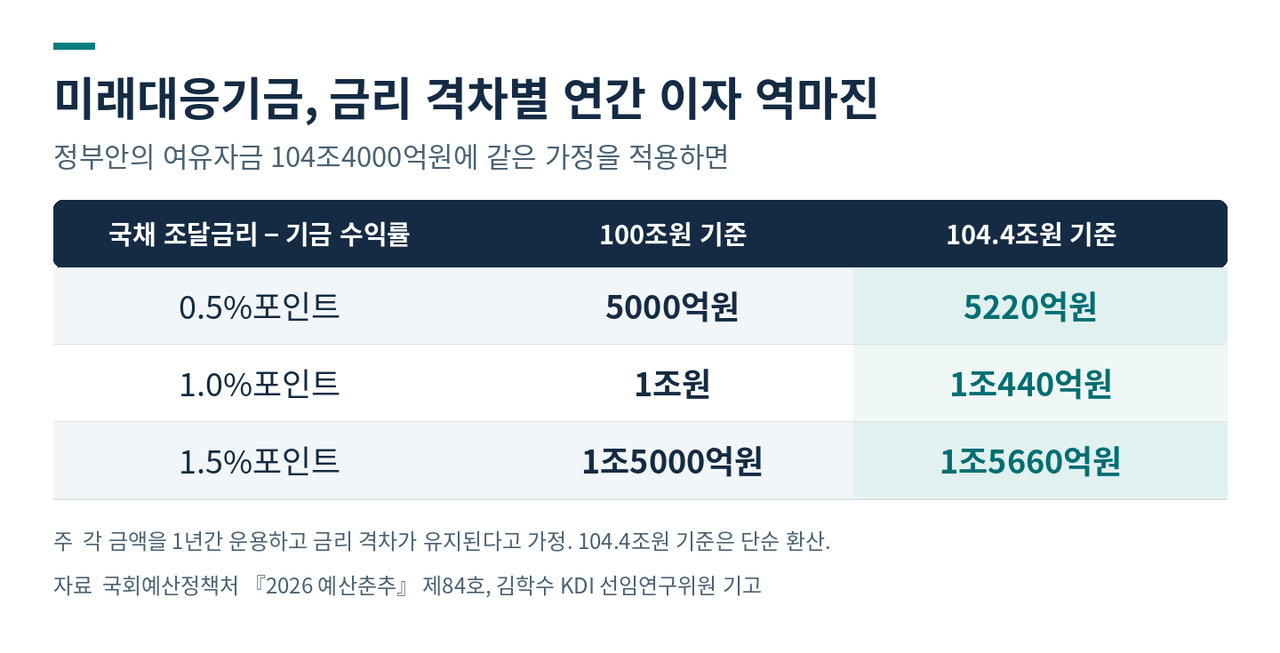
The arithmetic is straightforward. Reducing bond issuance by 100 trillion won saves the interest on that amount. Issuing bonds while keeping an equivalent sum in the fund means paying interest and earning investment returns at the same time. If the government's bond borrowing rate is 4 percent a year and the fund's investment return is 3 percent, the interest cost on 100 trillion won comes to 4 trillion won annually while the fund earns 3 trillion won — leaving a 1 trillion won annual gap that represents the cost of holding the fund compared with simply cutting bond issuance.
Kim Hak-su, a senior research fellow at the Korea Development Institute, estimated this cost at 500 billion to 1.5 trillion won per 100 trillion won per year, assuming a 0.5-to-1.5-percentage-point spread between the bond borrowing rate and the fund's investment return. The actual cost will vary depending on the maturity and interest rate of the bonds issued and how long the fund holds its assets. If long-term bond interest costs are locked in while returns on the fund's short-term assets decline, the negative carry could widen further.
How large a rainy-day reserve is enough to weather a revenue slump?
The government's rationale for building up idle reserves is to sustain growth-oriented spending even if the semiconductor cycle turns and tax revenue falls. In practice, national tax revenue came in 56.4 trillion won short of budget in 2023, when corporate earnings deteriorated, and a 30.8 trillion won shortfall followed in 2024. Having funds readily available when revenue drops sharply would reduce the pressure to cut spending or issue bonds under unfavorable market conditions.
Conversely, reducing bond issuance during a boom saves interest costs immediately and preserves borrowing capacity for when revenue falls. If the government can tap bond markets for needed funds in a timely manner, that approach may carry a lower cost. Ultimately, justifying a 104.4 trillion won reserve requires first establishing how much tax revenue would fall if the semiconductor cycle turns and how much of that shortfall the fund would need to cover. Annual withdrawal limits and accumulation caps also determine how long the fund could sustain spending through a prolonged period of weak revenue.
Kim proposed calculating the liquidity needed based on revenue-shortfall scenarios tied to a semiconductor downturn and directing the remaining resources toward reducing bond issuance. "The negative carry generated at that scale should be treated as an insurance premium and disclosed explicitly in the budget," Kim said, adding that the gap between the fund's investment return and its borrowing cost should also be published annually.
fact0514@heraldcorp.com