Where did the deceased leave their crypto?
Virtual assets excluded from Korea's one-stop inheritance inquiry service
Calls grow to include crypto in the service and freeze accounts upon death registration
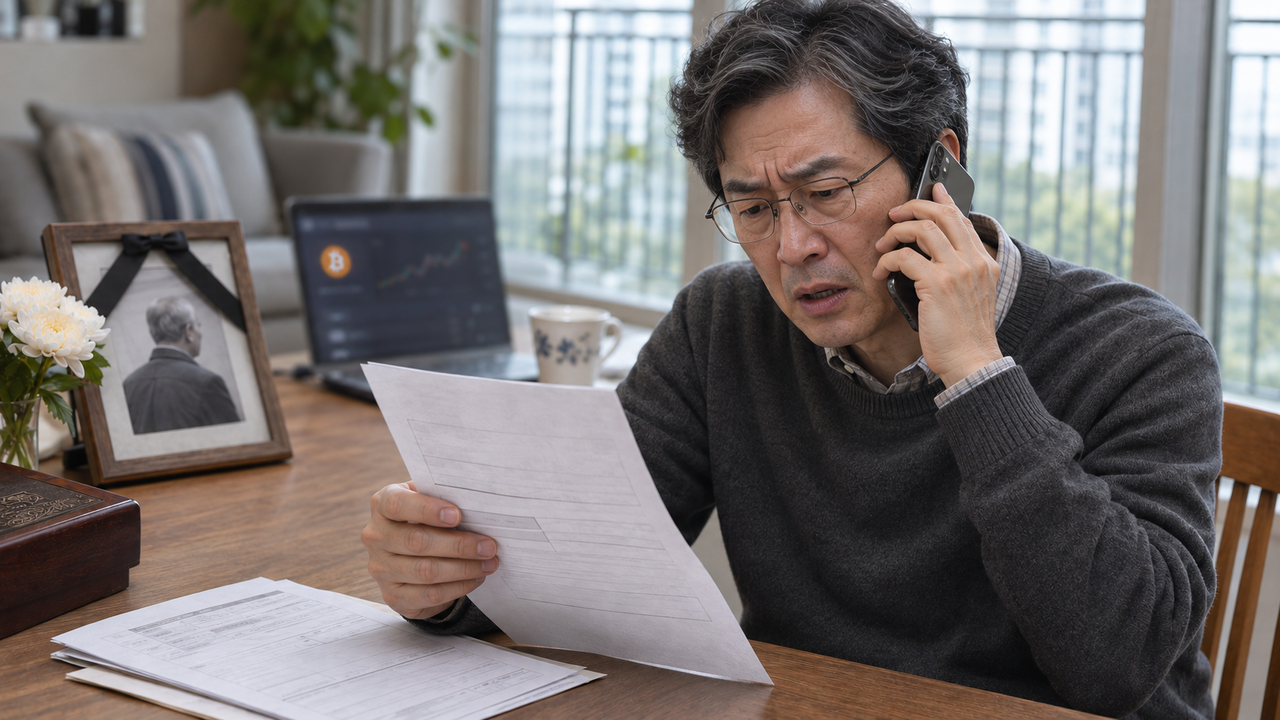
After losing a parent, a person surnamed Lee in their 50s used the government's Safe Inheritance One-Stop Service to check the deceased's bank deposits, shares and other assets. Then Lee remembered the parent had once mentioned buying "a little bitcoin." The inquiry results showed no cryptocurrency holdings. With no idea which exchange the parent had used, Lee had to contact each one individually to ask whether an account existed and whether any assets remained.
About 45 percent of exchange accounts holding 10 million won ($7,510) or more in virtual assets belong to users aged 50 and older, according to new data. As cryptocurrency becomes an established part of middle-aged and elderly Koreans' wealth, bereaved families still have no centralized way to find out whether a deceased relative held any — they must contact each exchange one by one. Calls are growing for virtual assets to be added to the government's integrated inheritance inquiry system and for rules to be updated so that accounts held in a deceased person's name can be quickly protected after a death is registered.
Over half of accounts with 1 billion won or more belong to those 50 and older
The Korea Financial Intelligence Unit and the Financial Supervisory Service released their survey on virtual asset service providers for the first half of 2026 on Sunday, showing that roughly 399,000 exchange accounts belonging to users aged 50 and older held more than 10 million won in virtual assets — about 45 percent of all 890,000 accounts above that threshold.
Users in their 50s accounted for the largest share by age group, with about 267,000 accounts, while those aged 60 and older held about 132,000. Particularly striking: roughly one in seven exchange accounts held by users 60 and older — 13.4 percent — contained more than 10 million won in virtual assets, the highest proportion of any age group.
Among accounts holding 1 billion won or more, more than half belonged to users aged 50 and older. Of the 3,275 such accounts in total, 1,077 belonged to users in their 50s and 787 to those aged 60 and older, together accounting for 56.9 percent. "There is considerable demand among people in their 50s and 60s to hold bitcoin over the long term," a bank official said. "The day when wealth management services at banks include virtual asset investment is not far off."
Bitcoin left by a parent: where do heirs even look?
If a parent never disclosed their crypto investments, children settling an estate may have no idea the deceased held bitcoin or other virtual assets at all. The government's Safe Inheritance One-Stop Service lets heirs check a deceased person's bank deposits, securities, land, vehicles and other major assets in a single inquiry — but virtual assets are not included.
Families who do not know which exchange the deceased used must contact each platform individually to ask whether any assets are held there. Exchanges have no way of knowing a user has died unless the family notifies them, which means protective measures — such as restricting transactions on the deceased's account — can be significantly delayed.
These gaps have prompted calls to add virtual assets to the integrated inheritance inquiry system and to put rules in place for quickly protecting accounts held in a deceased person's name. In response, Dunamu, the operator of the Upbit exchange, put forward proposals for reforming the virtual asset inheritance process at the 2026 National Assembly Legislative Expo, held at the National Assembly building in Yeouido, Seoul, on Nov. 5 and 6.
'Add crypto to the safe inheritance service, and freeze accounts fast when a death is registered'
In the policy proposal Dunamu submitted to the National Assembly, the company called for amending the Ministry of Interior and Safety directive governing the integrated processing of asset inquiries for deceased persons and those under guardianship, so that virtual assets are added to the Safe Inheritance One-Stop Service.
Under the proposed system, a single application filed through the Government24 portal or a local community center would prompt virtual asset service providers to check whether the deceased held any assets and report back. The proposal also calls for establishing an information-sharing procedure so that the receiving agency can request inquiries from each provider and relay the results to the heir.
Protecting accounts held in a deceased person's name would also require extending the financial sector's death-information sharing system to virtual asset service providers. Banks and other financial institutions already receive daily death notifications from the Ministry of Interior and Safety, allowing them to restrict transactions on a deceased person's accounts even without a separate notification from the family. Dunamu's proposal would apply the same system to virtual asset service providers, enabling account restrictions to take effect before an heir even files an asset inquiry.
The exchange industry had previously asked financial regulators to extend the rapid transaction-blocking system for accounts held in deceased persons' names to virtual asset service providers, but was told that sharing death information was not possible under current rules. Under the Credit Information Act, the entities to which credit information clearinghouses may provide information received from public institutions are defined by presidential decree — and virtual asset service providers are not on that list.
Dunamu's proposal therefore calls for amending Article 19, Paragraph 6 of the Credit Information Act's enforcement decree to add virtual asset service providers as eligible recipients of such information, giving exchanges the legal basis to receive death notifications and promptly restrict transactions on accounts held in deceased persons' names.

forest@heraldcorp.com