Current administration follows predecessors in rate-freeze dilemma
'Taxpayers will foot the bill in the end' vs. 'Inflation, approval ratings make hikes politically toxic'
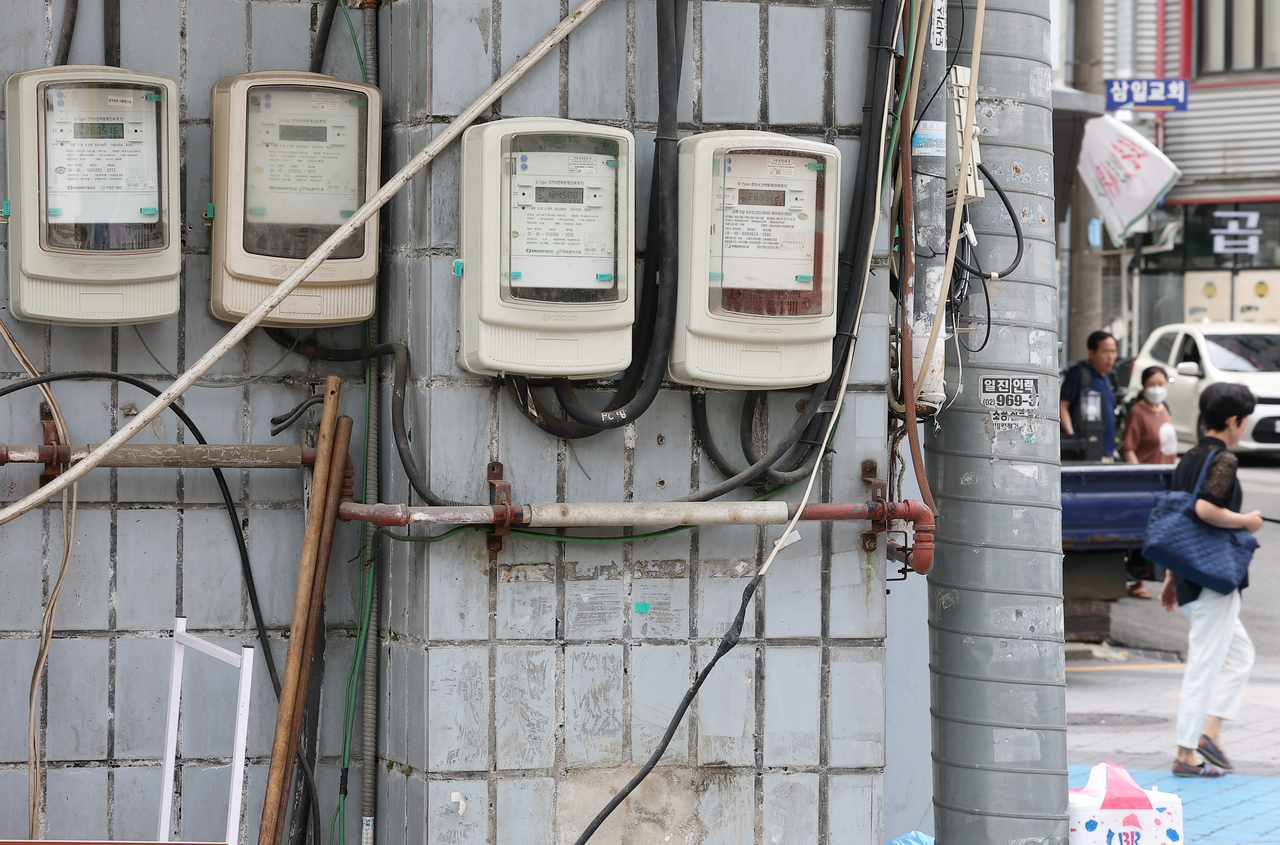
Concerns are growing that the Lee Jae-myung government is repeating the same "hot potato" pattern of suppressing electricity and gas rate hikes that every previous administration has pursued out of fear of falling approval ratings.
Critics say the failure to normalize utility rates is deepening the financial crisis at Korea Electric Power Corporation and Korea Gas Corporation and destabilizing the broader power and gas markets.
Kim Dong-cheol, the Korea Electric Power Corporation president, and Hong Eui-rak, the Korea Gas Corporation president — both former politicians — have been speaking in unison about the need for rate increases.
According to the energy industry on Sunday, Korea Electric Power Corporation posted a consolidated operating profit of 1.64 trillion won ($1.24 billion) in the third quarter of this year, a 70.9 percent drop from the same period last year.
The main cause is the freeze on electricity rates even as power generation costs have risen following a surge in fuel prices — including LNG and thermal coal — since the Middle East conflict began. Residential electricity rates have been frozen for 14 consecutive quarters; industrial rates for eight.
A consolidated operating loss is now forecast for the fourth quarter. KEPCO's total debt stood at 209.6 trillion won as of the end of the third quarter, already about 4 trillion won more than at the end of last year. Borrowings alone reached 132.8 trillion won. The interest burden is equally daunting: interest expenses for the first nine months of this year came to 3.2 trillion won, averaging 11.8 billion won a day.
As debts mount, so do capital requirements. KEPCO must invest more than 55 trillion won in transmission and distribution infrastructure between this year and 2030.
Korea Gas Corporation is in a similarly precarious position. Its total debt stands at about 40.6 trillion won, its debt ratio at 345 percent, and uncollected receivables have piled up to around 15 trillion won. Annual interest expenses amount to 500 billion won.
Uncollected receivables for residential city gas supply reached 13.83 trillion won in the third quarter, up 288.6 billion won from 13.54 trillion won at the end of the first half of this year. Receivables for power-generation gas use rose by 142.8 billion won to 533.7 billion won.
These receivables represent money the corporation has not collected from customers because it has been supplying gas below cost — an "on-credit" shortfall that grows borrowings and interest costs the longer it accumulates. With winter heating demand approaching, the receivables are likely to swell further.
LNG import costs have soared since the Middle East conflict, yet residential gas rates have been frozen since August 2024.
The Moon Jae-in government pursued a nuclear phase-out as a core policy priority but never raised electricity rates, a stance widely seen as having saddled KEPCO with more than 200 trillion won in debt.
A 2023 Board of Audit and Inspection report on the financial soundness and management of public institutions detailed, point by point, how electricity and gas rates went unraised from 2021 through early 2022.
Within the ruling camp, the prevailing view is that the Moon government's nuclear phase-out policy — which reduced the share of low-cost nuclear power while expanding expensive renewable energy and gas — was the decisive factor behind KEPCO's losses.
According to the audit findings, energy authorities at the time sought to raise electricity rates to reflect rising international energy costs, but the Ministry of Economy and Finance, then responsible for price stability, repeatedly blocked the increases on grounds of inflation control and public burden. An interagency economic coordination meeting held at Cheong Wa Dae on Dec. 17, 2021, was found to have blocked a planned rate hike.
The National Assembly Futures Institute said in a December report last year on restructuring the retail electricity market for industrial competitiveness that "the Moon government's rate-freeze stance suppressed electricity price increases even as international fuel costs surged after the Russia-Ukraine war in 2022, transferring the fuel cost burden onto KEPCO and triggering a severe financial crisis in which its debt exceeded 200 trillion won."
The Yoon Suk-yeol government was no different. After raising rates in the first and second quarters of 2023 (by 21.1 won per kilowatt-hour) and again in the fourth quarter of that year (by 10.6 won per kWh for industrial users only), it kept rates frozen thereafter.
When Russia invaded Ukraine in February 2022, energy prices including natural gas spiked sharply, and the wholesale price at which KEPCO purchases electricity from generators more than doubled to 197 won per kWh.
Yet retail selling prices remained at just 121 won per kWh for households and 119 won for industry — a situation where the raw material cost far exceeded the price of the finished product. In 2023, KEPCO was still buying electricity at 167 won per kWh and selling it to households and businesses at 150 won and 154 won respectively. The more it sold, the more it lost.
Shortly after taking office, President Lee Jae-myung signaled at a senior secretaries meeting on Aug. 14 last year that electricity rates would need to rise, saying, "If we are to meet our greenhouse gas reduction targets, electricity rates will inevitably go up. We need to inform the public and seek their understanding and consent."
Yet the Lee government has kept electricity and gas rates frozen despite soaring fuel costs driven by the Middle East conflict. Critics point out that if KEPCO and Korea Gas Corporation's financial deterioration deepens to the point where normal operations and service delivery become untenable, the government will have no choice but to inject public funds through equity investment, subsidies or payment guarantees — meaning the public will ultimately bear the cost anyway.
On the other hand, the prevailing view among government officials is that allowing sharp utility rate hikes to address accumulated deficits and debt at state-run enterprises risks stoking inflation and eroding approval ratings — making the "hot potato" game with electricity and gas rates all but unavoidable.
oskymoon@heraldcorp.com