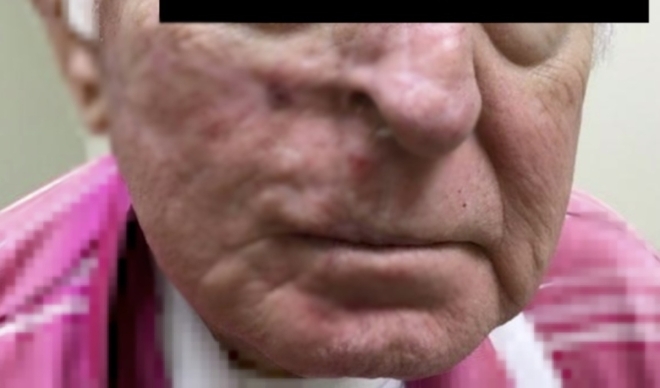
A man in the United States who received radiation treatment across his entire face as a teenager to treat severe acne was diagnosed with skin cancer 44 times after reaching his 70s.
What made the case unusual was that the cancers did not appear evenly across his face — they clustered on the right side. More than half of the skin cancers that developed over 11 years were found on the right side of his face.
The case was published Nov. 13 in the international journal JMIR Dermatology as a formal case report titled "Nonsyndromic Agminated Basal Cell Carcinomas: Diagnostic and Therapeutic Conundrum Case Report." Four American medical professionals, including Sarita Patisamm, authored the paper.
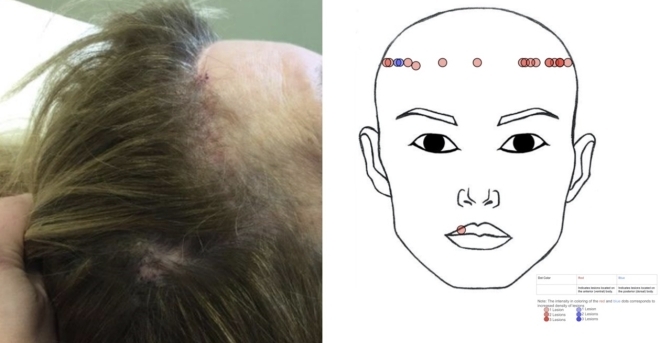
According to the paper, a 78-year-old patient received a total of 44 basal cell carcinoma diagnoses between 2013 and 2024 — a span of 11 years. Of those, 24 (54 percent) occurred on the right side of the face, with 20 concentrated around the right side of the mouth and cheek. A lesion distribution map released by the researchers clearly showed the clustering of cancerous lesions on the right side of the face.
The medical team focused on the patient's childhood medical history. As a teenager, the patient had undergone radiation treatment across the entire face for roughly three months to treat severe acne. While radiation was once used for acne treatment, there is a known risk that skin cancer can develop decades after such exposure.
The case alone is not enough to conclude that the past radiation treatment was the direct cause of the skin cancers. The medical team did consider the history of radiation exposure as a risk factor, but could not determine why the cancers concentrated on the right side of the face despite the radiation having been applied across the entire face.
The researchers raised the possibility that a genetic vulnerability existed only in certain areas of the skin, or that environmental factors were at play. They also cited "cutaneous mosaicism" — a phenomenon in which genetic changes appear in only some skin cells — as a possible explanation. However, genetic sequencing of the patient's lesion tissue was not performed, so the cause could not be confirmed.
To remove the repeatedly occurring cancerous lesions, the patient underwent Mohs micrographic surgery, electrodesiccation and curettage, and standard surgical excision. Mohs surgery involves removing cancerous tissue in thin layers, with each layer examined under a microscope to check for remaining cancer cells — a technique used for skin cancers in areas such as the face, where tissue preservation is important.
The paper also described a second patient: a 67-year-old who was diagnosed with 22 basal cell carcinomas over 24 years, from 2000 to 2024, with 19 of them concentrated near the forehead and hairline. Neither patient showed clear signs of a specific genetic syndrome, but both shared the pattern of skin cancers recurring repeatedly in a limited area.
Past radiation exposure, not just UV rays, a risk factor
Basal cell carcinoma is the most common type of skin cancer, originating in the basal layer cells of the skin's epidermis. The primary risk factor is ultraviolet radiation exposure. The risk can also increase with prolonged sun exposure or a history of radiation treatment.
The cancer typically grows slowly and rarely spreads to other organs. Left untreated, however, it can invade surrounding skin, muscle and bone, causing tissue damage. When it develops on the face in particular, surgery can leave scarring or visible changes to appearance.
The American Academy of Dermatology says basal cell carcinoma can appear in various forms — a shiny pink bump, a flesh-colored growth, a sore that does not heal, or a scar-like patch. If a wound repeatedly bleeds, crusts over or fails to heal, a dermatologist should be consulted.
The researchers said the two cases offer clues to understanding why skin cancers can concentrate in specific areas of the body.
123@heraldcorp.com