Buyback limits to be eased for three months starting Tuesday
Special crackdown on illegal short selling to run for three months
Capital market reform task force to be launched without delay
The government has begun preparations to activate the stock market stabilization fund as volatility surges at home and abroad, driven by a downturn on US markets and deepening uncertainty over the global AI and semiconductor industries.
Daily buyback order limits for listed companies will be eased for three months, and a special intensive surveillance campaign against illegal short selling will also be launched.
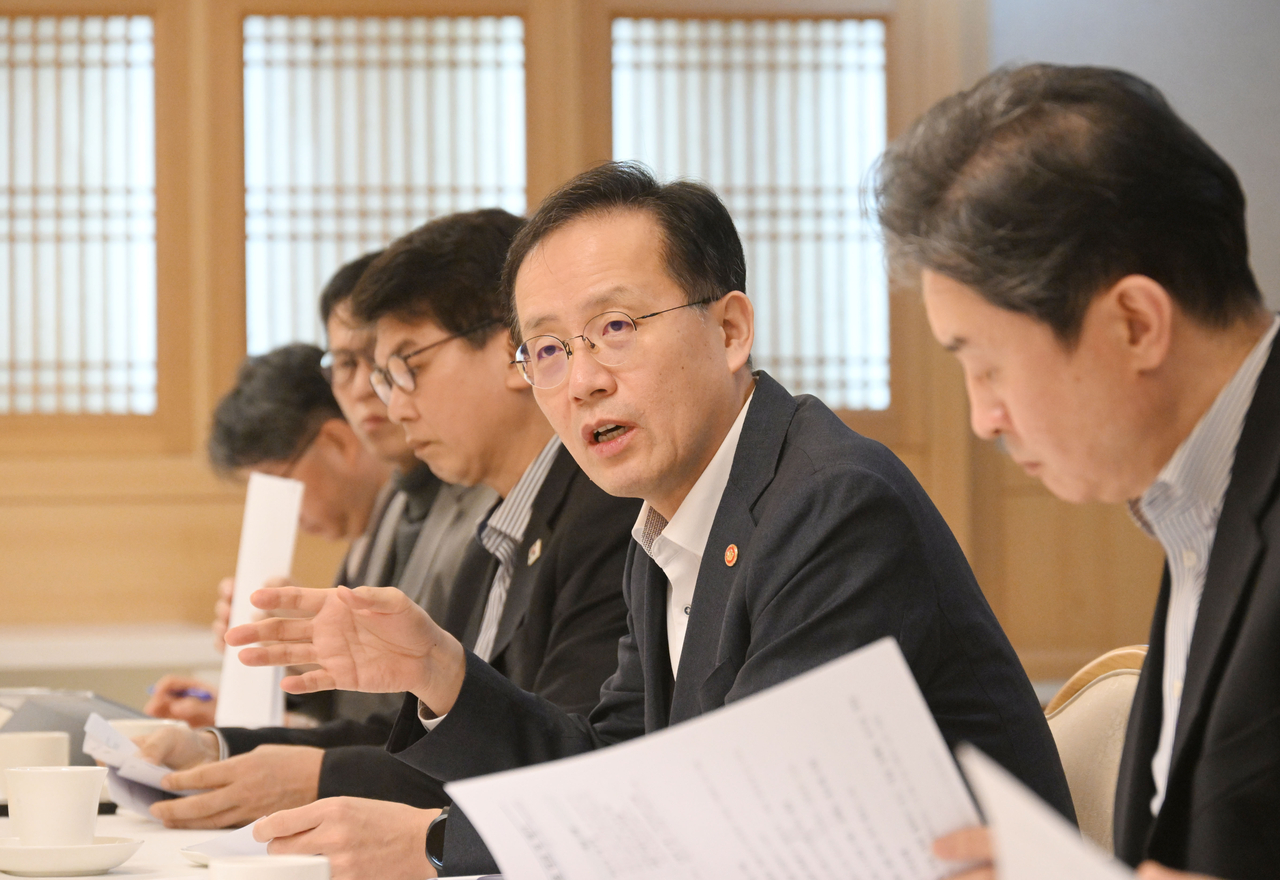
Deputy Prime Minister and Minister of Economy and Finance Lee Hyeong-il convened a joint emergency market situation review meeting — known as the F4 meeting — with relevant agencies at Government Complex Seoul on Sunday, announcing a phased set of market stabilization measures.
Bank of Korea Governor Shin Hyun-song, FSC Chairman Lee Eok-won and Financial Supervisory Service Director General Lee Chan-jin attended the meeting.
As a first step, the government will begin preparatory work — including reviewing activation procedures and strengthening operational effectiveness — to ensure the stock market stabilization fund can be deployed immediately in line with market conditions, in accordance with an existing contingency plan.
To ease stock market volatility, daily buyback order limits for listed companies will be relaxed for three months starting Tuesday. The FSC is set to approve the related measures Monday.
In addition, the Financial Supervisory Service and Korea Exchange will operate a three-month special intensive surveillance period targeting illegal short selling, with strict action to be taken against any violations detected.
Authorities will closely monitor margin financing, unsettled trading and forced liquidation trends to prevent market instability from spreading through cascading selling pressure, while also strengthening advance notification to investors ahead of forced liquidations. Surveillance against unfair trading practices — including the spread of false information and market price manipulation — will also be stepped up.
Meeting participants assessed that volatility in domestic and overseas markets had risen sharply due to uncertainties surrounding the global AI and semiconductor industries and US interest rate hikes. They noted that policy risks — including uncertainty over the profitability and financing of the AI industry, US data center regulations and tightened semiconductor export controls — were coming to the fore, fueling broader concern about the global AI industry ecosystem.
However, participants agreed on the need to guard against excessive anxiety and panic selling, noting that expectations for the AI industry's medium- to long-term growth remain largely intact.
Alongside short-term stabilization measures, the government said it will continue pursuing fundamental improvements to the capital market's underlying structure so that domestic markets can respond stably to external shocks.
To that end, the government plans to launch a dedicated capital market reform task force without delay and use it to discuss improvements to the tax and capital market systems aimed at encouraging long-term investment and easing supply-demand imbalances.
The government called on the National Assembly to actively cooperate in processing related bills and budget proposals to enable the swift implementation of capital market reform policies, including improvements to the method of valuing listed shares under inheritance and gift tax law, the creation of a new productive-finance ISA, the introduction of a Child Independence Fund and the strengthening of retirement pension functions.
The government added that it will concentrate all available policy resources on nurturing next-generation industries to succeed semiconductors, developing advanced strategic industries, strengthening the competitiveness of the service sector and diversifying exports.
y2k@heraldcorp.com