National Assembly Research Service study diagnoses 163 non-metropolitan cities and counties by local conditions and youth net migration rate
Greater Seoul surpassed the rest of the country in total population around 2019, but in youth population the tipping point came around 2004
'Good conditions don't keep young people — and even those who arrive don't stay'
The Greater Seoul area began to hold more young residents than the rest of the country about 15 years before its total population overtook that of non-metropolitan regions, a new government-commissioned study shows. Analysts say the youth-led concentration in the capital region has been driving the broader population shift all along. The findings raise questions about the effectiveness of the government's "5 Poles, 3 Specials" decentralization and balanced regional development initiative, with researchers warning that the policy will fall short unless conditions are created to keep young people from leaving and to help them settle outside the capital region.
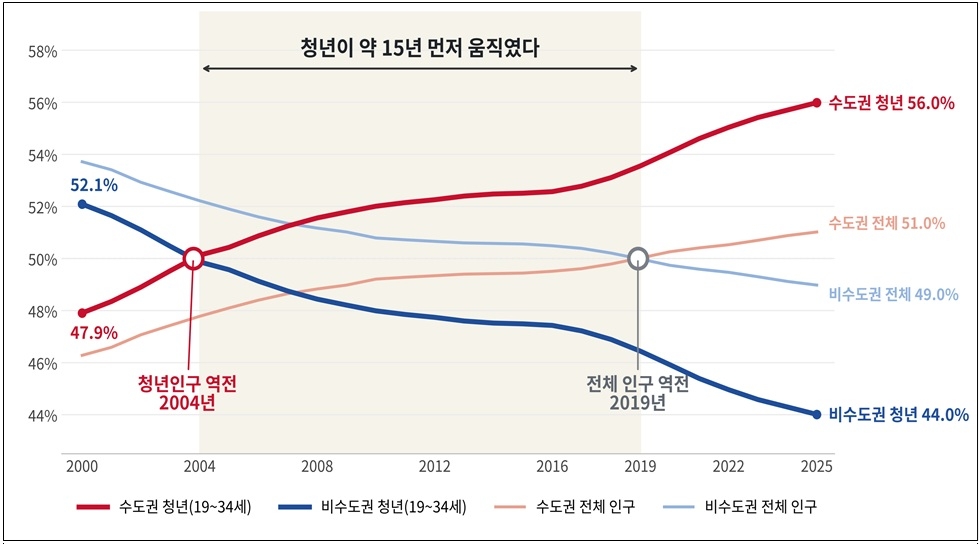
According to a policy research report titled "Development of Inter-regional Inequality Analysis Indicators and Empirical Research," commissioned by the National Assembly Research Service from the Korea Research Institute for Human Settlements, the Greater Seoul area's total population surpassed that of non-metropolitan regions in 2019. For young people aged 19 to 34, however, that crossover occurred around 2004 — roughly 15 years earlier.
The share of the national youth population living in the Greater Seoul area rose from 47.9 percent in 2000 to 56.0 percent in 2025, while the non-metropolitan share fell from 52.1 percent to 44.0 percent over the same period. By 2025, the gap between the two stood at 12.0 percentage points — about six times the roughly 2-percentage-point gap for the overall population.
The report compared population growth rates, total fertility rates and youth net migration rates against local conditions across five categories — employment, transportation, lifestyle, culture and education — and found that the youth net migration rate showed the most consistent relationship with local conditions.
In non-metropolitan areas, 15 of 16 key condition indicators showed a clear correlation with the youth net migration rate. In the Greater Seoul area, only 5 of the same indicators showed such a relationship.
A closer look at individual indicators reveals that young people are leaving even where conditions are relatively good.
In areas where all five categories — employment, transportation, lifestyle, culture and education — exceeded the national median, a net outflow of 188,000 young people aged 20 to 34 was recorded over the five years from 2020 to 2024.
About 78 percent of that outflow involved moves to other provinces, with those in their 20s accounting for the majority. The list includes many of the regional hubs that have long anchored their areas: Suseong-gu and Dalseo-gu in Daegu, Changwon and Gimhae, Dong-gu, Jung-gu and Ulju-gun in Ulsan, Haeundae-gu in Busan, Mokpo, Yeosu and Gangneung.
The reasons for leaving differ by area. In Daegu's Suseong-gu, primary and secondary education and housing conditions are solid, but jobs and higher-education institutions are lacking. The share of workers employed at large companies stands at 10.7 percent — less than half the 22.9 percent average across Seoul's districts — and residents in their 20s tend to leave for other provinces when it comes time for university or employment.
Ulsan's Dong-gu and Changwon have many factories but offer young people few ways in. In Dong-gu, 43.3 percent of workers are employed at large companies, yet the entry employment rate for local young people was just 2.5 percent.
"Good primary and secondary education and housing are not enough to retain young people," the report said. "The fact that a place was prosperous in the past and is comfortable for middle-aged and older residents does not mean young people feel the same way. Good universities and jobs come first."
A separate problem is that young people who do arrive often do not stay, because local living areas depend on a single new town or a single factory.
In Muan, the youth population surged each time residents moved into the Namak and Oryong new towns. Yet 46.5 percent of the young people who came to Muan from the Gwangju and South Jeolla Province area were originally from neighboring Mokpo — a shift within the region rather than genuine inflow from outside.
Dangjin has benefited from relatively strong short-term employment conditions thanks to its steelworks and industrial complexes. But when the steel industry slumped between 2018 and 2021, young people left again.
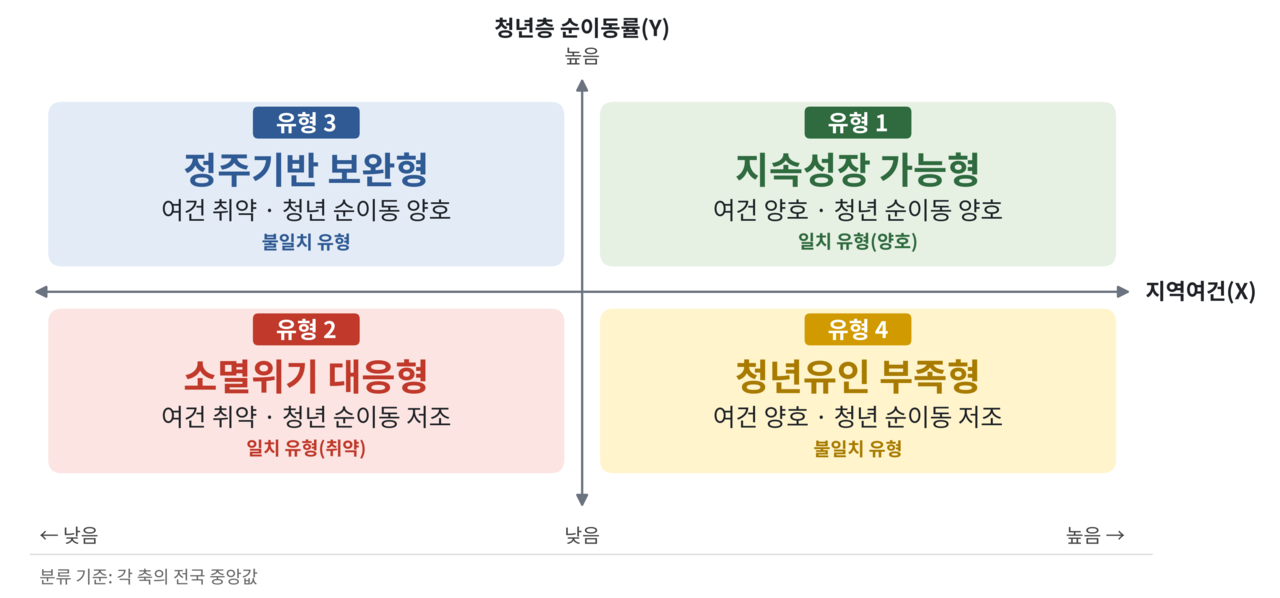
"Jobs are a necessary condition for keeping young people, but not a sufficient one," the report said, recommending that regions seize the current moment of youth inflow to improve settlement conditions while diversifying their industrial base into services and other sectors.
The report also stressed that every region has its own story. "Even where headline figures — population, gross regional domestic product, settlement conditions — look similar, the structure and trajectory of the population, the content and makeup of industry, and the weakest settlement factors all differ," it said. "Each region must build a system for diagnosing and assessing its own situation, setting a vision for the future and drawing up a roadmap tailored to its own narrative."
thlee@heraldcorp.com