Kospi tumbles 5.21% last week, falling below 5,000
Nasdaq drops 5.28%; Nvidia plunges more than 14%
Foreign investors net sell for 6 consecutive sessions, offloading over 5 trillion won
Financial authorities prepare market stabilization fund for possible deployment
First potential activation since 2008 eyed as markets seek calm
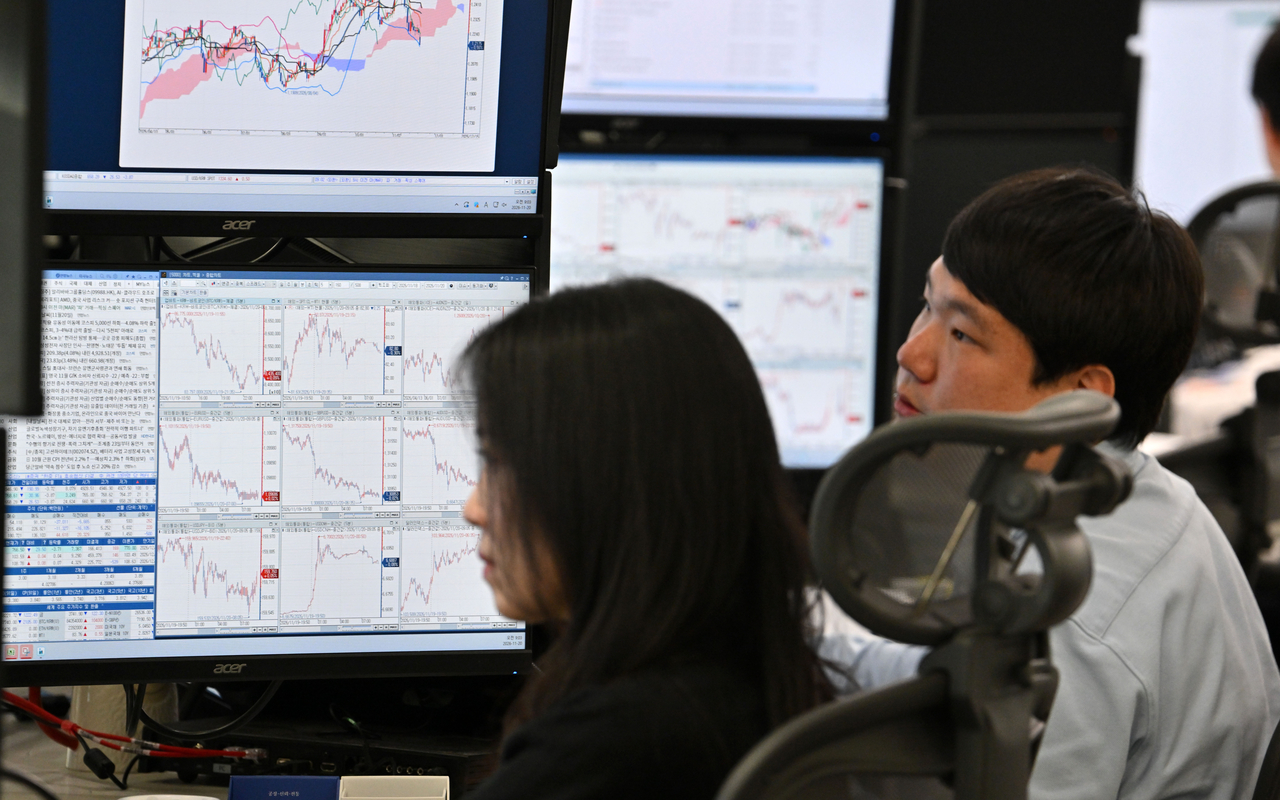
Fears of a "Black Monday" are spreading across South Korea's stock market as AI investment uncertainty from the United States and a sharp selloff in semiconductor shares weigh on sentiment. The Kospi plunged more than 5 percent last week, surrendering the 5,000-point threshold, and Wall Street's steep decline has deepened concerns about further losses.
Financial authorities are now preparing to activate the securities market stabilization fund for the first time in 18 years — since the 2008 global financial crisis — raising hopes that the measure could ease downward pressure on the market.
According to Korea Exchange, the Kospi closed Friday at 4,869.96, down 267.93 points, or 5.21 percent, from the previous session. The benchmark index fell back below the 5,000 level for the first time in three trading sessions, marking its lowest close since Jan. 16, when it finished at 4,840.74.
Foreign investors offloaded 1.14 trillion won ($858 million) during regular trading hours. Over six consecutive sessions starting Nov. 13, they net sold a combined 5.1 trillion won. Institutional investors also net sold 951 billion won, while retail investors net bought 1.6 trillion won. Including after-market trading from 4 p.m. to 8 p.m., foreign investors net sold 1.1 trillion won and institutions net sold 933 billion won, while retail investors net bought 1.52 trillion won.
Investor sentiment froze as concerns mounted over tightening US semiconductor regulations. Despite AI company Anthropic's successful initial public offering, which raised around 143 trillion won, reports emerged that AMD — following Nvidia — faces exposure to China-related sanctions risks. A string of negative developments surrounding AI stocks has also continued in the wake of a scandal involving former Nvidia CEO Jensen Huang.
All three major Wall Street indexes fell sharply on Monday. The Dow Jones Industrial Average dropped 1.93 percent, while the S&P 500 and the Nasdaq Composite declined 3.70 percent and 5.28 percent, respectively.
The Dow and the S&P 500 each fell more than 10 percent from their recent peaks, entering correction territory. The S&P 500 posted its seventh consecutive session of losses Monday, its longest losing streak since February 2020 during the early days of the COVID-19 pandemic. The Nasdaq has now erased all of its gains for 2026.
The CBOE Volatility Index, Wall Street's so-called fear gauge, surged 26.20 percent from the prior session, reaching its highest level since April 2025.
AI and semiconductor stocks bore the brunt of the selloff. Nvidia fell 14.01 percent, while SanDisk (-16.05 percent), Micron (-13.89 percent), AMD (-13.25 percent), Broadcom (-12.19 percent), CoreWeave (-12.02 percent) and SK hynix's American depositary receipts (-13.11 percent) all tumbled more than 10 percent. The Philadelphia Semiconductor Index dropped 10.73 percent.
News that Nvidia is under investigation by the Securities and Exchange Commission also surfaced over the weekend, adding to anxiety. Foreign media reported that SEC investigators are examining potential accounting issues at the company, though the specific nature of the probe has not been confirmed.
Nvidia is already under investigation by the Department of Justice and the Department of Commerce over possible violations of AI chip export controls to China, a probe that arose in connection with a scandal involving former CEO Huang and a woman suspected of being a Chinese intelligence operative.
Huang's departure has also fueled fears that the aggressive AI investment cycle — and the circular flow of capital it sustained — could grind to a halt, adding another layer of pressure on markets.
As Black Monday fears intensified amid the global market rout, financial authorities met over the weekend to discuss activating the securities market stabilization fund. The fund is a pool of capital assembled by securities firms, banks and other financial institutions to be deployed during sharp market downturns when investor sentiment deteriorates rapidly.
Deputy Prime Minister and Finance Minister Lee Hyeong-il, Bank of Korea Governor Shin Hyun-song, Financial Services Commission Chairman Lee Eok-won and Financial Supervisory Service Director Lee Chan-jin attended the meeting. The authorities said they would immediately begin preparations to ensure the fund could be activated at any time depending on market conditions.
During the 2008 global financial crisis, 515 billion won was raised and injected into the market in multiple tranches between November of that year and March of the following year. If deployed now, it would mark the first activation of the fund in 18 years.

th5@heraldcorp.com