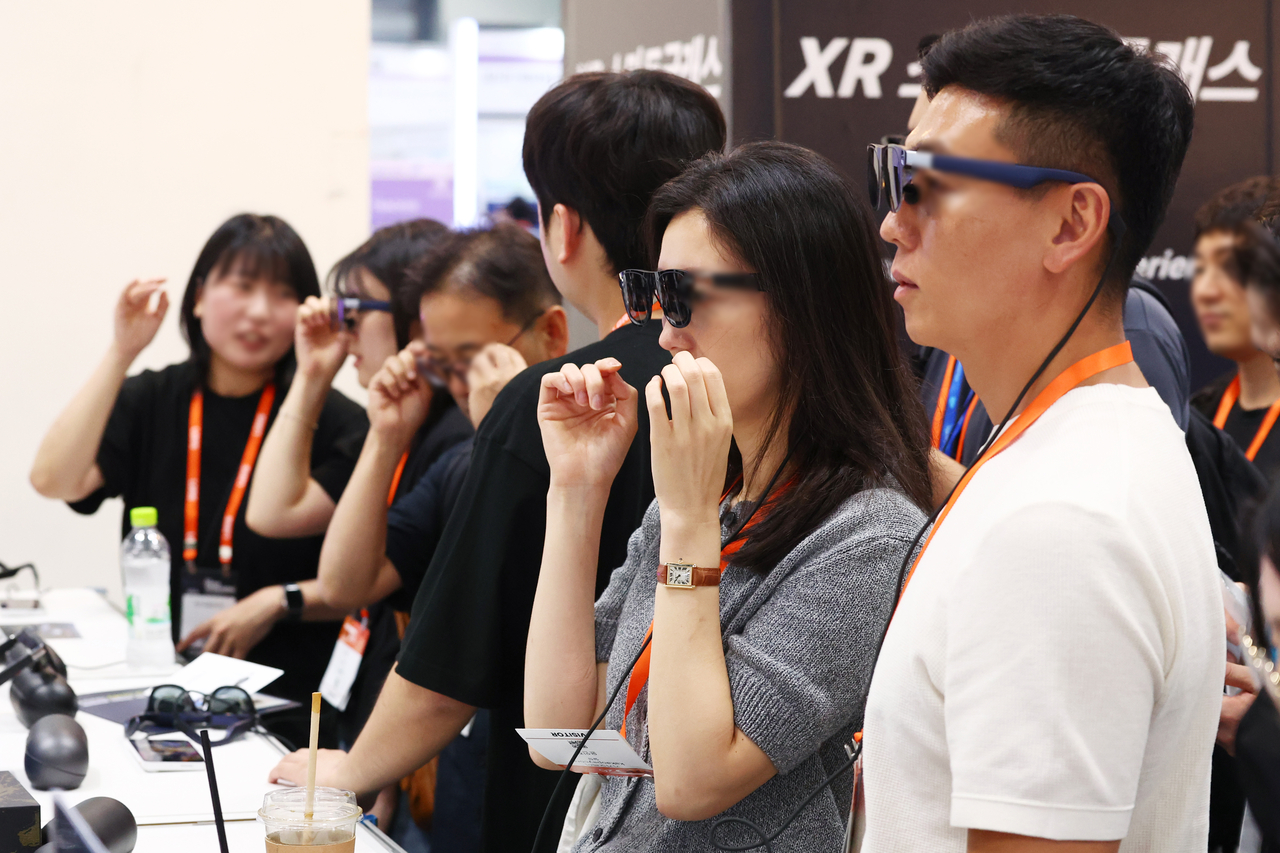
Legislation is being pursued that would require AI smart glasses to be equipped with a recording indicator and oblige individuals to notify others when filming them in private settings.
Democratic Party of Korea lawmaker Lee Ju-hee, a member of the National Assembly's Science, ICT, Broadcasting and Communications Committee, announced Monday that Lee had introduced two bills — an amendment to the Act on Promotion of Information and Communications Network Utilization and Information Protection and an amendment to the Personal Information Protection Act — collectively dubbed the "Smart Glasses Illegal Recording Prevention Act."
The core of the amendments is to ensure that people being filmed with smart glasses can recognize that they are being recorded, by setting manufacturing and import standards and imposing a notification obligation on users.
Major manufacturers such as Meta currently equip their smart glasses with indicator lights that signal when recording is underway, but some lower-priced products either lack such features or make it difficult to tell from the outside whether recording is taking place.
Under the current Personal Information Protection Act, the obligation to display and notify recording activity for mobile image-processing devices applies only to filming for business purposes, leaving a gap when individuals record others in private contexts.
To address this, the proposed amendment to the Information and Communications Network Act would require manufacturers and importers of wearable video-recording devices — including smart glasses — to build in a recording indicator function and take technical measures to link the recording and indicator functions so they operate together.
The bill also prohibits users from arbitrarily disabling or interfering with the indicator function, and bans the manufacture, import, sale, distribution and advertising of any product or program designed to circumvent it.
Sellers would be required to inform buyers of how the recording indicator works and of the potential penalties and sanctions for filming others without consent.
The companion amendment to the Personal Information Protection Act would require anyone using a wearable image-processing device — such as glasses or a watch — to indicate and announce the fact of recording through lights, sounds, signs or other means whenever filming a person or related objects, regardless of whether the purpose is business-related. Violations would carry a fine of up to 10 million won ($7,200).
"Everyone should be able to know on the spot that they are being filmed and refuse if they do not consent," Lee said. "We will establish standards to protect privacy from the moment of recording, so that no one discovers footage of themselves taken with smart glasses after the fact on the internet."
husn7@heraldcorp.com