'We call for restoration of upstream-downstream solidarity, fair compensation and an end to overlapping regulations'
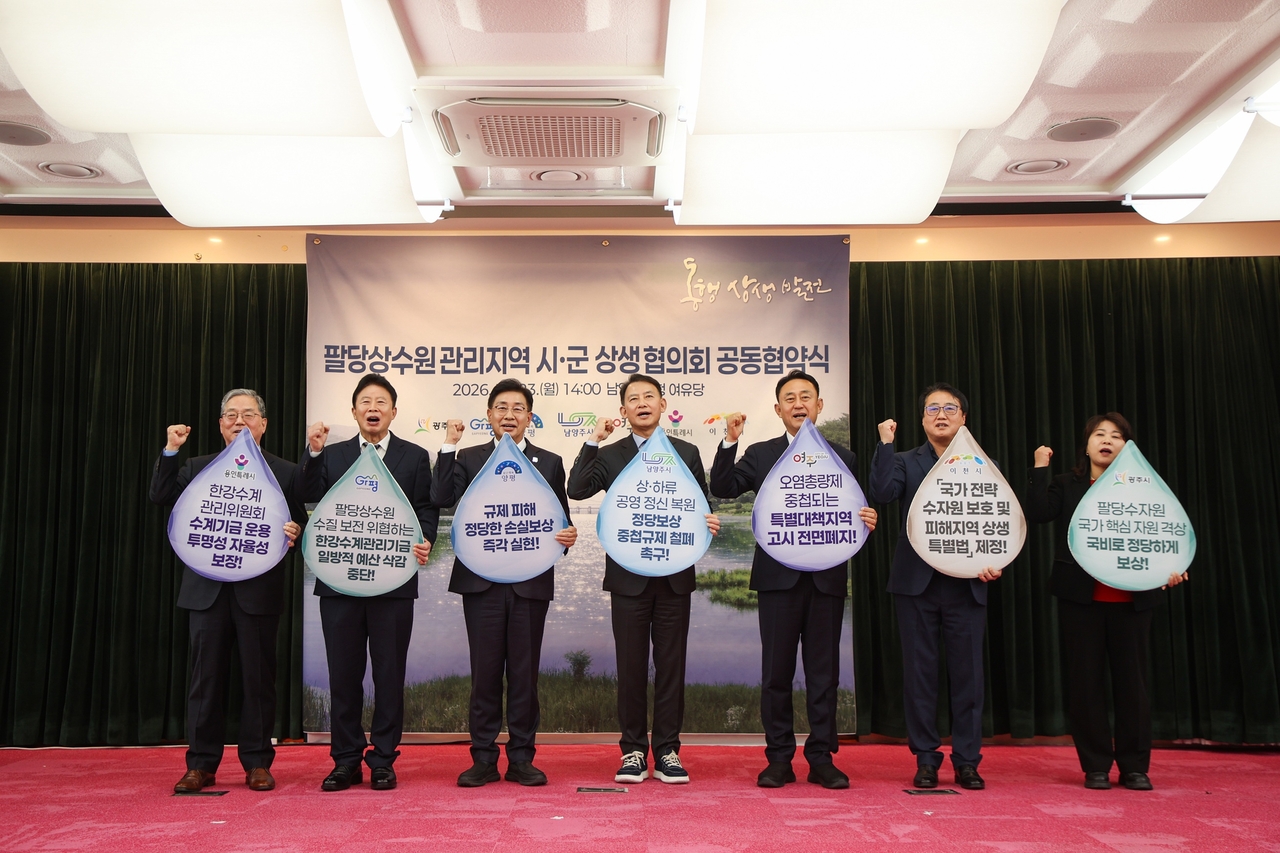
Seven municipalities in the Paldang water source management area have formed a joint cooperation council and signed a collective agreement to push for regulatory reform.
Namyangju, Yongin Special City, Gwangju, Icheon, Yangpyeong-gun, Yeoju and Gapyeong-gun convened Monday at Namyangju City Hall's Yeoudang Hall to establish the Paldang Water Source Management Area Municipal Cooperation Council and agreed to mount a coordinated campaign for regulatory improvements.
The seven local governments issued a joint declaration titled "We call for restoration of the upstream-downstream solidarity spirit, fair compensation and an end to overlapping regulations," solemnly pledging to "stand firmly united and fight with full force."
Namyangju Mayor Choi Hyeon-deok and the other municipal leaders said they "can no longer tolerate an abnormal water management policy that demands one-sided sacrifice." The seven municipalities are "strongly urging the government and the National Assembly to act on six demands for the mutual development of 26 million greater Seoul residents, the establishment of national water security, and the restoration of rights lost to regulatory damage," they added.
The following is the full text of the joint declaration by municipalities in the Paldang water source management area.
"We call for restoration of the upstream-downstream solidarity spirit, fair compensation and an end to overlapping regulations!"
The Paldang reservoir, the lifeblood of 26 million greater Seoul residents, has quietly underpinned national development and public health for half a century. Yet the residents of the Paldang water source management area have borne the burden alone — suffering severe infringement of property rights and stunted regional development under excessive, overlapping regulations imposed to protect it.
In 1998, the central government — through the Ministry of Environment — made three pledges under a special Han River water quality improvement plan: a shift from regulation-only to support-centered policy; permanent support based on the beneficiary-pays principle; and autonomous regional development through a total pollution load management system. Those promises remain unfulfilled. The municipalities have faithfully implemented the total pollution load management system, yet they remain bound by a double and triple layer of restrictions — the Special Measures Area designation and the riparian zone designation — a clear form of regional discrimination that undermines public trust in government.
Water resources have become a core national strategic asset, far beyond their role as mere drinking water. Just as the state compensates border communities for their sacrifice in the name of national defense, the residents of the Paldang area — who have protected the nation's water for 50 years in the name of economic security — deserve to be recognized not merely as victims of regulation but as contributors to national water security, and to receive the treatment and fair compensation they are owed.
We can no longer tolerate an abnormal water management policy that demands one-sided sacrifice. The seven municipalities in the Paldang water source management area therefore strongly urge the government and the National Assembly to take the following actions for the mutual development of 26 million greater Seoul residents, the establishment of national water security, and the restoration of rights lost to regulatory damage.
1. Immediately deliver fair compensation for regulatory losses.
Raise the water use charge levy rate to reflect current realities and substantially increase resident support project funding.
Codify substantive loss compensation and resident support provisions in the Framework Act on Environmental Policy and the Act on Improvement of Water Quality and Support for Residents of the Han River Basin.
2. Fully abolish the Special Measures Area designation, which overlaps with the total pollution load management system.
Given that water quality is already strictly managed through the total pollution load management system, the Special Measures Area designation — whose policy mandate has expired — must be immediately rescinded.
Outdated restrictions that directly harm residents' livelihoods — including limits on the siting of wastewater discharge facilities and buildings within sewage treatment zones — must be immediately eliminated.
3. Stop the unilateral budget cuts to the Han River Basin Management Fund that threaten Paldang water quality.
Immediately cease the practice of cutting the basin fund — built on the unilateral sacrifice of upstream residents under the beneficiary-pays principle — using the government's discretionary spending criteria.
Restore funding to realistic levels for core water quality management projects essential to protecting Paldang Lake, including installation and operating costs for environmental infrastructure, total pollution load management plan operations, and nonpoint source pollution reduction projects. Stop shifting the burden onto local government finances.
Revise guidelines to reflect the diverse needs and realities of residents in fund operations, expand the types and scope of eligible support projects — including revenue-generating activities — and guarantee autonomous management.
Transfer to local governments the direct implementation, ownership and autonomous operational rights of state-name land purchase projects — under which residents bear the sacrifice while the state reaps the benefits — and also transfer ownership and operational rights of already-purchased land to local governments, returning it as shared space for residents.
4. Reform the Han River Basin Management Committee and guarantee transparency and autonomy in fund operations.
Break free from the central government's unilateral and monopolistic control, secure the independence of the Han River Basin Management Committee, and guarantee the participation of local governments and residents throughout the entire fund management process.
5. Elevate Paldang water resources to the status of a core national strategic asset and provide fair compensation through national funds.
In keeping with Paldang Lake's importance, move away from the distorted compensation structure that relies solely on water use charges paid by downstream residents.
Just as the state directly bears the cost of national security, legislate a direct and sustainable compensation support system funded by the national budget.
6. Promptly enact a special act — tentatively titled the Special Act on Protection of National Strategic Water Resources and Mutual Development of Affected Areas.
Break free from the existing passive and rigid legal framework and enact a special act that guarantees water security and the shared development of upstream regions.
The special act must specifically set out a comprehensive overhaul of outdated overlapping regulations, fair compensation backed by national funds, and a plan for building smart water management infrastructure.
The municipalities of the Paldang water source management area solemnly declare that they will stand firmly united and fight with full force until the day when the value of Paldang Lake — a national water security asset preserved through the tears and sacrifice of its residents — bears fruit in the form of fair compensation and rational regulatory reform.
Nov. 23, 2026
The municipalities of the Paldang water source management area
pjh@heraldcorp.com