Platform expected to expand from private to public chains as infrastructure diversifies
'AI essential for STO implementation,' firm stresses need to verify 24-hour settlement system
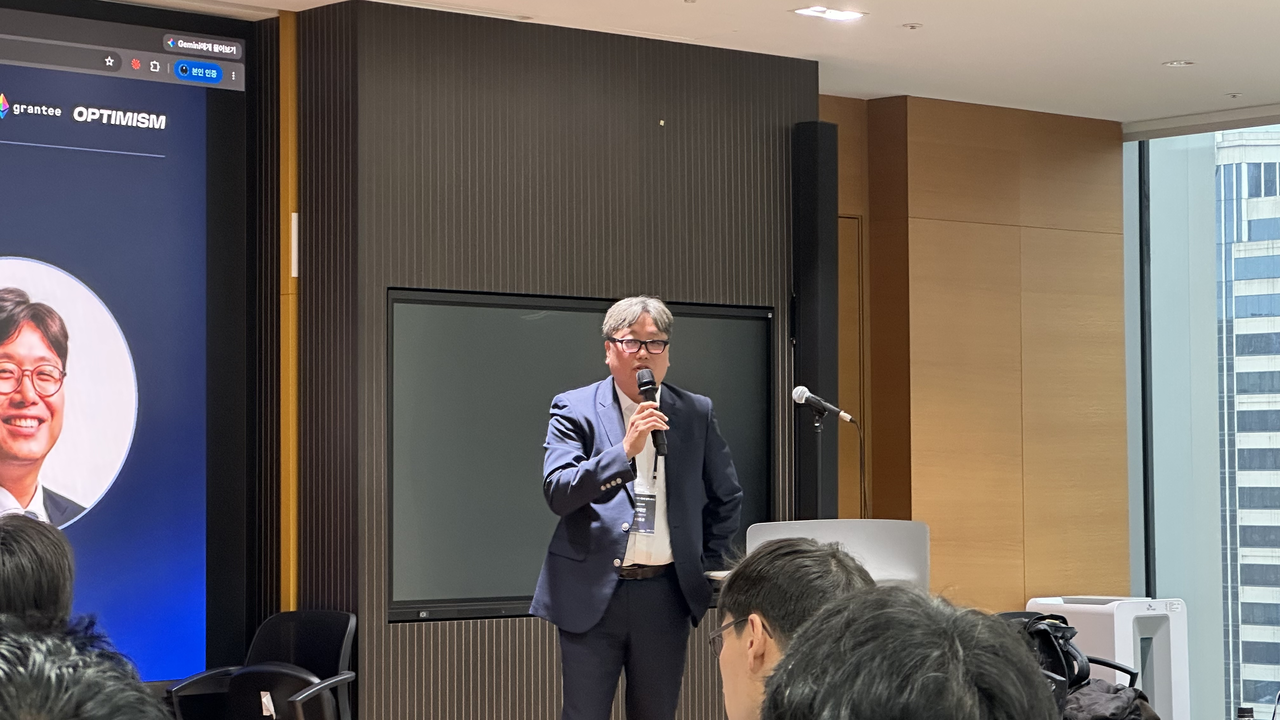
KB Securities is developing a multi-chain issuance and distribution platform to serve both domestic and overseas security token offering (STO) markets. The firm expects the market to take shape gradually at first — centered on private placement products when the new regime launches next year — before accelerating sharply in two to three years as the scope expands to include public offerings. AI is also expected to play a growing role as the financial industry shifts its existing systems to blockchain-based infrastructure.
Park Jae-man, head of the AI and Digital Division at KB Securities, said Monday at the third Ethereum Korea policy seminar at KB Securities headquarters in Yeouido, Seoul, that securities firms face real difficulties because the infrastructure accepted in overseas markets differs from what is permitted domestically. "We are designing the architecture so that we can respond even when new infrastructure is added," Park said.
KB Securities is preparing a multi-chain issuance and distribution platform capable of flexibly connecting multiple blockchains. The firm also expects the domestic STO market to gradually expand its use of blockchain from private chains to public chains over the long term, with infrastructure becoming more diverse along the way.
"We recently added a new infrastructure while preparing another, and we completed the related work in two to three weeks," Park said. "That is how flexible a multi-chain platform we are building."
On the international front, the firm is drawing lessons from the US market as a reference for what lies ahead in Korea. "It is extremely important to experience and learn in advance from the US market what will happen in Korea," Park said. "We are paying close attention to what pain points and hurdles existed, and which companies solved them — and how — to actually make money."
KB Securities announced in September that it had signed MOUs with global tokenization platform Securitize and the Optimism Foundation, with plans to offer tokenized money market funds (MMFs) and other products to institutional investors. The Financial Services Commission also announced in September that it would allow the tokenization of institutional-only private MMFs and private bonds starting in February next year as a first step under its STO policy framework.
Park cited instant liquidity — one of the core values of STOs — as the reason MMFs were chosen as an initial product. "We thought MMF was one of the most important products for liquidity," Park said. "We are preparing equally for both domestic and overseas markets."
However, Park said rapid market growth is unlikely in the short term even after the STO regime takes effect in February next year. The initial permitted products — private MMFs and bonds — have relatively inactive secondary markets, which means the key STO advantages of instant settlement and immediate fund receipt may not stand out as clearly at first.
"Once it is verified that instant payment, delivery versus payment (DvP), and 24-hour operation all work properly, explosive success stories could emerge when the market moves to the second phase in two to three years and expands to public bonds and securities," Park said.
Park also stressed the role of AI in building STO infrastructure. Converting the complex operational systems of existing securities firms into blockchain-based smart contracts, he said, requires advanced AI capabilities.
"At first, I thought about how to use AI to make STOs faster and more efficient," Park said. "But now my thinking has shifted to whether it is even possible to implement STOs properly without strong AI capabilities."
Park said simply replacing a database with a blockchain while keeping existing business processes intact would not be enough to fully realize the advantages of STOs. Translating the data and workflows of complex, intertwined legacy financial systems into smart contracts demands a high level of software design expertise, making AI indispensable, Park added.
As a challenge the industry must collectively verify before the regime launches, Park pointed to building a system capable of operating around the clock, 365 days a year. Confirming that DvP settlement can be automated across a multi-firm system and run stably at any hour is essential, Park said.
"I am not sure whether two or more companies in Yeouido's financial district have ever maintained and operated a 24/7 system," Park said. "I think it is no easy challenge."
"Ideally, all DvP settlements would be automated and run regardless of the time," Park added. "Consortium partners and other securities firms will need to work together to solve challenges none of us have faced before."
kyoung@heraldcorp.com