
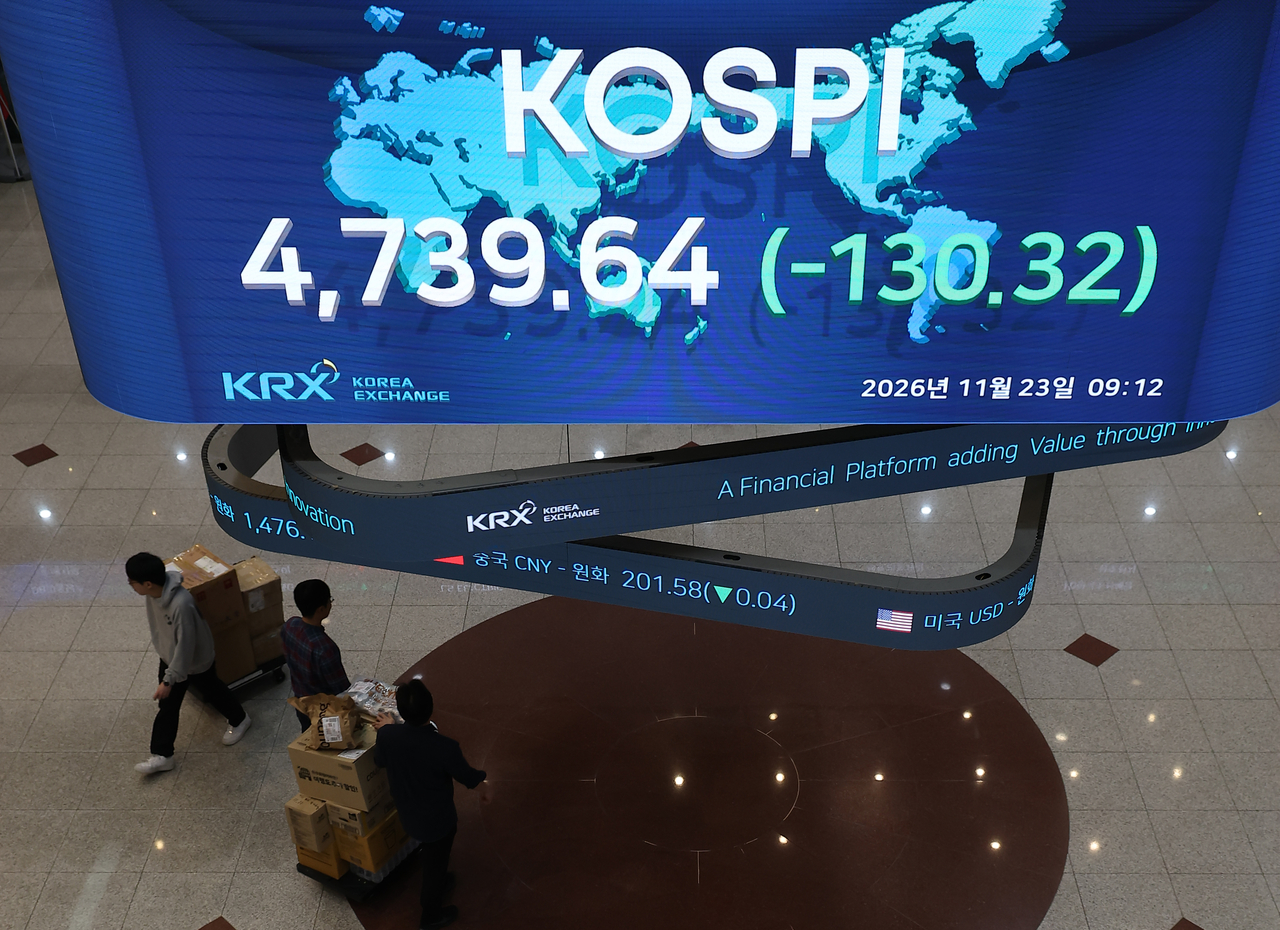
South Korea's stock market stabilization fund is expected to serve mainly as a psychological buffer against a sharp market selloff rather than a tool capable of reversing a downtrend, analysts say. Given past instances in which actual fund deployment failed to halt a falling market, the consensus is that any intervention this time would be more effective at calming panic selling and limiting losses than at turning the tide.
According to the financial investment industry, the government announced Sunday that it had begun preparations to activate the stabilization fund immediately if market conditions warrant, following an emergency joint market-monitoring meeting — known as the F4 meeting — held that day. The move comes in response to heightened global market volatility driven by concerns over AI industry profitability and financing and the possibility of US data center regulation. Alongside the fund, the government said it would ease the daily limit on share buyback orders by listed companies for three months and launch a special crackdown on illegal short selling.
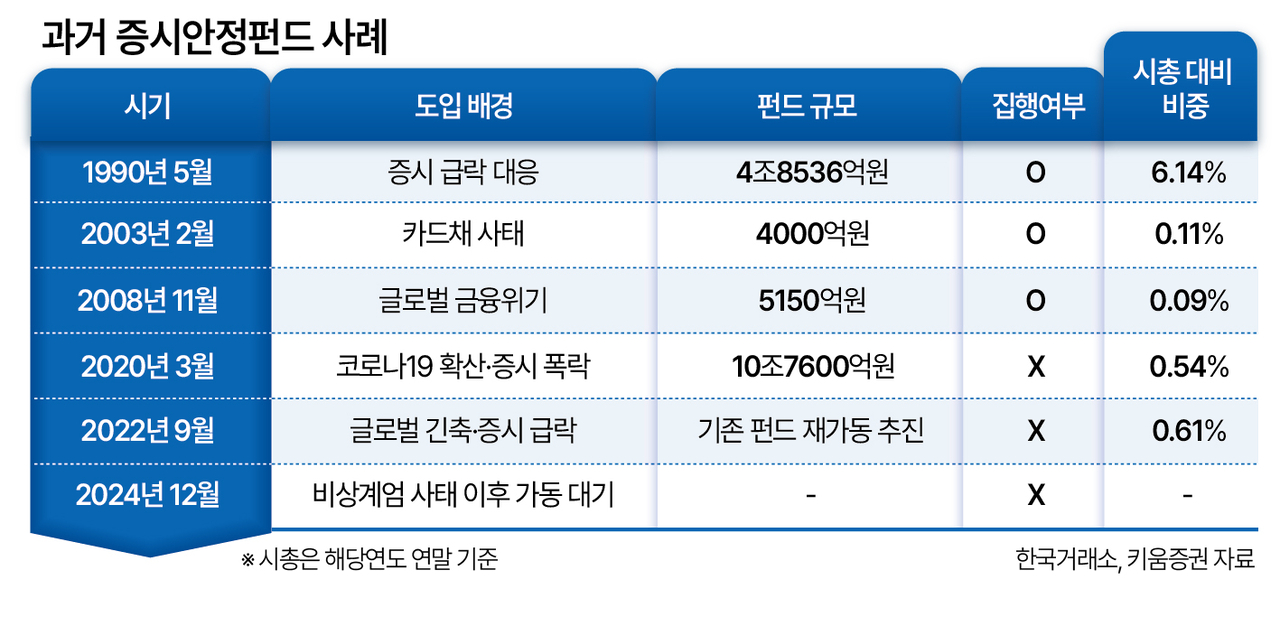
The stock market stabilization fund is a mechanism through which the government directly purchases shares to restore market stability during abnormal economic conditions such as a financial crisis. It has been deployed three times in South Korea. The first came in 1990, when a 4.85 trillion won ($3.63 billion) fund was established to counter a market slump caused by an economic slowdown and an oversupply of shares. A further 400 billion won was deployed during the credit card crisis of 2003, and 515 billion won during the global financial crisis of 2008. During the COVID-19 shock of 2020, financial institutions assembled a 10.76 trillion won fund, but a market rebound meant no actual purchases were made. In 2022, when global monetary tightening triggered a sharp market decline, and again in December 2024, when the emergency martial law crisis erupted, authorities went no further than reviewing whether to reactivate the existing fund.
Opinions on the fund's effectiveness are divided across the industry. While policy intervention can help calm excessive panic selling, analysts repeatedly note that the fund alone cannot reverse a downtrend if the underlying causes of the decline remain unresolved.
Song Min-gyu, vice president of the Korea Institute of Finance, said the stabilization fund had historically been operated on a temporary basis in exceptional circumstances and had been relatively small compared with those of other countries. "It has been able to ease temporary psychological anxiety in the stock market, but past precedent shows it has not been enough to produce a share price rebound or a meaningful increase in liquidity," Song said.
Song advised that while direct government intervention in the stock market through the fund should generally be avoided, if the cause of a sharp decline lies outside the market itself, authorities should minimize side effects by pre-announcing the trigger conditions and scale of any deployment. "The right sequence is to proactively assess institutional investment strategies and the scale of investment before moving to stabilize the market," Song added.
Recent share buybacks by major semiconductor companies also illustrate how even tens of trillions of won in spending can struggle to hold back broader market selling pressure. SK hynix launched an additional 20 trillion won buyback program from Oct. 29 and had repurchased about 6.6 trillion won worth of its own shares on the domestic market through Friday — yet a rebound in SK hynix's share price, let alone a broader Kospi recovery, has remained elusive.
Taiwan's experience also shows both the potential and the limits of policy intervention. Authorities there approved the activation of a financial stabilization fund on Nov. 6, but selling pressure on global technology stocks and foreign capital outflows continued, keeping the market under pressure. By Friday, Taiwan's benchmark index had fallen more than 9 percent from its closing level on the day the fund activation was approved.
Despite the debate over effectiveness, analysts say a blanket ban on short selling — another measure floated as a potential market stabilization tool — is effectively off the table. That is why the stabilization fund is seen as the only viable alternative.
Han Ji-young, a researcher at Kiwoom Securities, said a short selling ban was being discussed in the market as a stabilization measure but could weigh on South Korea's bid to join the MSCI developed-market index. "The risk of heightening concerns about foreign investor access and damaging policy credibility is likely to outweigh any short-term benefit from easing selling pressure," Han said. "Compared with a short selling ban, the stabilization fund is expected to be relatively more effective because it can supply direct buying demand and signal the government's commitment to market stability without restricting foreign investors' ability to trade or hedge," Han added.
The current push to activate the fund is seen as aimed more at limiting the depth of a selloff than at reversing the broader market trend. Because the scale and deployment method of the fund have yet to be specified, the industry expects its effect to be confined to capping index losses and calming a rush of panic selling rather than producing a sustained turnaround.
On historical patterns, Han noted that "there has been a tendency for panic selling to subside and for a rebound to emerge even when the market stabilization fund enters only the preparation stage, before any actual deployment." Han added that while other factors — including shifts in monetary policy and a reduction in external uncertainty — also contributed to share price recoveries at the time, "the signal itself that the government would not stand by and allow a market freefall helped ease investors' excessive anxiety."
With the stabilization fund now on the table, some analysts are advising investors to hold existing positions rather than sell at the lows. Kim Dae-jun, a researcher at Korea Investment Securities, said that in both 2020 and 2022, funds of more than 10 trillion won were assembled but markets stabilized through verbal intervention alone, with no actual capital deployed into the stock market. "The Kospi has already fallen excessively relative to fundamentals, and the authorities' stabilization measures are becoming more concrete," Kim said. "Even if the index wobbles for a while, there is no need to join the panic selling now."
kacew@heraldcorp.com





