
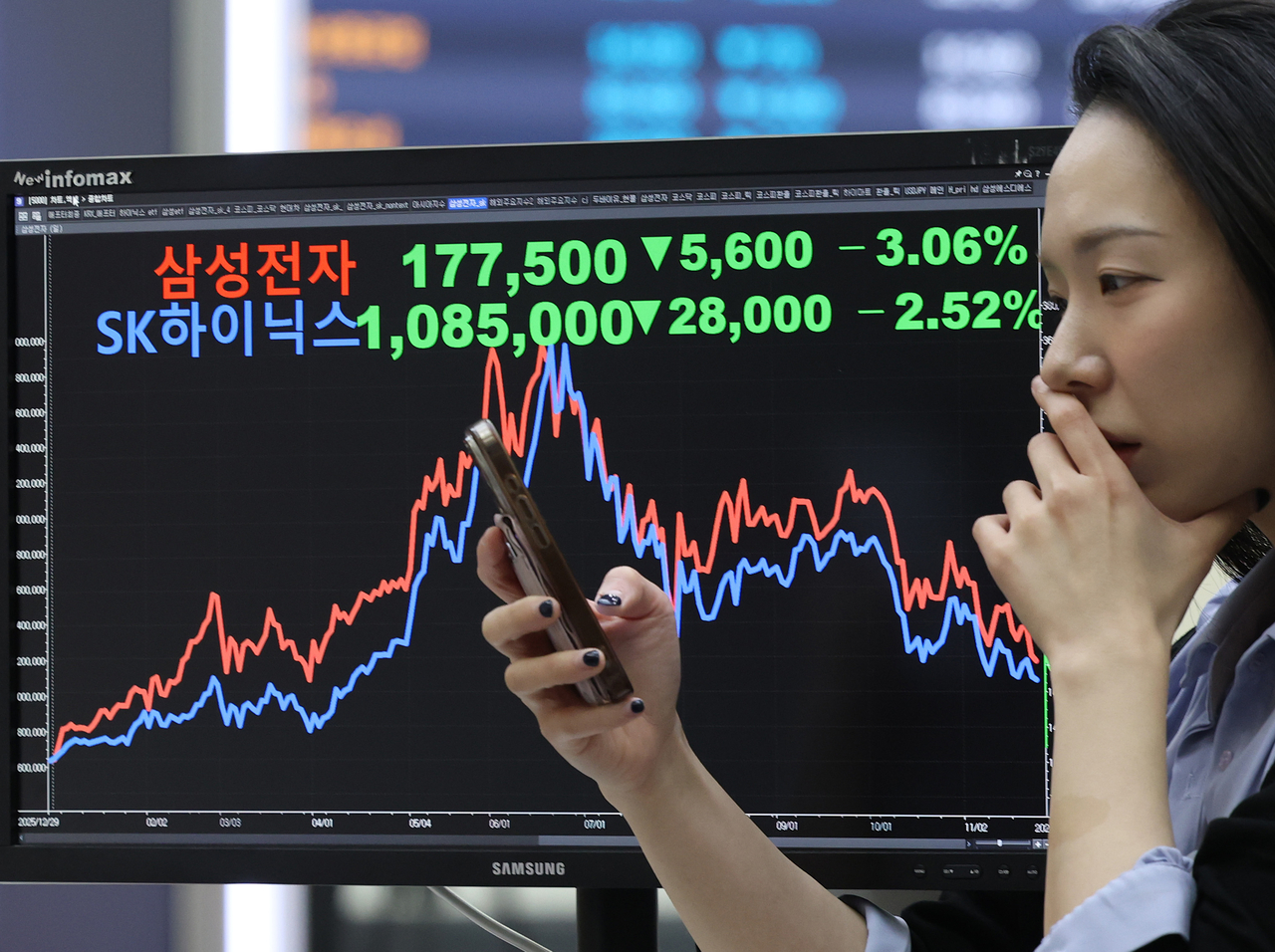
Global investment banks are successively cutting their target share prices for Samsung Electronics and SK hynix, citing expectations that a supply surge from 2028 will drag down memory chip prices and weaken profitability.
According to the financial investment industry Monday, Goldman Sachs, in a report released the previous day (local time), lowered its target price for Samsung Electronics by 30 percent to 350,000 won ($262) from 500,000 won. It also cut its target for SK hynix by about 43 percent, to 2 million won from 3.5 million won. The bank maintained a buy rating on both companies.
Goldman Sachs forecast that the semiconductor supply shortage expected to persist through next year will largely ease by 2028, pushing memory chip prices into a downward trend. The bank projected that CXMT's production expansion, combined with slowing demand for PCs and smartphones, will narrow the DRAM supply deficit from 5.1 percent next year to 1.2 percent in 2028, bringing the market close to balance.
As a result, Goldman Sachs projected that commodity DRAM prices for Samsung Electronics and SK hynix will fall 20 percent and 19 percent, respectively, from the prior year in 2028, with NAND prices also declining around 20 percent. Reflecting the expected impact of falling memory chip prices on earnings, the bank also cut its 2028 operating profit forecasts for the two companies by 26 percent and 23 percent, respectively.
The HBM market is expected to continue growing on the back of AI demand, with the total market size projected to expand from $60 billion this year to $200 billion in 2027 and $237 billion in 2028. However, Goldman Sachs cautioned that HBM market growth alone will not be enough to offset the profitability hit from falling commodity memory chip prices.
Earlier, Sean Kim, a Morgan Stanley analyst known in the industry as the "grim reaper of semiconductors," cut target prices for Samsung Electronics and SK hynix by 19 percent and 38 percent to 309,000 won and 1.6 million won, respectively, on Nov. 9. Morgan Stanley had warned that new semiconductor production facilities coming online from late 2027 could trigger a supply-driven erosion of profitability from 2028 onward.

korean@heraldcorp.com





