
Linking 56-nation science and technology network to domestic farming
Secretariat based at Namseoul University; first pilot project to begin within 100 days
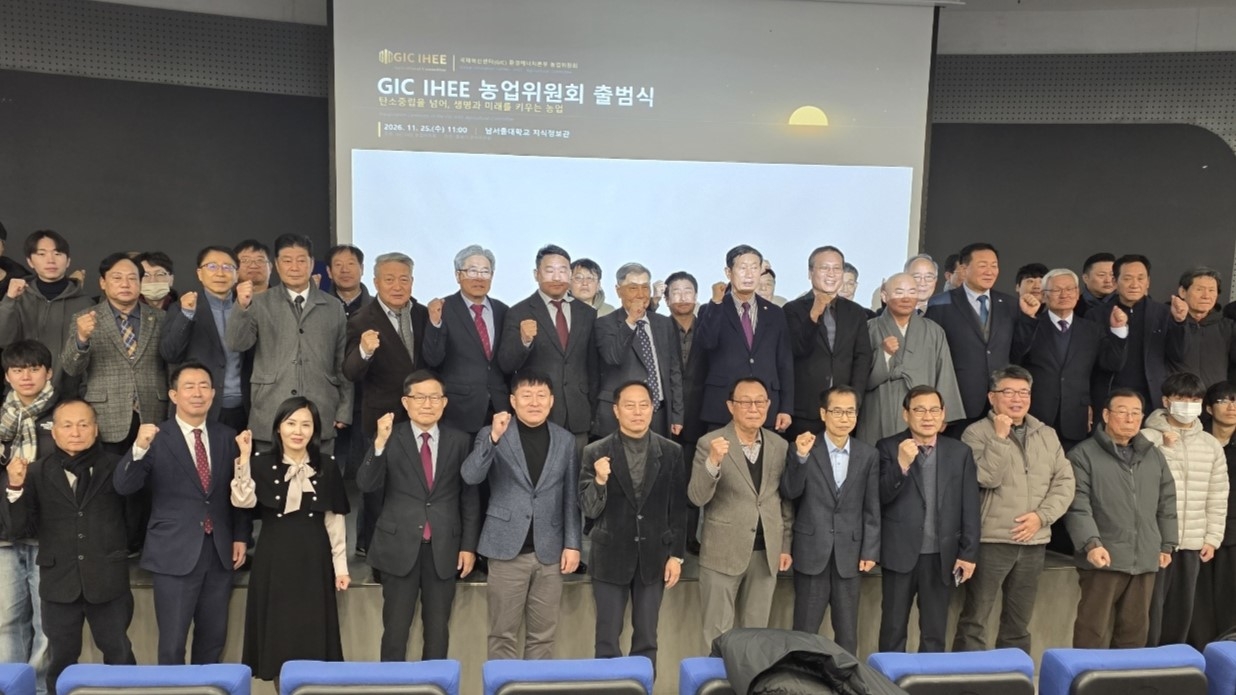
"The future of agriculture we envision is not about building one more smart farm or importing new technology. What we want to create is one connected ecosystem."
Choi Kyung-eun, chair of the Agriculture Committee under the International Hub for Environment and Energy (IHEE) of the Global Innovation Center (GIC), made the remarks Wednesday in her opening address at the committee's inaugural ceremony, held at the Knowledge and Information Center of Namseoul University in Cheonan, South Chungcheong Province. The event drew participants from government agencies and local authorities, universities and research institutions, agribusiness, information and communications technology and energy companies, and representatives of the farming community.
GIC is an international science and technology innovation cooperation body established in Silicon Valley in 2015 through collaboration between the US and Chinese governments. Its network spans scientists, entrepreneurs and policymakers from 56 countries, 36 Nobel laureate scientists, more than 80 of the world's top 500 companies, and about 30,000 technology innovators. The Agriculture Committee operates under IHEE, the GIC division responsible for environment and energy, and will be headquartered at Namseoul University.
The committee was founded on the premise that agriculture can be part of the solution to the climate crisis rather than a cause of it. While farming is a carbon-emitting industry, it is also one capable of reducing carbon and sequestering it in soil and the ocean — a proposition the committee intends to prove not through slogans but through data and field demonstration.
"Today's launch does not simply mean the creation of another organization," Choi said. "It is the starting point of a commitment to forge new solutions by connecting the challenges of agriculture and the environment, climate and food, energy and local economies." Choi added that the agricultural environment is deteriorating rapidly due to climate change, with growing pressures on food security and farming communities, and that agriculture must now pursue productivity, economic viability, environmental sustainability and long-term resilience together.
The committee has set out five core directions: carbon-neutral farming (CARBON), which applies low-carbon production and energy-saving technologies in the field to achieve real emissions reductions; circular life farming (BIO), which uses microbial, fermentation and biotech methods to improve the health of soil, crops and livestock while converting agricultural byproducts into resources; smart farming (SMART), which manages farms through data and AI; marine farming and blue carbon (BLUE), which restores marine ecosystems such as tidal flats and seagrass beds to absorb carbon and generate income for local communities; and international agricultural cooperation (GLOBAL), which draws on the network of GIC's 56 member countries and some 30,000 member companies.
Among these, the most notable initiative is a carbon-neutral smart livestock platform. "We will connect every stage — from animal husbandry and livestock waste to energy, carbon emissions, processing, distribution and consumption — into a single data stream," Choi said. "Starting from the data generated by a single animal, we will analyze the productivity, costs, environmental impact and carbon footprint of an entire farm, and build a new livestock model in which AI supports farmers' decision-making." The system integrates farm management and carbon accounting in one place, and farmers will be able to convert their carbon reductions into emissions credits.
The committee also plans to expand overseas. Choi said it would begin with an already-confirmed international agricultural development project in Russia's Primorsky region and then extend to Southeast Asia, South America and the Middle East. Choi added that the committee aims to become an open cooperation platform where government agencies, local authorities, companies, universities, research institutions, farmers and domestic and international partners share experience and technology, conduct joint demonstrations and commercialize results together.
Yoon Seung-yong, president of Namseoul University, said in a congratulatory address that the university would actively support the committee as an implementation partner to ensure its smart farm education and research capabilities translate into real-world results. GIC Secretary-General Zhao Gang said the organization would connect the technologies and experience of member countries and innovative companies to help the Agriculture Committee serve as a bridge for international cooperation.
The committee plans to transition to a standing committee structure within 30 days of its launch, designate its first smart livestock demonstration farm within 60 days, and begin its first pilot project within 100 days. Through these steps, it expects to generate new farm income through carbon reduction, improve the livestock environment by addressing odors and waste, develop agricultural talent in partnership with Namseoul University's smart farm department, and expand international agricultural cooperation.
Kim Young-hwa, a professor in Namseoul University's smart farm department who will serve as the committee's secretary-general, said the inaugural ceremony marked "the first button fastened" and pledged to deliver tangible results that farmers and businesses can feel.
pooh@heraldcorp.com





