Foreign investors have dumped close to 200 trillion won ($149 billion) worth of shares in just two stocks — Samsung Electronics and SK hynix — so far this year, rapidly eroding the combined market capitalization weight of the semiconductor pair within the Kospi. Their combined share of Kospi market cap, which had approached 60 percent as recently as June, has shed more than 12 percentage points in just five months, falling to around 47 percent.
With no clear buying force to fill the void, market watchers are closely monitoring whether the outcome of the December FOMC meeting and Samsung Electronics' expected resumption of large-scale share buybacks early next year could help untangle the badly skewed supply-demand dynamics.
According to Korea Exchange, foreign investors recorded net selling of about 225.06 trillion won on the Kospi through Wednesday — a staggering figure compared with net selling of just 4.66 trillion won for all of last year.
Of that total, net selling in SK hynix (100.67 trillion won) and Samsung Electronics, including preferred shares (97.42 trillion won), combined for 198.1 trillion won — meaning roughly 88 percent of all foreign net selling on the Korean stock market this year was concentrated in just these two semiconductor names.
The relentless foreign selling has translated directly into a sharp decline in the two companies' Kospi weight. As of Wednesday, Samsung Electronics and SK hynix together accounted for 47.67 percent of Kospi market cap, down 12.02 percentage points from the cycle high of 59.69 percent recorded on June 25.
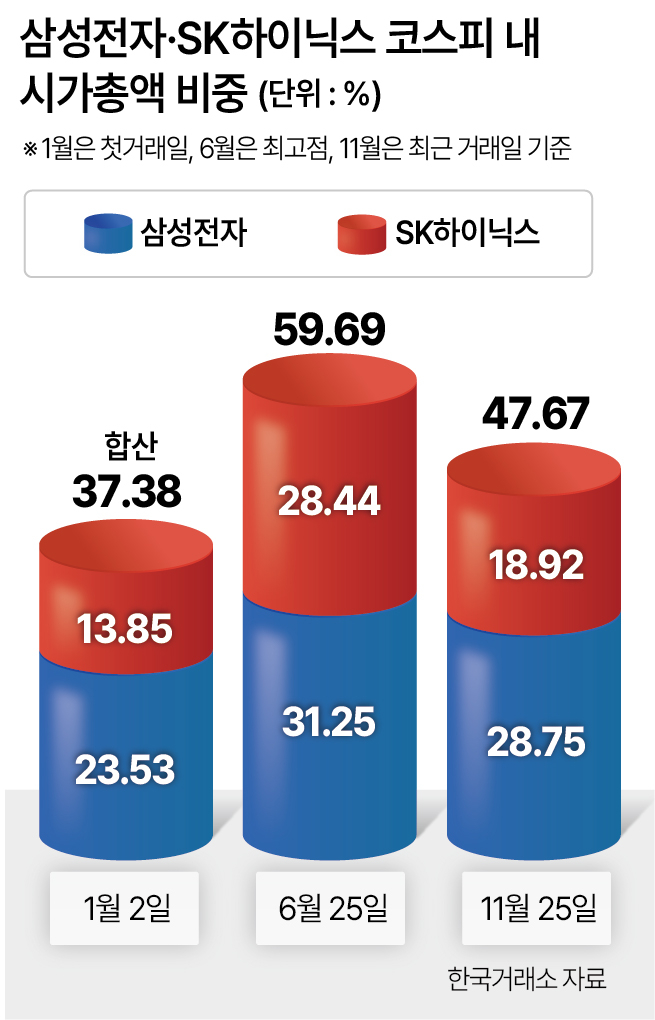
The two companies' combined Kospi weight started the year at 37.38 percent on the first trading day of January, then soared toward 60 percent by June, riding the semiconductor supercycle. As skepticism about AI demand grew and markets entered a correction, the figure began falling sharply, and this month it broke below the 50 percent threshold.
Share price declines have also deepened. On Wednesday, Samsung Electronics and SK hynix fell roughly 9 percent and 10 percent, respectively, sending shockwaves through the broader market. Samsung Electronics dropped as low as 170,000 won intraday, pushing its market cap below 1,000 trillion won — the first time the common shares have traded below that level since March 31. SK hynix slid to an intraday low of 1.027 million won on Wednesday, putting the 1 million won floor in jeopardy.
Measured against their respective all-time closing highs, Samsung Electronics — which peaked at 362,500 won — has fallen 52.9 percent, while SK hynix — which peaked at 2.919 million won — has fallen 64.7 percent.
Securities analysts cite three factors behind the foreign exodus: a rotation away from AI-heavy global portfolios toward non-AI assets, supply-demand pressure from mega initial public offerings such as Anthropic's, and a stronger dollar driven by growing expectations of a large Federal Reserve rate cut in December.
Retail investors, who bought nearly 100 trillion won net this year and helped prop up the index, are also seen as having limited capacity for further purchases after accumulating losses from bargain-hunting in the 6,000–6,500 range in the second half. On Thursday, however, the market was partially recovering some of Wednesday's losses in early trading.
Analysts say a sustained rebound in the Kospi and its two semiconductor heavyweights will ultimately require a series of significant catalysts to shift the supply-demand tide. The most immediate question is whether the FOMC meeting on Dec. 8-9 will ease uncertainty over Federal Reserve monetary policy and calm fears of further tightening.
The index rebalancing triggered by Anthropic's inclusion in major benchmarks — including the MSCI, Russell, FTSE and NASDAQ 100 — is expected to wrap up by mid-to-late December, which could ease some of the global capital drain. Samsung Electronics' large-scale buyback, set to resume early next year, is also widely cited as a key inflection point for the supply-demand outlook.
"Samsung Electronics has 55 trillion won to 75 trillion won remaining for shareholder returns in 2026, and attention should be paid to the possibility that buybacks resume in February following a board decision at the end of January," said Kim Jae-seung, an analyst at Hyundai Motor Securities. "If the program proceeds at a daily average of around 500 billion won — similar to the pace seen during the August-to-October buyback period — it could partially ease concerns about the supply-demand gap in the domestic market."
Nam Dae-jong, an analyst at Daol Investment & Securities, said that "how management balances the shareholder return policy with capital expenditure decisions will be the most pressing near-term issue," adding that "this is a time to deploy cash flow wisely for future growth, drawing on the company's relatively advanced technology and record earnings."
Calls are also mounting for a restoration of confidence in the semiconductor industry outlook and shareholder returns as the key to a recovery. Park Yu-ak, an analyst at Kiwoom Securities, said share prices would "rebound after a period of year-end and early-year consolidation, as conviction in HBM earnings and shareholder returns broadens."

jiyun@heraldcorp.com